Arizona AG Warns Seniors About ATM Scams: How LiquidChain ($LIQUID) Solves the Security Crisis

Another day, another warning for the most vulnerable. The Arizona Attorney General's office just issued a fresh alert: seniors are getting hammered by sophisticated ATM and card-skimming scams. It's the old story—financial infrastructure built on trust, exploited by those who have none.
Where Legacy Systems Crack
The problem isn't new, but the tools are. Criminals deploy Bluetooth skimmers, install fake card readers, and use pinhole cameras—all to drain accounts from a generation that still remembers passbooks. The central choke point? The transaction itself. Data flows through aging rails, creating single points of failure that fraudsters love to target.
Enter The Protocol Play
This is where blockchain isn't just speculation—it's a security upgrade. LiquidChain ($LIQUID) approaches the problem from the ground up. Instead of securing a database, it secures the transaction ledger itself. Every transaction gets hashed, timestamped, and immutably recorded across a decentralized network. Skim a card? The fraudulent transaction attempt is visible, verifiable, and can be flagged in near real-time before settlement.
Cutting Out The Middleman, Not The Human
The tech bypasses the need to trust a single entity's security. Validation comes from the network consensus, not a central server that can be compromised. For users, especially seniors, the experience can remain familiar—a card, a PIN—but the backend armor is radically different. It's about hardening the pipes, not just putting a better lock on the vault door.
Finance's Ironic Twist
There's a certain dark humor here. The same sector that once dismissed crypto as 'for criminals' now watches as crypto-native security models step in to fix the very fraud plaguing its legacy systems. Maybe the real scam was thinking the old way was ever secure enough.
The bottom line? While regulators play whack-a-mole with the latest skimmer design, protocols like LiquidChain are redesigning the molehill. It won't stop every social engineering trick, but it makes the technical heist infinitely harder. In the arms race of financial security, decentralization isn't just an option—it's becoming the new front line.
Fragmented Liquidity Creates Vectors For Exploitation
The scams plaguing Arizona seniors often rely on the opacity of moving funds between different silos. Frankly, the current DeFi landscape is a mess. Liquidity is fragmented across Bitcoin, Ethereum, and Solana. Jumping between these chains usually requires complex bridging, wrapped assets, and multiple transaction steps.
Each step introduces friction and a potential point of failure where malicious actors can confuse users.
LiquidChain ($LIQUID) tackles this fundamental flaw by functioning as a Layer 3 (L3) infrastructure that fuses Bitcoin, Ethereum, and solana liquidity into a single execution environment. By creating a Unified Liquidity Layer, the protocol eliminates the need for risky wrapped assets or convoluted bridge transfers.
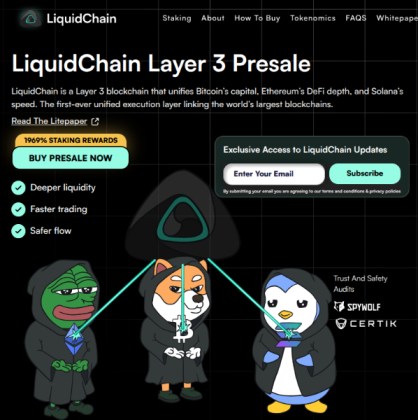
Source: LiquidChain
For a user or developer, this means Single-Step Execution. The data suggests that reducing the number of ‘hops’ a transaction must take drastically lowers the surface area for errors.
The project’s ‘Deploy-Once Architecture’ allows developers to build applications accessing users and liquidity from all three major chains simultaneously. Instead of a disjointed system where funds can easily disappear into the ether of a complex bridge, LiquidChain offers a cohesive environment.
This consolidation is critical. By streamlining the user flow, the protocol removes the technical obfuscation that scammers often hide behind.
EXPLORE THE LIQUIDCHAIN ECOSYSTEM.
LiquidChain L3 Protocol Enhances Verifiable Settlement
Beyond simplification, the core security proposition of LiquidChain lies in its status as a LAYER 3 protocol. Layer 1s (like Bitcoin) provide security, and Layer 2s handle scaling. But L3s? That’s where the magic happens, application-specific layers where custom logic and verifiable settlement occur.
The project utilizes a Cross-Chain VM (Virtual Machine) designed to handle the intricacies of multi-chain settlement without forcing the user to manage distinct wallets for every network.
This infrastructure is powered by the $LIQUID token, which serves as the primary transaction fuel for the network. Unlike legacy systems, where value transfer is opaque, the LiquidChain model emphasizes verifiable settlement.
For institutional participants (and savvy retail traders), this transparency is non-negotiable. The protocol also introduces Liquidity Staking, incentivizing users to secure the network while earning rewards, creating a deeper economic alignment between network security and user participation.
We’re seeing a clear shift in the market away from ‘wild west’ infrastructure toward compliant, transparent execution layers.
With Developer Grants available to encourage secure application building, the ecosystem is positioning itself as a hub for the next generation of safe, cross-chain DeFi. If you’re watching the infrastructure thesis, $LIQUID represents a bet on the convergence of major chains into a safer, more usable whole.
VISIT THE OFFICIAL LIQUIDCHAIN ($LIQUID) PRESALE SITE.
This article is for informational purposes only and does not constitute financial advice. Cryptocurrency investments, including presales and new protocols like LiquidChain, carry significant market risk and volatility. Always conduct independent research.
