Trump Claims Ignorance of $500M Abu Dhabi Bet on WLFI - What It Means for Crypto Markets

Former President Donald Trump's latest denial about a half-billion-dollar Middle Eastern investment is sending shockwaves through financial circles—and crypto traders are watching closely.
The $500 Million Question
When a sovereign wealth fund drops nine figures on a single position, markets notice. Abu Dhabi's reported $500 million bet on WLFI represents the kind of institutional capital that traditional finance loves to hype—until the paperwork gets inconvenient.
Political Denial, Market Reality
Trump's 'didn't know' defense creates the perfect storm: enough plausible deniability to avoid legal headaches, but sufficient smoke to signal something's burning. Crypto markets thrive on exactly this ambiguity—where traditional regulatory frameworks stumble, blockchain transparency theoretically shines.
The Institutionalization Paradox
Here's the cynical finance jab: Wall Street spends decades building compliance departments only to have politicians plead ignorance about nine-figure transactions, while crypto gets criticized for being too transparent about wallet movements. The irony would be delicious if it weren't so expensive.
Digital assets don't care about political theater—they care about capital flows. And $500 million moving anywhere moves everything.
Why The Trump Deal Raises Questions
The denial lands amid a fast-building paper trail around World Liberty Financial’s cap table and its ties to Gulf-linked capital. According to the report, a firm associated with Sheikh Tahnoon bin Zayed Al Nahyan, an Abu Dhabi royal tied to the emirate’s state investment machinery, acquired roughly 49% of World Liberty Financial in a deal valued at about $500 million, with documents reviewed by the Journal indicating the agreement was struck just days before Trump took office.
The report also describes why the timing is politically combustible: months after the reported stake purchase, the Trump administration moved ahead with supplying the United Arab Emirates with advanced US-made AI chips despite prior concerns about diversion risks to China, intensifying the perception that business and statecraft are entangled.
World Liberty Financial, for its part, has rejected the suggestion that any government action was influenced by the investment. A spokesperson said that neither Trump nor Steve Witkoff was involved in the transaction and called claims tying it to the chips decision “100% false,” while White House counsel said the president has no involvement in business deals that WOULD implicate his constitutional responsibilities.
The controversy has a second, crypto-native layer: the same Abu Dhabi orbit has already shown it is willing to use World Liberty-linked instruments as settlement rails. Abu Dhabi-backed MGX used World Liberty’s dollar-pegged stablecoin (USD1) to settle a $2 billion investment into Binance, a deal publicly discussed by World Liberty co-founder Zach Witkoff at TOKEN2049 in Dubai.
That combination has given critics an easy narrative hook: foreign state-linked capital gaining proximity to a US president’s family business while policy decisions affecting the same country MOVE through Washington.
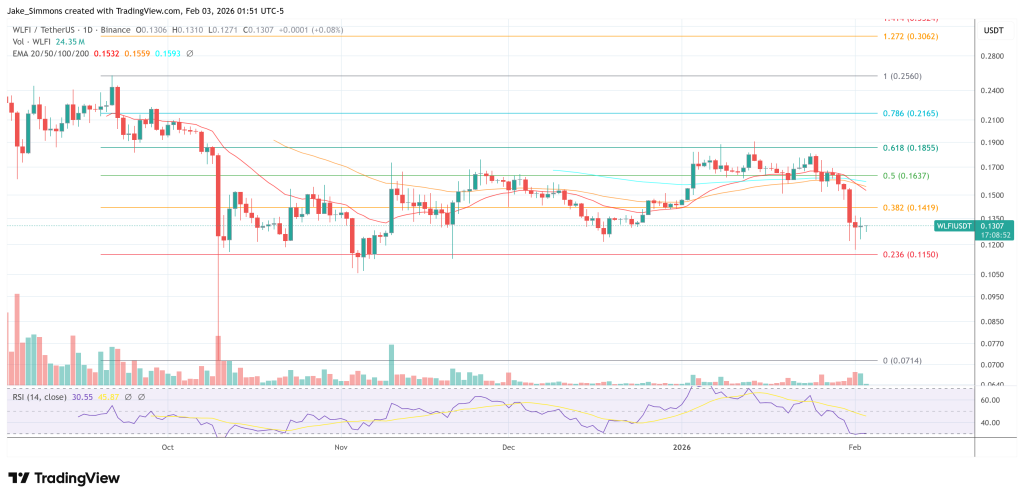
At press time, WLFI traded at $0.13.