Binance SAFU Fund Bolsters Reserves: Adds 1,315 Bitcoin ($100M) During Market Dip – Strategic Move Revealed

While traders panic-sell, Binance's insurance fund is quietly buying the dip.
The SAFU Signal
In a move that speaks louder than any CEO tweet, Binance has funneled a cool 1,315 Bitcoin—valued at roughly $100 million—into its Secure Asset Fund for Users. This isn't petty cash; it's a strategic deployment from the world's largest crypto exchange, executed precisely when market sentiment hit a low. The timing is either impeccable confidence or a masterclass in optics.
Decoding the Deposit
The SAFU fund acts as an emergency backstop, a self-insurance pool funded by exchange fees. Adding to it during weakness sends a dual message: first, that Binance has the liquidity to make such a move, and second, that it views current prices as a long-term value proposition. It's a hedge against counterparty risk that also doubles as a bullish bet on Bitcoin itself. A neat trick, if you can pull it off.
Market Mechanics at Play
This isn't just a stash of digital gold. It's a psychological lever. Major exchange reserves are a key on-chain metric watched by institutional players. A growing SAFU fund can indirectly bolster confidence in the entire ecosystem's stability—or at least Binance's slice of it. It makes you wonder what their internal models are forecasting that the public hasn't priced in yet.
The Finance World's Cynical Whisper
Let's be real—this is the crypto equivalent of a bank touting its capital ratios during a minor recession. It's prudent, it's smart PR, and it conveniently distracts from regulatory headaches. In traditional finance, they'd issue a press release and hire a consultant. In crypto, they just buy more Bitcoin.
The final take? When the giant starts accumulating while others flee, it's worth watching the tape a little closer. This move doesn't guarantee a bottom, but it sure doesn't signal a lack of conviction.

Binance Under Scrutiny as the Market Searches for Direction
Many analysts have been quick to point fingers at Binance and its founder, Changpeng Zhao, following the latest wave of market weakness. The criticism largely stems from Binance’s dominant position in global derivatives trading, its deep liquidity pools, and its outsized influence on funding rates, open interest, and liquidation dynamics.
In periods of stress, any sharp move originating on Binance tends to Ripple across the entire crypto ecosystem, reinforcing the perception that the exchange acts as a central transmission point for volatility.
However, despite the intensity of these claims, there is currently no concrete on-chain or market evidence showing that the exchange or CZ actively triggered or engineered the recent sell-off. Liquidation data suggests that leverage was widely distributed across multiple platforms, and in several instances, Binance recorded a smaller share of forced liquidations relative to its market share. This weakens the argument that Binance was the primary source of systemic pressure.
What appears more likely is that Binance is being conflated with broader structural issues: excessive leverage, thinning liquidity, and fragile investor sentiment. These conditions can amplify moves regardless of where they begin. The coming days will be critical. How price reacts, how leverage resets, and whether spot demand returns will determine whether the market stabilizes—or confirms that a deeper bearish phase is unfolding.
Bitcoin Breaks Key Weekly Structure
Bitcoin’s weekly chart reflects a clear shift in market structure following the loss of the $80,000 psychological level. After failing to reclaim the 50-week moving average (blue line), BTC has resumed its downward trajectory, confirming this zone as active resistance rather than temporary consolidation. The rejection NEAR the mid-$90K area marked a lower high relative to the 2025 peak, reinforcing a broader bearish trend on higher timeframes.
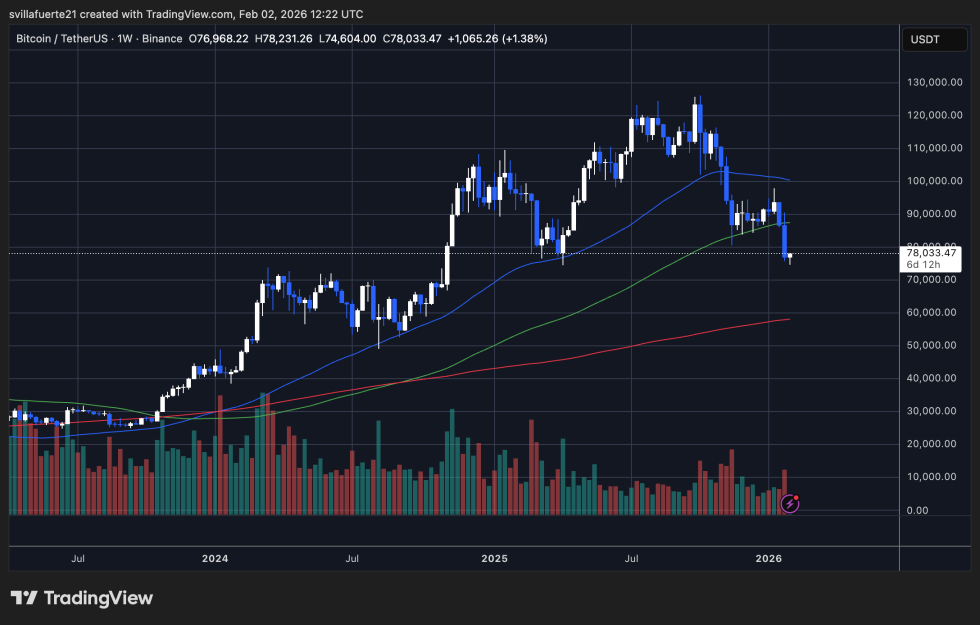
Price is now trading below both the 50-week and 100-week moving averages, while the 200-week moving average (red line) continues to rise well below current levels. This configuration historically signals a transition phase, where momentum has turned negative but long-term structural support has not yet been tested. The recent breakdown toward the $74,000–$78,000 range places bitcoin back near a former high-volume area from early 2025, which may offer short-term stabilization but does not yet qualify as a confirmed bottom.
Volume dynamics add to the cautionary outlook. Selling pressure has increased on down weeks, while rebound attempts have been accompanied by weaker volume, suggesting limited conviction from buyers. This pattern aligns with distribution rather than accumulation.
Unless Bitcoin can reclaim and hold above the 50-week moving average, the path of least resistance remains to the downside. In this context, the market appears to be entering a corrective or early bear phase, with further downside risk toward deeper demand zones still unresolved.
Featured image from ChatGPT, chart from TradingView.com
