Bitcoin Futures Trading Volume Plunges to Lowest Monthly Level Since — What’s Next for Crypto Markets?

Bitcoin futures just hit a chilling milestone—the lowest monthly trading volume in over two years. While some see it as a market cooling off, others whisper about a storm brewing beneath the surface.
Where Did All the Traders Go?
Open interest is thinning out faster than a hedge fund's patience during a sideways market. Major exchanges are reporting quiet order books, with institutional players pulling back or shifting strategies. It's not just a dip—it's a drought.
The Quiet Before the Volatility Spike?
History shows these volume craters often precede massive moves. Low liquidity can turn a ripple into a tidal wave when momentum shifts. Remember 2023's summer lull before that 40% autumn rally? Markets have a short memory—and a shorter attention span.
Spot Markets Telling a Different Story
Here's the twist: spot Bitcoin accumulation continues steadily. Long-term holders aren't blinking. This divergence screams one thing—speculators are taking a breather while believers keep stacking. The futures casino might be empty, but the vaults are still filling.
Regulatory Shadows and ETF Aftermath
Post-ETF approval hangover? Possibly. The initial frenzy has settled into a steady drip. Meanwhile, regulators keep drawing lines in the sand—always a step behind the technology, as usual. Nothing slows momentum like bureaucratic uncertainty.
So is this the calm before the next bull run or warning signs of deeper fatigue? In crypto, boredom often proves more profitable than excitement. Just ask anyone who bought during last year's 'boring' consolidation phase—and sold during the subsequent mania. Sometimes the smartest trade is watching paint dry while Wall Street panics about quarterly returns.
Bitcoin Futures Volume Signals Speculative Cooldown
The drop to the lowest monthly futures volume since 2024 reflects a clear reduction in trading intensity compared with earlier stages of the cycle, when aggregate monthly volumes regularly exceeded $2 trillion. This shift points to a moderation in short-term speculative behavior and a pullback in aggressive positioning, particularly among traders who rely heavily on leverage to amplify returns.

As volatility compresses and directional conviction weakens, these participants tend to reduce activity, contributing to lower overall turnover in the derivatives market.
Such phases are not unusual within Bitcoin’s market structure. Historically, periods of declining futures volume often follow extended stretches of heightened volatility, serving as a reset mechanism where traders reassess risk exposure, tighten position sizing, and wait for clearer signals before re-engaging. Rather than reflecting a loss of interest in bitcoin itself, the slowdown suggests a temporary pause in speculative appetite.
Importantly, the contraction in volume appears orderly rather than abrupt. There are no clear signs of widespread stress, panic-driven exits, or forced deleveraging. Instead, the gradual decline indicates a controlled reduction in participation, with large and professional players selectively scaling back exposure. This behavior leads to lower trading activity without destabilizing price action or triggering disorderly liquidations.
The current environment is more consistent with consolidation than capitulation. Reduced futures volume highlights a market transitioning into a quieter phase, where leverage is unwound methodically and positioning becomes more conservative, setting the stage for a future expansion once volatility and conviction return.
Bitcoin Tests 100-Week Moving Average as Correction Stabilizes
Bitcoin’s weekly chart highlights a market that has transitioned from strong trend expansion into a corrective and consolidative phase. After peaking above the $120K region, BTC entered a broad pullback that erased a significant portion of the prior advance, bringing price back toward the low $80K area. This decline unfolded alongside a clear loss of momentum, visible in the series of lower highs and the rejection from the 50-week moving average (blue), which has now turned into dynamic resistance.
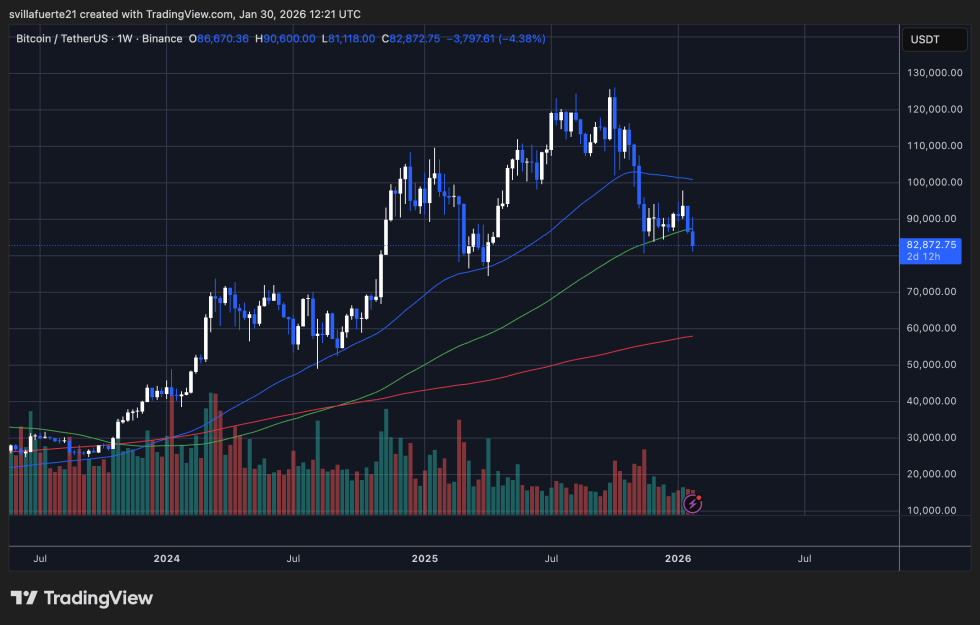
Currently, Bitcoin is trading near $82,800, sitting just above the 100-week moving average (green). This level is technically important, as it often acts as a medium-term trend filter during late-cycle corrections. So far, price has managed to stabilize around this zone, suggesting that selling pressure is no longer accelerating, but buyers have not yet regained control either. The 200-week moving average (red), still rising near the mid-$50K area, remains far below spot price, indicating that the broader macro trend has not broken down despite the correction.
Volume has contracted meaningfully compared to the distribution phase NEAR the highs, reinforcing the idea that this move is corrective rather than panic-driven. Overall, the chart points to a phase of price compression and structural digestion. Bitcoin appears to be searching for acceptance around current levels, with the next decisive move likely dependent on whether the 100-week average holds or fails.
Featured image from ChatGPT, chart from TradingView.com
