Metals & Crypto Crater: Binance Open Interest Plummets Back to Pre-October 10 Levels Amid Global Sell-Off

Risk assets are getting hammered. A wave of selling pressure has washed over global markets, taking down everything from precious metals to digital currencies in a classic flight-to-safety rout.
The Leverage Unwind
The clearest signal comes from the derivatives desks. Over at Binance, the world's largest crypto exchange, total open interest—the sum of all outstanding futures and options contracts—has just collapsed. It didn't just dip; it cratered all the way back to levels not seen since before October 10. That's a massive, coordinated unwind of leveraged bets. Traders aren't just taking profits; they're running for the exits and closing positions en masse.
Not Just a Crypto Story
This isn't an isolated crypto winter. Gold, silver, and industrial metals are all feeling the heat, painting a picture of broad-based risk aversion. When both 'digital gold' and the real thing are falling in tandem, it points to a macro driver—maybe inflation fears, maybe growth concerns, maybe just good old-fashioned panic. The correlation screams one thing: liquidity is being pulled from the system.
The New Normal Volatility
For crypto veterans, this is a brutal reminder of the asset class's inherent volatility. The market can giveth, and the market can taketh away—fast. That plunge in open interest suggests the hot money and speculative leverage that fueled recent rallies has evaporated, at least for now. The floor is being tested by traders who actually have skin in the game.
So, is this the big one? Or just another healthy—if painful—reset? One cynic's correction is another's buying opportunity, after all. Just remember: in finance, 'long-term investment' is often just the story you tell yourself while waiting for a trade to come back to breakeven.
Leverage Rebuild Signals Persistent Risk Appetite
Despite the recent drawdowns, leverage remains a defining feature of the current crypto market structure. According to top analyst Darkfost, many investors continue to pursue market exposure through high leverage, creating conditions where relatively small price moves can trigger sharp bursts of volatility.
These moves are frequently amplified by liquidation cascades, as forced position closures accelerate downside momentum. Crucially, this behavior persists even after the October 10 event, which previously led to a significant destruction of liquidity and capital across the market.

The persistence of this risk appetite is clearly visible in derivatives data. A useful way to isolate true positioning trends is to examine open interest expressed in BTC terms rather than notional value. By doing so, the distortion caused by price fluctuations is removed, offering a clearer picture of how much exposure traders are actually carrying. This approach highlights whether leverage is genuinely being rebuilt or merely appears higher due to price effects.
Viewed through this lens, open interest on Binance stands at approximately 123,500 BTC. This already exceeds the level recorded just before the October 10 sell-off, when open interest had fallen to around 93,600 BTC. The increase of roughly 31% since that low indicates that risk appetite has gradually returned. Rather than a crypto market operating defensively, current positioning suggests that leverage is once again accumulating, leaving prices vulnerable to further volatility if sentiment shifts abruptly.
Bitcoin Tests Key Support as Downtrend Pressure Persists
Bitcoin’s price action continues to reflect a fragile and corrective market structure. After failing to reclaim the $95,000–$100,000 region, BTC has extended its pullback and is now trading NEAR the $82,800 area, marking a clear breakdown from the recent consolidation range. The move lower is occurring below the short- and medium-term moving averages, with price firmly capped by the declining 50-day and 100-day averages, reinforcing the loss of upside momentum.
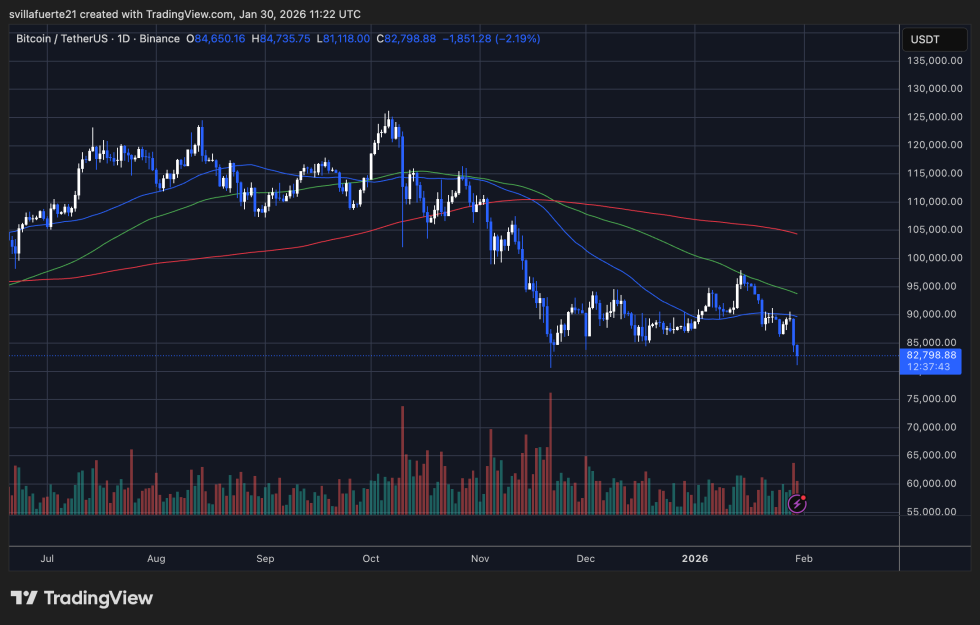
The 200-day moving average remains well above current levels, highlighting the broader deterioration in trend strength since the October peak. Structurally, Bitcoin has transitioned from higher highs to a pattern of lower highs and lower lows, signaling that sellers continue to control rallies rather than buyers defending breakouts. Volume spikes during sell-offs, particularly in November and December, suggest distribution rather than healthy rotation.
The $82,000–$85,000 zone now stands out as a critical support area. A sustained hold could allow for short-term stabilization or range formation, but a decisive breakdown WOULD expose deeper downside toward the $78,000–$80,000 region, where previous demand emerged. On the upside, any recovery attempt is likely to face immediate resistance near $88,000–$90,000, followed by stronger supply closer to $95,000.
Featured image from ChatGPT, chart from TradingView.com
