Bitcoin’s Lost Coin Supply Is Shrinking – Here’s Why It Matters for Your Portfolio

Bitcoin's permanent supply squeeze just kicked into high gear.
Forget the daily price swings. The real story is unfolding beneath the surface: the pool of Bitcoin lost forever is trending lower. That's not a typo. The 'hard cap' of 21 million just got harder.
The Vanishing Act
Early adopters misplacing hard drives, wallets locked by forgotten passwords, coins sent to unspendable addresses—this 'lost supply' has long been a shadowy pillar of Bitcoin's value proposition. It silently tightened availability, acting as a built-in deflationary mechanism. Now, that trend is reversing? Not exactly. The rate of new coins being lost is falling.
What's Changed?
Custody got professional. Institutional-grade storage solutions and widespread adoption of multi-signature wallets mean fewer catastrophic user errors. The ecosystem matured. We're not in the 'laptop-in-a-landfill' phase anymore. The market is valuing security, and it's paying off in preserved supply.
The Ripple Effect
This isn't just a fun crypto-trivia fact. A slower bleed of coins into the digital abyss means the effective liquid supply is marginally higher than previous models predicted. It subtly shifts the supply/demand calculus. For miners, it means the long-term 'true' circulating supply they compete over is slightly larger. For investors, it means one less unpredictable variable—though good luck finding a quant model that ever accurately priced it in to begin with. (Most traditional finance risk models still treat Bitcoin as a 'glitch in the matrix,' so don't hold your breath.)
The takeaway? Bitcoin's scarcity narrative remains ironclad, but its sources are evolving. The market is growing up, and with that maturity comes a new kind of predictability. The wild west of permanent loss is being fenced in by best practices—proving that sometimes, the most bullish signal isn't a price spike, but a decline in sheer human error.
Price Declines, And Lost Bitcoins Are Dropping
While the price of bitcoin struggles with heightened volatility, the market dynamics are starting to see a critical shift in trend and investors’ activity. Several key metrics are now displaying a cautious signal about the market again, and one of those is the Bitcoin Lost Coins metric.
In the research, Joao Wedson, the founder of on-chain data platform Alphractal, disclosed that the BTC lost coin supply is declining, hinting at a subtle but meaningful shift in the network’s long-term dynamics. According to the market expert, this decline is not a coincidence.
This development suggests that many coins that were previously thought to be permanently unreachable are being reclassified as active, lowering the expected proportion of Bitcoin that cannot be recovered. It also essentially increases the usable quantity of BTC, which has an impact on the scarcity assumptions that underlie long-term pricing models.
Wedson highlighted that several analysts attributed the decline solely to the Exchange-Traded Funds (ETFs), but the story is beyond the narrative. While the ETF was the structural catalyst, the real trigger was breaking the long-awaited $100,000 price mark. When Bitcoin hits the price range, all economic incentives are altered.
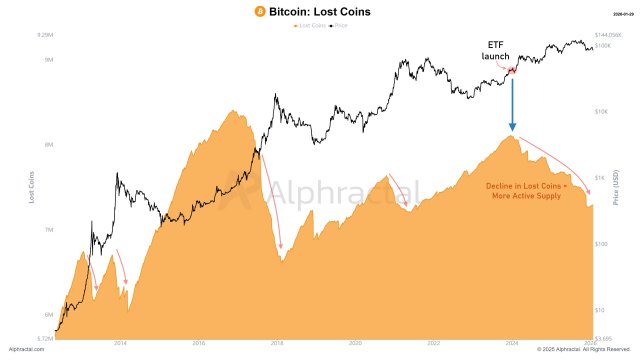
BTC that had been sitting idle for years in exchange cold wallets have started to MOVE due to custody restructuring, address migrations, and UTXO consolidation. At the same time, OG whales and long-term holders have also moved into distribution mode, as they are actively selling into the market. This is considered a classic behavior during redistribution phases, not market collapse.
The developments coincide with individuals and companies making serious efforts to recover coins once believed to be lost in old backups, forgotten hard drives, abandoned multisigs, legal custodianships, estates, and inheritances. In simple terms, BTC that were economically dead before came back to life.
After his analysis, Wedson believes that the Core point is simple. BTC ETFs did not create any new coins, and the $100,000 level did not either. Instead, all they did was reawaken an old supply that had been dormant. However, the Lost Coins are declining due to BTC becoming too valuable to ignore.
What Are BTC Investors Doing In The Market
Despite the ongoing volatile landscape, CW, a market expert, revealed that Bitcoin’s large holders are steadily purchasing low-leveraged long positions. These investors are building long positions rather than chasing aggressive bets, suggesting increasing confidence in the absence of excessive risk.
Related Reading: Bitcoin Big Money Bet: Whales Are Ramping Up Long Positions As Market Sets Up
On the other hand, the high-leveraged long positions of all retail investors have been liquidated. It is worth noting that the majority of high-leverage investors lost their money before the rally even started.
