Ethereum and Solana Flash Red: Negative Buy/Sell Pressure Signals What’s Next for Crypto Giants

Warning lights are blinking across two of crypto's biggest ecosystems. On-chain metrics for Ethereum and Solana are painting a concerning picture of negative buy/sell pressure, raising questions about near-term momentum.
The Pressure Gauge Turns Negative
Forget the hype—the raw data tells a different story. Analysis of exchange flows and order book depth reveals a distinct tilt toward selling pressure for both assets. It's not a crash, but a persistent drain that suggests large holders are taking chips off the table or rotating capital elsewhere.
Ethereum's Scaling Paradox
The network continues its technical evolution, yet price action struggles to keep pace. The pressure data hints that even successful upgrades can't always override broader market sentiment or trader fatigue. It's a classic case of 'buy the rumor, sell the news' playing out in real-time—a favorite pastime for the crypto crowd that treats every announcement like a short-term trading signal.
Solana's Speed Bump
Solana's blistering throughput remains its flagship feature, but speed alone isn't fueling buy-side demand right now. The negative pressure indicates that network activity and developer momentum aren't translating into sustained purchasing power. Sometimes, the market just needs a breather after a parabolic run—or maybe it's finally questioning the 'ultra-sound money' narrative attached to an asset with no hard cap.
What This Really Means for Traders
This isn't necessarily a doom signal, but a clear caution flag. Negative buy/sell pressure often precedes consolidation or a pullback as weak hands get shaken out. It forces the market to find a new equilibrium, a level where genuine demand finally meets supply. For long-term believers, it might just be another dip to accumulate. For everyone else, it's a reminder that in crypto, the only thing faster than a Solana transaction is the shift from greed to fear on the charts.
In the end, these signals expose the fickle heart of digital asset markets—where technological prowess and financial flows can diverge for painfully long periods, much to the delight of cynical hedge fund managers placing their shorts.
Market Balance Tilts Bearish For Ethereum And Solana
While the broader cryptocurrency market has faced steady downside pressure over the past few weeks, the market dynamics of both Ethereum and Solana are undergoing a crucial shift. This shift is being reflected in the Buy/Sell Pressure Delta for ETH and SOL, which has recently turned negative.
The Buy/Sell Pressure Delta is a key metric that measures the imbalance between buying and selling forces in the market. It is worth noting that when the delta goes negative, it indicates a lack of bullish momentum since selling pressure is greater than purchasing pressure.
According to Alphractal, an advanced on-chain data analytics platform, the metric flipping negative suggests that ethereum and Solana sellers are gaining control of the market. With buying momentum currently fading, the risk of short-term downside or consolidation becomes high.
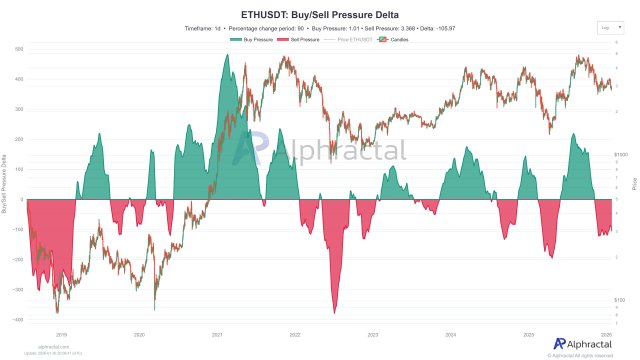
This shift typically points to trend exhaustion, not necessarily an immediate reversal. It also points to a cooling phase after periods of stronger momentum and buying activity. In some scenarios from the past, the platform highlighted that a negative Buy/Sell Pressure Delta has also led to price bottoms. However, this is mostly common when selling pressure starts to lose strength again, with capital flows favoring accumulation over distribution.
Furthermore, Alphractal noted that for this ongoing trend to signal a potential bottom in Ethereum and Solana prices, it is critical to monitor whether the delta is exhibiting stability or a recovery, rather than expanding further into negative territory. In the meantime, analyzing the lower timeframes would aid in spotting early signs of a shift back toward buying pressure.
At this point, it is not a standalone signal, and context matters. Price action, volume, and broader on-chain data must confirm whether the market is transitioning into a period of continuation or accumulation. As this imbalance develops across the two networks, it increases the downside risk and emphasizes how crucial it is to keep an eye on whether demand can stabilize or keep declining in the upcoming sessions.
ETH Position Inside A Dense Basis Cluster
Ethereum remains capped by the growing volatility across the crypto market, hovering below the $3,000 price mark. After delving into ETH’s recent price action, Chris Beamish has outlined that the leading altcoin is trading on a dense cost basis cluster.
The positioning carries significance as it represents a breakeven zone for many ETH holders. As ETH holds this zone, the market is leaning toward absorption and the formation of a base. However, a breakdown WOULD move the price into thinner support where underwater supply may derisk.
