US Treasury Debt Explodes on Ripple’s XRPL - The Numbers Will Shock You

Forget Wall Street's paper shuffling—the real debt action just jumped chains. The United States Treasury's obligations are now ballooning on Ripple's XRPL, and the scale is rewriting the rulebook for sovereign finance on the blockchain.
The Ledger Doesn't Lie
While traditional balance sheets get lost in fiscal quarters and political spin, XRPL offers a real-time, immutable record. Every Treasury issuance—every bond, every note—etched onto a decentralized ledger visible to all. It's transparency that cuts through the usual fog of government accounting, a brutal spotlight on the actual figures that would make any central banker sweat.
Why This Platform? Why Now?
XRPL isn't just another database. Its architecture bypasses legacy settlement delays, turning multi-day processes into near-instant finality. For managing a debt pile that grows by the second, that speed is a weapon. It allows for a more dynamic, programmable approach to sovereign debt—imagine bonds that settle in seconds or interest payments automated by smart contracts. It’s a system built for an era where debt isn't just held, it's traded in internet time.
The move signals a quiet but profound shift: when a nation's most critical financial instrument migrates to a public blockchain, it's a vote of confidence in the infrastructure's resilience and efficiency over the creaking systems of old.
A New Benchmark for Everything
This isn't a test. It's live-fire. The performance, security, and cost-efficiency of handling this volume on XRPL sets a new benchmark for every other asset class. If it can handle the U.S. Treasury, what can't it handle? It proves the network's enterprise-grade capacity and could trigger a domino effect of institutional adoption for real-world assets.
So, while traditional finance debates rate cuts in stuffy conference rooms, the foundation is being repoured in real-time on a decentralized ledger. The debt figures are staggering, but the real story is the venue—a silent, powerful endorsement that the future of high-stakes finance is transparent, fast, and on-chain. After all, what's a few trillion between distributed nodes?
US Treasury Debt Skyrockets On Ripple’s XRPL
Over the past year, tokenized US Treasury debt on the XRP Ledger has skyrocketed to more than $150.19 million. Data from the tokenized asset analytics platform RWA.xyz shows that digital platforms such as OpenEden Digital, Zeconomy, Ondo, and Archax have been the primary drivers behind this latest surge in activity and volume.
XRPL data also shows that US Treasury debt has not been the only asset class to experience growth on the network. Recent reports revealed that the XRP Ledger achieved a significant milestone, surpassing $1 billion in total tokenized assets. While tokenized US treasury debt contributed significantly to this growth, other asset classes, including stablecoins, private credit, commodities, and private equity, have also recorded substantial volume, reflecting the network’s expanding role in global digital finance.
Stablecoins recorded the highest volume of over $338 million within the $1 billion tokenized asset growth, representing approximately 160% more than US Treasury debt. In comparison, private equity accounted for $55.2 million, reflecting less than 33% of tokenized treasuries.
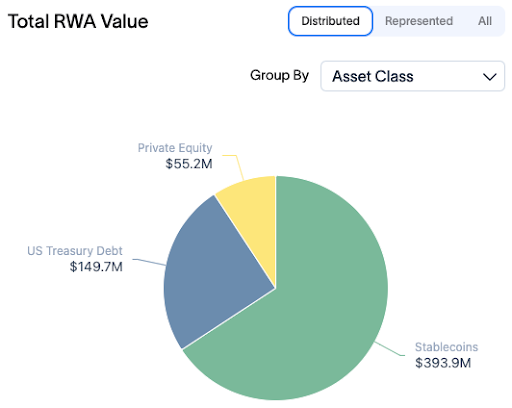
Across all networks, tokenized US Treasury holdings have now reached about $10 billion. While the percentage held by the XRP Ledger is impressive, it still represents just 1.4% of the total. Nonetheless, the growth rate of US Treasury debt on XRPL is striking, showing a more than 2,900% increase from the roughly $5 million on the network in 2025.
The recent surge in tokenized US Treasury debt on the XRP Ledger underscores the expanding integration of traditional finance with blockchain technology. It also reflects the rising demand for Real-World Asset (RWA) tokenization, which has become a fundamental aspect of Ripple and XRPL’s utility and key driver of the network’s growth and expansion into broader markets.
Why This Is A Big Deal
Historically, US Treasury debt was tracked and recorded through conventional banking and government systems. As a result, trading relied heavily on intermediaries, transactions and settlements were slow, and most retail investors had limited access. At the same time, Paper records and centralized systems dominated the market, making processes less transparent and tedious.
However, the introduction of blockchain technology has significantly improved how debt is represented and managed. On the XRP Ledger, Treasury debt can now be tokenized, allowing near-instant settlement and real-time verification on a public network. This reduces the reliance on intermediaries and introduces a new level of transparency and security compared to traditional methods.
The rise of tokenized Treasury debt also signals changes in investor behavior and broader market dynamics. It shows that blockchain-based assets can now compete with traditional markets, offering faster, more efficient, and accessible alternatives for institutions and governments.
