Stablecoin Exodus: $7 Billion Vanishes in 7 Days - Is This Bitcoin’s Bear Market Signal?

Digital dollar proxies are pulling a disappearing act. The stablecoin market just shed a staggering $7 billion in capital—in a single week. That's not a typo. It's a liquidity drain that echoes across every crypto chart.
The Canary in the Coalmine
Forget the noisy price swings of Bitcoin or Ethereum. The real pulse of crypto sentiment beats in the stablecoin sector. These tokens are supposed to be the boring, parked capital—the dry powder waiting on the sidelines. When that powder starts vanishing, it's not a vote of confidence. It's capital fleeing for the exits, seeking the perceived safety of traditional finance or simply evaporating into thin air.
A $7 Billion Question Mark
This isn't a gradual bleed. A weekly drop of this magnitude acts like a sudden pressure change in the market. It suggests leveraged positions unwinding, speculative bets getting called in, and a broad-based retreat from crypto risk. The mechanics are simple: users redeem their stablecoins for flat, and the issuers burn the tokens. Poof. Market cap down. Available liquidity shrinks. The entire ecosystem feels the squeeze.
Connecting the Dots to Bitcoin
History doesn't repeat, but it often rhymes. Sharp contractions in stablecoin supply have frequently preceded or coincided with broader crypto downtrends. Why? Because stablecoins are the primary fuel for trading pairs. Less fuel means less capacity to buy, which amplifies selling pressure on assets like Bitcoin. It creates a vicious cycle of declining liquidity and falling prices.
So, is this the definitive bear market confirmation? Maybe. Or perhaps it's just the market taking a brutally efficient shower—washing out the weak hands and excess leverage, as it does every few years. After all, in crypto, a crisis is just a restructuring opportunity waiting for a press release. One financier's panic is another's chance to buy the fear—just after their risk management team signs off on it, of course.
Bitcoin Outlook Darkens
According to market analyst Darkfost, who shared the data on social media platform X (previously Twitter), this is the first time in the current cycle that the stablecoin market has experienced such a steep weekly decline from approximately $162 billion to $155 billion in just seven days.
Darkfost described this drop as a clearly negative signal, suggesting that investors are increasingly choosing to exit the crypto market altogether instead of rotating capital within it.
The mechanics behind the trend are relatively straightforward. When demand for stablecoins falls, it typically means investors are converting their holdings back into fiat currency rather than keeping capital parked on-chain.
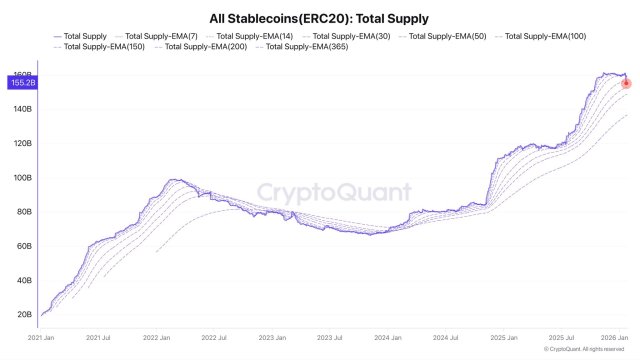
As a result, stablecoin issuers burn excess tokens that are no longer needed, leading to a decline in overall supply. For this reason, a shrinking ERC‑20 stablecoin market cap is widely viewed as a bearish indicator.
Importantly, the same pattern is beginning to appear on other blockchain networks, reinforcing concerns that the trend is not isolated to Ethereum-based assets.
Darkfost also pointed to historical precedent, noting that a similar contraction in stablecoin supply in 2021 coincided with Bitcoin’s transition into a bear market, although the Terra Luna collapse also played a role during that period.
Analyst Warns Of Potential Crypto Liquidity Crunch
At the same time, macroeconomic risks are resurfacing. Crypto analyst Crypto Rover has warned that the likelihood of a US government shutdown by January 31 has surged to nearly 80%, up dramatically from estimates of just 10% to 15% one day earlier.
According to his analysis, a government shutdown could pose serious challenges for bitcoin and crypto markets due to its impact on liquidity. Historically, when shutdowns begin, the US Treasury rebuilds its Treasury General Account (TGA) by pulling cash out of financial markets.
During the last shutdown cycle, the TGA increased by roughly $220 billion, effectively draining that amount of liquidity from the system. Crypto markets, Rover argues, are particularly vulnerable to such conditions.
In the previous episode, markets initially rallied briefly before liquidity dried up. That was followed by sharp declines, with Bitcoin and ethereum (ETH) falling between 20% and 25%, while altcoins suffered even deeper losses.
This time, the setup appears even more fragile, according to Rover’s view. Liquidity in the market is already thin, investor confidence is weak, and institutional capital is largely concentrated in equities and gold rather than digital assets.
Furthermore, Rover notes that volatility is elevated, and crypto prices are reacting sharply to relatively small capital flows. Under these conditions, a shutdown-driven liquidity drain could be especially damaging, potentially triggering another severe market sell-off.
At the time of writing, Bitcoin was trading at $88,183, having erased all the gains seen in the first week of the year. It is now down 5% over the past seven days, with the cryptocurrency sitting 30% below the all-time high of $126,000 reached last October.
Featured image from OpenArt, chart from TradingView.com
