Bitcoin Fresh Buyers Fight To Stay Above Water: Stabilization Or Capitulation?

Fresh Bitcoin buyers are scrambling to hold their ground. Is this the calm before the next leg up—or the final gasp before a wave of capitulation?
The Battle for the Break-Even
New entrants who bought near recent highs are now in a psychological tug-of-war. Every dip tests their conviction, while every minor rally offers a fleeting hope of breaking even. It's a classic market inflection point where sentiment, not just charts, dictates the next move.
Stabilization's Telltale Signs
Look for consolidation within a tightening range—that's the market catching its breath. Declining volume on downswings can signal selling exhaustion. When the price stops making lower lows, the foundation for a potential rebound is laid. This isn't flashy; it's the hard work of building a new base.
The Capitulation Scenario
The alternative is uglier. A sharp, high-volume break below key support levels triggers stop-losses and panic selling. This 'flush out' of weak hands—while painful—historically creates the washed-out conditions that set the stage for the next bull run. It's brutal, fast, and often marks a bottom.
So, which is it? The data is conflicted, oscillating between these two narratives daily. One thing's certain: in crypto, the line between 'strategic accumulation' and 'catching a falling knife' is drawn entirely in hindsight—usually by the same analysts who missed the call. Watch the price action, ignore the noise, and remember the oldest rule in the book: don't invest more than you can afford to lose.
STH MVRV Near a Statistical Extreme
Adler adds that another key metric reinforcing this fragile setup is Short-Term Holder MVRV (STH MVRV), which measures the ratio between Bitcoin’s market price and the cost basis of short-term holders. In simple terms, when STH MVRV drops below 1.0, it signals that this cohort is, on average, holding unrealized losses and is increasingly vulnerable to panic-driven selling.
According to Adler, current STH MVRV stands at 0.897, meaning short-term holders are clearly underwater. More importantly, the metric is approaching the lower boundary of its 155-day statistical range, where the Mean minus one standard deviation sits near 0.875. With only around 2.5% remaining before reaching that statistical minimum, Bitcoin is entering a zone that historically aligns with market exhaustion and local bottom formation.

Adler notes that in many past observations, price stabilization occurred when the metric touched or approached this lower band, as buyers stepped in and selling pressure weakened. However, the market remains at a critical decision point. A clean break below 0.875 WOULD signal extreme oversold conditions and raise the risk of short-term holder capitulation.
Together, both charts frame the same battlefield. The $89.8K–$90K region is the key defense zone for fresh buyers, while $92.5K now acts as resistance. With MVRV pressing toward a statistical extreme, Bitcoin is approaching a make-or-break moment between stabilization and deeper downside.
Bitcoin Bears Pressure Key Support Zones
Bitcoin (BTC) is facing renewed downside pressure after failing to reclaim the $90,000 region, with the latest pullback pushing price toward the $88,600 area. The 3-day chart shows BTC slipping back into the lower part of its recent range, reflecting a fragile market structure where rallies are being sold and buyers remain hesitant to step in aggressively.
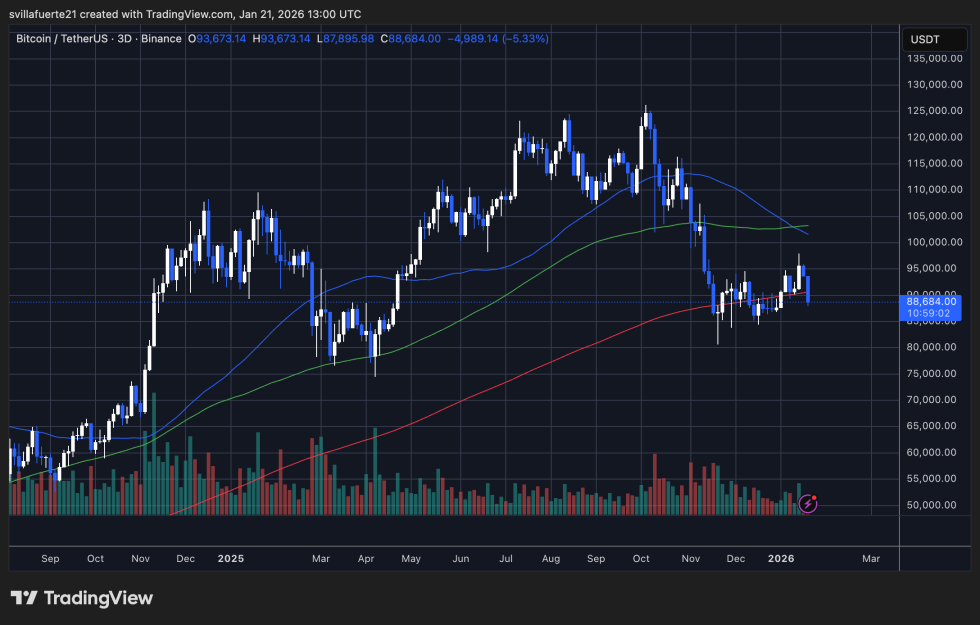
From a trend perspective, BTC is trading below its key moving averages, with the faster lines curling downward and acting as dynamic resistance. The most notable barrier sits around the $100,000–$105,000 zone, where the broader trend indicators remain overhead and signal that the market is still in recovery mode rather than a confirmed uptrend. Even the recent bounce attempts have struggled to sustain momentum, highlighting that demand has not returned with enough force to absorb selling pressure.
At the same time, BTC continues to hold above the red long-term moving average, which is still rising and represents the broader bull market foundation. This keeps the larger structure intact, but the price action suggests that bulls must defend the $88,000–$90,000 area to prevent further weakness.
If BTC stabilizes and reclaims $90K, it could open the door for a push back into the mid-$90K range. However, if selling accelerates below $88K, the market risks revisiting deeper support levels from the late-2025 consolidation.
Featured image from ChatGPT, chart from TradingView.com
