Trump Tariffs Ignite Bitcoin’s Risk-Off Retreat: Exchange Netflows Signal Short-Term Capitulation

Geopolitical tremors send crypto scrambling for cover.
When traditional markets flinch, digital assets feel the aftershock first. The latest tariff volley from Washington isn't just reshaping trade flows—it's triggering a classic risk-off rotation, with Bitcoin caught in the crossfire. Exchange data reveals the telltale signs of a shaken herd.
The Flow Tells The Story
Net inflows to exchanges are ticking upward. That's the market's pulse quickening. It's not the slow, confident accumulation of a long-term believer; it's the hurried movement of capital looking for an exit ramp. Each deposit represents a potential sell order waiting to be executed, adding latent downward pressure to the order books. This is short-term noise, the kind that creates buying opportunities for those with steady hands.
Liquidity In The Crosshairs
This isn't about Bitcoin's fundamentals changing. The network hums along, immutable as ever. This is about liquidity and sentiment—the two most fickle forces in finance. Traders are de-risking portfolios, moving to the sidelines, and converting volatility into cash. It's a defensive play as old as markets themselves, just with a digital asset twist. A classic case of weak hands funding the future stacks of the patient.
Correction or Catalyst?
Every macro shock tests an asset's narrative. For Bitcoin, this is another stress test of its 'digital gold' thesis. Does it act as a safe haven, or does it get swept up in the initial panic? The price action suggests the latter for now, but the real story unfolds in the aftermath. These dips have a historical habit of looking like genius entry points in the rearview mirror. After all, Wall Street often mistakes volatility for risk, while the crypto-native see it as the cost of admission for generational returns.
Tariff Risk Keeps Bitcoin Tied to Macro Conditions
The XWIN Research Japan report explains that several Bitcoin pullbacks between 2025 and 2026 aligned with periods of rising economic uncertainty driven by tariff hikes and trade frictions. During these episodes, BTC declined alongside equities, reinforcing that the market still treats Bitcoin as a macro-sensitive risk asset rather than a defensive hedge. Instead of decoupling during stress, Bitcoin often reacts like a high-beta instrument when traders rush to reduce volatility in their portfolios.

Economic risk tends to hit Bitcoin quickly because investor behavior adjusts fast. As uncertainty around growth and interest rates increases, capital typically shifts toward short-term protection. In that process, Bitcoin is frequently viewed as a liquid asset that can be sold temporarily to lower portfolio risk, rather than a long-term store of value that benefits from risk-off flows. This dynamic can amplify downside moves even when long-term fundamentals remain intact.
Exchange Netflow provides a supplementary LAYER of evidence. During correction phases, brief spikes in exchange inflows often appear, consistent with tactical repositioning and short-term profit protection. However, these inflows have not persisted, suggesting the absence of sustained structural selling pressure.
For now, the base scenario remains that tariff-driven economic risk is weighing on Bitcoin. If exchange inflows become sustained and supply-demand conditions weaken further, that assessment WOULD need to be reassessed.
BTC Holds Its Ground After Breaking Below $90K
Bitcoin is trading around $88,800 on the weekly chart after a sharp selloff that briefly pushed price below the $90,000 psychological level. This drop marks a clear shift in momentum, as BTC failed to hold the mid-range structure that supported price action throughout the late-2025 consolidation phase. The weekly candle shows heavy downside pressure, with sellers rejecting attempts to stabilize above $92,000 and forcing a retest of lower demand.
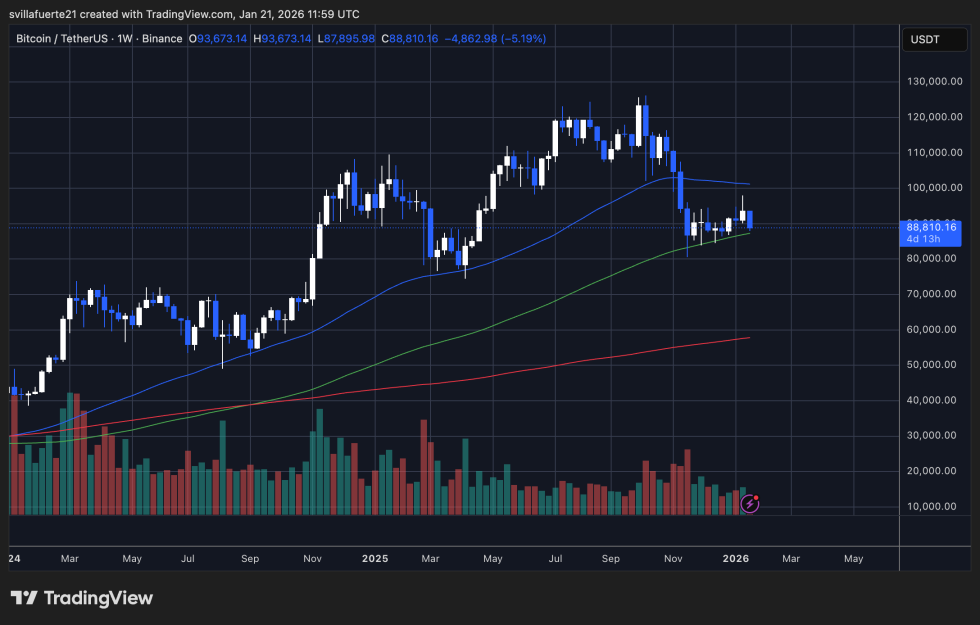
Technically, Bitcoin remains trapped between key moving averages. Price is still below the blue long-term trend line, which has acted as dynamic resistance since the breakdown from the $100,000+ region. At the same time, BTC is holding above the green moving average, suggesting that while the market is weak, longer-term buyers are still defending the broader uptrend structure.
This creates a fragile equilibrium: as long as Bitcoin holds above the current support zone, bulls can attempt to rebuild a base and reclaim $90,000-$92,000. However, if volatility expands and the market loses the green trend line, it would expose BTC to a deeper correction toward the mid-$80,000s, where previous demand briefly stepped in during the prior drawdown.
Featured image from ChatGPT, chart from TradingView.com
