Ripple President Monica Long Reveals Her Bold 2026 Crypto Market Predictions

Ripple's top executive just laid out her vision for the next two years—and it's not for the faint of heart.
The Institutional Floodgates Are Open
Forget niche adoption. Long sees 2026 as the year traditional finance fully embraces crypto infrastructure. Think real-time cross-border settlements becoming mundane, not magical. The boring back-office stuff finally gets a tech upgrade that cuts settlement times from days to seconds and bypasses the usual fee-hungry intermediaries.
Regulation: From Roadblock to Roadmap
The regulatory fog is lifting. Clear frameworks are emerging, moving from reactive crackdowns to proactive guidance. This isn't about stifling innovation; it's about providing the guardrails that let institutional capital off the sidelines and into the game at scale. Expect fewer headlines about enforcement and more about established pathways.
Utility Trumps Speculation
The narrative is shifting decisively from 'number go up' to tangible problem-solving. Assets with proven, scalable use cases—especially in payments and liquidity—will lead the next growth phase. The market starts rewarding efficiency over hype, a concept that might baffle your average Wall Street trader still betting on quarterly earnings whispers.
The message is clear: the building phase is accelerating. The tools are moving from the hands of crypto-natives to the engines of global finance. The real question isn't if, but how fast the old guard adapts—or gets left behind.
#1 Stablecoins (Ripple USD) As The Settlement Layer
Long’s central prediction is that stablecoins will stop being treated as an “alternative rail” and become foundational to global settlement. “Within the next five years, stablecoins will become fully integrated into global payment systems—not as an alternative rail, but as the foundational one,” she wrote. “We’re seeing this shift not in theory, but in practice, as heavyweights like Visa and Stripe hard-wire these rails into incumbent flows.”
She ties that trajectory to US policy momentum, arguing the GENIUS Act “inaugurated the digital dollar era,” and positioning “highly compliant, US issued stablecoins, including Ripple USD (RLUSD)” as a standard for programmable, 24/7 payments and collateral use in markets. Long also points to “conditional approval from the OCC to charter the Ripple National Trust Bank” as part of Ripple’s compliance strategy.
The near-term demand driver, in her telling, is B2B, not retail. Long cites research claiming B2B payments became the largest real-world stablecoin use case last year, reaching an annualized $76 billion run-rate—up sharply from early 2023 levels. She argues stablecoins can unlock liquidity and reduce working-capital drag, citing “over $700 billion” of idle cash on S&P 1500 balance sheets and “more than €1.3 trillion across Europe.”
#2 Institutional Exposure And Tokenization
Long argues crypto is increasingly used as financial infrastructure rather than just a speculative asset. “Crypto has evolved from a speculative asset into the operating LAYER of modern finance,” she wrote. “By the end of 2026, balance sheets will hold over $1 trillion in digital assets, and roughly half of Fortune 500 companies will have formalized digital asset strategies.”
She points to a 2025 Coinbase survey she says found 60% of Fortune 500 companies are working on blockchain initiatives, and notes “more than 200 public companies” holding bitcoin in treasury. She also highlights the rise of “digital asset treasury” firms, claiming they grew from four in 2020 to more than 200 today, with nearly 100 formed in 2025 alone.
On market structure, Long forecasts “collateral mobility” as a key institutional use case, with custodians and clearing houses using tokenization to modernize settlement. Her stated expectation is that “5–10% of capital markets settlement” moves onchain in 2026, supported by regulatory momentum and stablecoin adoption by systemically important institutions.
#3 Custody Consolidation AcceleratesLong frames digital asset custody as the institutional on-ramp and predicts consolidation as custody offerings commoditize. “M&A activity in this space is a signal of maturity, not just momentum,” she wrote, citing $8.6 billion in crypto M&A in 2025. She argues regulation will push banks toward multi-custodian setups and predicts “more than half of the world’s top 50 banks” will add at least one new custody relationship in 2026.
She also points to convergence between crypto and traditional finance through deals such as Kraken’s purchase of NinjaTrader and Ripple’s acquisitions of GTreasury and Hidden Road, positioning them as steps toward safer, more integrated institutional workflows.
#4 Blockchain And AI ConvergeLong’s final theme is automation: smart contracts paired with AI models running treasury and asset-management processes continuously. “Stablecoins and smart contracts will enable treasuries to manage liquidity, execute margin calls and optimize yield across onchain repo agreements, all in real-time without manual intervention,” she wrote.
She argues privacy tech is critical for regulated deployment, pointing to zero-knowledge proofs as a way for AI to assess risk or creditworthiness without exposing sensitive data.
Long’s overarching claim is that 2026 marks a transition from experimentation to infrastructure: stablecoins as settlement and collateral, tokenization in Core market plumbing, custody as a trust anchor, and AI-driven automation as the efficiency layer.
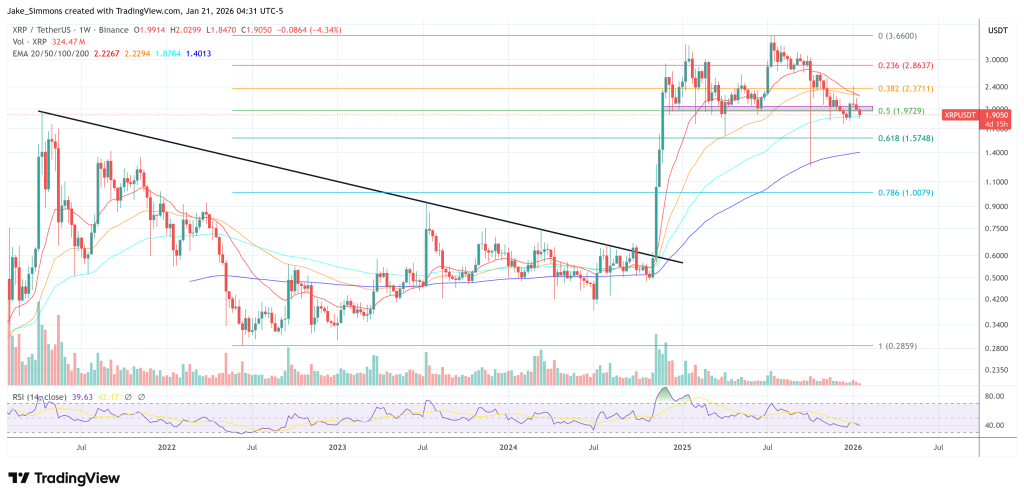
At press time, XRP traded at $1.905.