Solana Labs CEO Warns: Ethereum’s ’Walkaway’ Mentality Is a Fatal Mistake for Crypto

Solana's top executive just dropped a bombshell on crypto's complacency culture—calling the Ethereum-esque 'build it and they will come' approach a death wish for the industry.
Why 'Walkaway' Thinking Dooms Projects
Forget passive development. The CEO argues that waiting for users and developers to magically appear—a mindset some associate with Ethereum's early ethos—is a fast track to irrelevance. Blockchains need relentless hustle, not hopeful waiting.
Survival of the Fittest in the Layer-1 War
The message is clear: in the brutal arena of competing blockchains, only the aggressive survive. It's a direct challenge to teams who prioritize perfect tech over user adoption and real-world utility. Build a better mousetrap, and the world might beat a path to your door—or it might just stick with the mousetrap it already knows.
The new rule? Ship, adapt, and conquer. Or become another ghost chain in the crypto graveyard—right next to the vaporware ICOs that promised to revolutionize finance but barely paid for their founders' Lamborghinis.
Why Solana Can’t Afford To Ossify
Yakovenko replied that he “actually think[s] fairly differently on this,” laying out a philosophy that treats adaptability as Core to Solana’s value proposition. “Solana needs to never stop iterating,” he wrote. “It shouldn’t depend on any single group or individual to do so, but if it ever stops changing to fit the needs of its devs and users, it will die.” In Yakovenko’s framing, the risk is not merely technical stagnation; it is a network losing relevance to the people building and transacting on it.
Buterin’s “walkaway test” rests on the idea that Ethereum should reach a point where its usefulness does not “strictly depend on any features that are not in the protocol already,” even if the ecosystem continues improving via client optimizations and limited parameter changes. He also sketched a set of medium-term protocol objectives, ranging from quantum resistance and scalable architecture to long-lived state design and decentralization safeguards, aimed at making Ethereum robust “for decades” and reducing the need for frequent disruptive upgrades.
Yakovenko’s critique is less about those specific goals than the premise that a base layer should aspire to being able to “ossify if we want to.” In his view, ossification is not a neutral milestone; it risks locking in a protocol that can’t keep pace with developer and user demands. “To not die requires to always be useful,” he wrote. “So the primary goal of protocol changes should be to solve a dev or user problem.” At the same time, he emphasized prioritization over maximalism: “That doesn’t mean solve every problem, in fact, saying no to most problems is necessary.”
A key overlap in both positions is a skepticism toward dependence on a single “vendor,” though they operationalize it differently. Buterin wants Ethereum’s base layer to become sufficiently complete that it can remain dependable even if the upgrade cadence slows dramatically. Yakovenko, by contrast, argues that solana should assume upgrades will keep coming, but not necessarily from any one core team.
“You should always count on there being a next version of solana, just not necessarily from Anza or Labs or fd,” he wrote, referencing major entities in Solana’s development orbit. He then pointed to a future where governance and funding mechanisms could directly underwrite that work, suggesting “we are likely to end up in a world where a SIMD vote pays for the GPUs that write the code,” a nod to both on-chain coordination and the growing role of AI-assisted development.
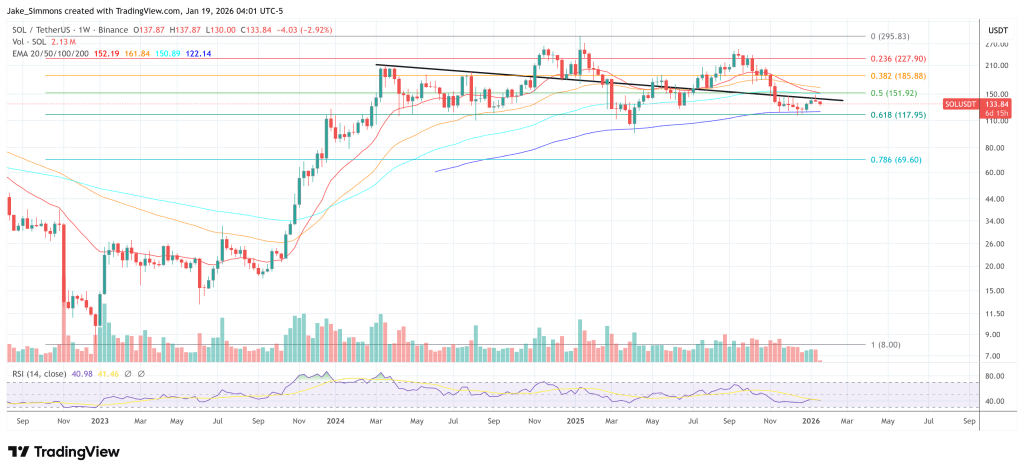
At press time, SOL traded at $133.84.