Bitcoin Miners Hit the Brakes: Hashrate Plunges to 3-Month Low

The hum of the world's most powerful computer network just got quieter. Bitcoin's hash rate—the total processing power securing the blockchain—has nosedived to its lowest point in a quarter. It's a sudden power-down that's got the entire crypto ecosystem leaning in.
What's Behind the Pullback?
Miners aren't just turning off rigs for fun. This is a classic economic squeeze play. When the cost of electricity to run those specialized computers starts nipping at the heels of the Bitcoin rewards, the less efficient operations get unplugged. It's a brutal, automated efficiency drive—survival of the fittest (and cheapest) watt.
The Network's Self-Correcting Mechanism
Here's the beautiful, cynical part of the Bitcoin code: this is a feature, not a bug. The network automatically adjusts mining difficulty roughly every two weeks. With less collective hashing power competing, the next adjustment will likely make it easier for the remaining miners to find blocks. It's a self-healing cycle that keeps the 10-minute block time ticking, no matter how many miners come or go. A perfect little economic engine, completely indifferent to who fuels it.
Reading the Tea Leaves for Price
Historically, major hash rate drawdowns have sometimes preceded price bottoms. The logic? Weak hands—the high-cost miners—get flushed out, selling their mined coins to cover costs. Once that forced selling subsides, the market can find a firmer footing. Of course, past performance is the favorite bedtime story of every finance bro trying to predict the future.
The hash rate will roar back. It always does. Either the Bitcoin price recovers, making mining profitable for more players, or a new generation of even more efficient hardware hits the market. Until then, the network demonstrates its resilience not through constant growth, but through its ruthless, unfeeling adaptability. A stark reminder that in crypto's decentralized jungle, the only real constant is the code's cold, mathematical logic.
7-Day Average Bitcoin Mining Hashrate Has Declined Recently
The Bitcoin “Hashrate” refers to an indicator that keeps track of the total amount of computing power that the miners as a whole have attached to the blockchain. This metric may be used as a proxy for the behavior of the network validators.
When the value of the Hashrate goes up, it means new miners are joining the chain and/or old ones are expanding their facilities. Such a trend implies BTC mining is looking attractive to these validators.
On the other hand, the indicator observing a decline suggests some of the miners have decided to disconnect their rigs from the network, potentially because they are finding the cryptocurrency to be unprofitable.
Now, here is a chart from Blockchain.com that shows the trend in the 7-day average value of the Bitcoin Hashrate over the past year:
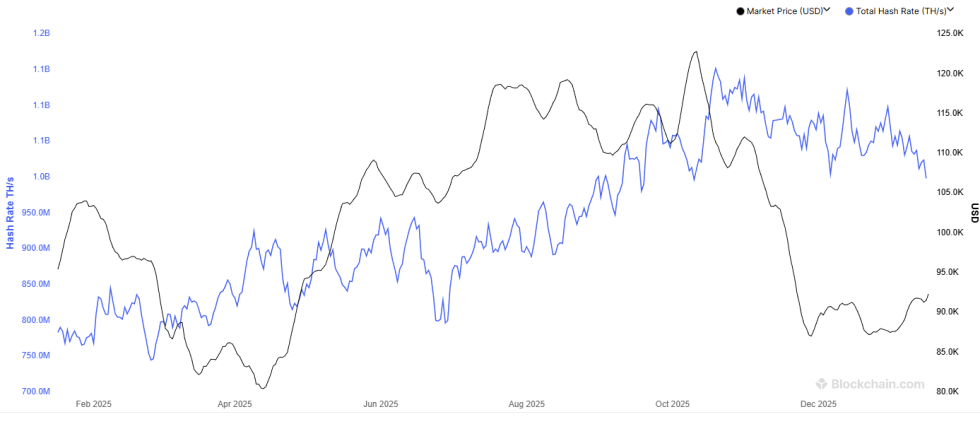
As displayed in the above graph, the 7-day average Bitcoin Hashrate set a new all-time high (ATH) around 1,151 exahashes per second (EH/s) back in October. Since this record, however, the indicator’s value has gone down.
What’s behind this trend? The answer to that question could lie in the miner revenue. Miners earn their income through two means: block subsidy and transaction fees. Out of these, the former contributes the largest portion to their revenue.
Block subsidy remains fixed in terms of BTC value (outside of Halving events, during which they permanently get slashed in half), but its USD value changes alongside the cryptocurrency’s price. Thus, miner revenue is more-or-less dependent on the asset’s price action.
Back in October, Bitcoin rallied to a new ATH, so miners responded by upgrading their facilities. When the bullish price action didn’t continue, however, the cohort started pulling back. As a result, the 7-day average Hashrate has fallen to around 998 EH/s, its lowest level in more than three months.
Interestingly, the latest continuation of the decline in the indicator has come despite the fact that the cryptocurrency has made some recovery recently. This may be a possible sign that miners aren’t yet convinced by a return of bullish momentum.
A potential consequence of the Hashrate decline may be a drop in the Bitcoin mining Difficulty during the next network adjustment. According to data from CoinWarz, miners have taken an average of 10.6 minutes per block since the last adjustment, which is notably slower than the blockchain’s target of 10 minutes.
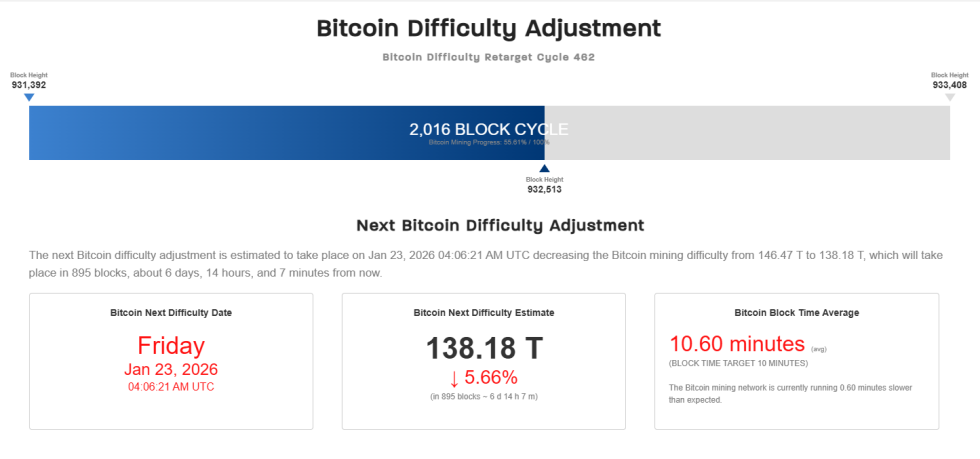
To correct for this, Bitcoin could be forced to decrease its Difficulty by 5.6% in the next biweekly adjustment. However, something to note is that there is still about a week to go until this event, so the network’s response could change depending on how the Hashrate behaves in the coming days.
BTC Price
At the time of writing, Bitcoin is floating around $95,500, up more than 5% over the last seven days.
