Chainlink Ignites Swift’s Multi-Bank Tokenization Breakthrough: The 2026 Cross-Border Revolution

Swift just cut the red tape—and Chainlink lit the fuse.
The global banking messenger's latest pilot didn't just test tokenized assets; it torched the old playbook. Multiple major banks moved tokenized value across multiple public and private blockchains. No single network dominated. The interoperability problem that's haunted finance for years? It just got a working solution.
The Oracle Engine in the Machine
Chainlink's role wasn't flashy—it was fundamental. Its Cross-Chain Interoperability Protocol (CCIP) acted as the secure messaging layer, the trusted highway between disparate ledgers. It didn't just move data; it verified it, ensuring a token burned on one chain was accurately minted on another. This is the plumbing that makes a multi-chain financial system possible, turning walled gardens into open parks.
Why This Isn't Just Another Pilot
Forget the hype cycles. This moves beyond theoretical 'what ifs' into operational 'how to.' It proves that existing financial giants, using their existing Swift infrastructure, can interact with both private permissioned chains and public decentralized ones like Ethereum. The barrier between TradFi and DeFi isn't just lowering—it's getting a professionally installed turnstile.
The Cynical Take (Because Finance Demands One)
Let's be real: the banks aren't doing this for the beauty of decentralization. They're doing it because legacy settlement takes days, costs a fortune, and leaves everyone holding counterparty risk. Tokenization promises to squeeze those inefficiencies into dust—and turn them into profit. It's not a revolution out of kindness; it's a calculated upgrade to protect their slice of a multi-trillion-dollar pie.
The bottom line? The race to tokenize everything—bonds, funds, real estate—just found its missing link. The infrastructure for a unified global ledger is being built, not by a single entity, but through a messy, collaborative, and suddenly very real competition. The future of finance is fragmented, and for the first time, that's its greatest strength.
Swift Hits Tokenized-Asset Interoperability Milestone
Chainlink posted via X on Jan 15: “As part of Swift’s work with Chainlink & UBS Asset Management, Swift completes landmark interoperability milestone with BNP Paribas, Intesa Sanpaolo, & Société Générale.”
The trial, which Swift described as a “landmark” milestone, focused on the “seamless exchange and settlement of tokenized bonds,” with payments supported in both fiat and digital currencies. Swift said the work covered delivery-versus-payment settlement and key lifecycle events including interest payouts and redemption, with participants taking on familiar market roles such as paying agent, custodian and registrar.
Swift framed the outcome as a step beyond point integrations. It said this was “the first time we have demonstrated our ability to orchestrate tokenized asset transactions as a single, coordinated process across both blockchain platforms and traditional systems,” positioning Swift as a neutral coordinator in a market that is rapidly splintering across chains, protocols, and settlement stacks.
A key element of the project ran through SG-FORGE’s infrastructure. Swift said the trial “harness[ed] their digital asset and EURCV stablecoin” to enable DvP settlement for tokenized bonds using both fiat and stablecoins, while also supporting the bond lifecycle events tested in the exercise. BNP Paribas Securities Services and Intesa Sanpaolo acted as paying agents and custodians, and Swift argued the settlement flows executing “over Swift” showed tokenized bonds can leverage existing infrastructure rather than forcing institutions into bespoke blockchain plumbing.
The network also highlighted standards alignment, saying the initiative showcased integration of ISO 20022 messaging with “blockchain-native platforms,” a detail that speaks directly to operational adoption for firms already running ISO-native post-trade and payments processes.
Thomas Dugauquier, Swift’s tokenised assets product lead, cast the effort in institutional terms: “This milestone demonstrates how collaboration and interoperability will shape the future of capital markets. It’s about creating a bridge between traditional finance and emerging technologies.”
Chainlink’s Role
While the bond trial involved European banking counterparts, Swift explicitly tied the work to a broader sequence of pilots, including “bridging tokenized assets with existing payment systems with UBS Asset Management and Chainlink.” In that earlier UBS pilot, Swift, UBS Asset Management and Chainlink tested a model for settling tokenized fund subscriptions and redemptions while keeping cash settlement compatible with existing fiat rails carried over Swift’s network footprint.
Swift also pointed to other recent experiments spanning fiat and digital currency settlement with Citi, digital asset transaction exchange with Northern Trust and the Reserve Bank of Australia, and ISO 20022-based blockchain interoperability with HSBC and Ant International.
Beyond technology, Swift said it has submitted proposed market practice guidelines to the Securities Market Practice Group, arguing that innovation in digital assets should not come “at the expense of systemic stability” and that clearer practices can reduce onboarding complexity for institutions.
With the trial series “now complete,” Swift said it is focused on adding “a blockchain-based ledger” to its infrastructure stack, starting with real-time, 24/7 cross-border payments “designed in collaboration with over 30 banks worldwide.”
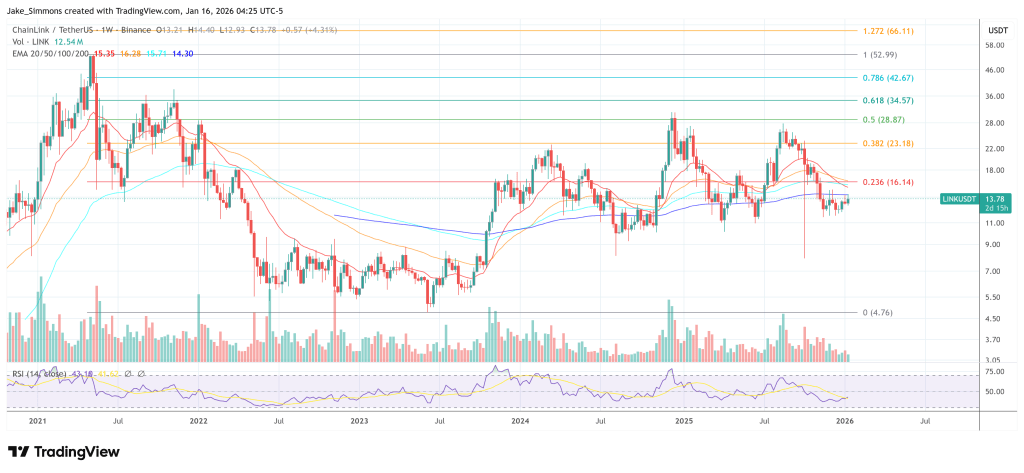
At press time, Chainlink (LINK) traded at $13.78.