Bitcoin’s Next Surge Hinges on Expanding Dollar Liquidity, Says Arthur Hayes

Bitcoin's price action feels stuck—like a high-performance engine waiting for the right fuel. According to crypto veteran Arthur Hayes, that essential fuel is dollar liquidity. Without a fresh influx, the flagship cryptocurrency struggles to reclaim its former momentum.
The Liquidity Lifeline
Hayes argues that macro liquidity conditions, not just halving cycles or ETF flows, are the ultimate driver for crypto markets. When the financial system is flush with dollars, that capital seeks yield and innovation—often flowing into digital assets. Tighten the taps, and the entire complex feels the squeeze.
Navigating the Crosscurrents
The current landscape presents a clash of narratives. Institutional adoption grows while traditional monetary policy tries to reign in excess. For Bitcoin to break out, it needs a decisive shift—either from central bank policy easing or from the market ingeniously creating new forms of synthetic dollar liquidity, because apparently the real stuff is being hoarded by the usual Wall Street suspects.
It's a stark reminder: in the high-stakes game of global finance, even the most decentralized asset can't fully decouple from the old system's plumbing. The path forward isn't just about technological adoption; it's a waiting game for the liquidity spigot to turn, proving once again that in finance, the 'free market' often has a central banker on speed dial.
Hayes Links Bitcoin To Dollar Liquidity
According to Hayes, the key for Bitcoin is the amount of money sloshing through the system. He mentioned the US Federal Reserve’s balance sheet expanding through what he called more aggressive money creation, mortgage rates falling as lenders loosen, and commercial banks stepping up loans to industries backed by government strategy.
Bitcoin fell 15% in 2025 while gold jumped 44%. Technology stocks led the S&P 500 with a total return of 25%, against the S&P’s overall 18% return. Those figures, Hayes argued, show that last year was a story about where liquidity landed, not about crypto losing its basic case.
Government Support Sends Tech Higher
Hayes also highlighted how governments have shifted capital into certain tech projects. He suggested that both China and the US used executive actions and public funds to push money into artificial intelligence work, saying this has helped tech firms attract big flows regardless of immediate return on equity.
He named US President Donald TRUMP when pointing to policy moves that favor AI investment. That dynamic, he said, helped explain why the Nasdaq performed strongly even as Bitcoin slumped.
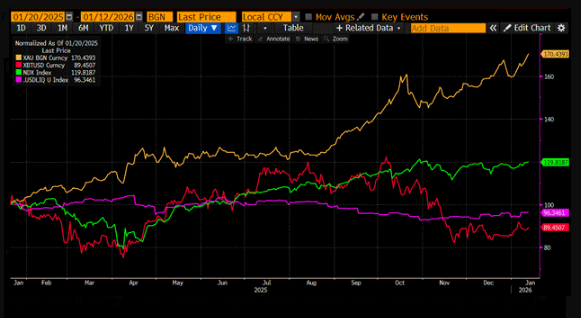
He added a more pointed claim about military spending. Hayes said the US will keep using its military might and that such efforts require large-scale production financed through the banking system.
That, in his view, can add to broader liquidity if the banking sector starts funding big government-backed projects. Reports have disclosed that Hayes believes these forces could force dollar liquidity higher in 2026, creating fertile ground for risk assets — including Bitcoin.
Markets reacted when the latest US inflation figures came in cooler than expected. Bitcoin inched close to $97,000 and rose more than 5% in 24 hours. Ethereum, Solana, and Cardano each posted gains near 8% in the same span.
Bond yields fell and the dollar weakened, which left cash looking for a new home. That pattern is familiar: softer inflation tends to lower borrowing costs and makes investors more willing to take risk.
A Bull Case With ConditionsBased on Hayes’ logic, Bitcoin’s upside depends on ongoing fiat debasement. He frames Bitcoin as monetary technology whose value rises when fiat is weakened. That view is coherent but conditional. If central banks choose to stay tight, or if inflation flares and forces a policy shift, Hayes’ scenario may not unfold. For the time being, his forecast is a liquidity story — one that will be tested by policy choices in 2026.
Featured image from Unsplash, chart from TradingView
