Ripple’s XRPL Permissioned Domains: The ’Gamechanger’ Nears Go-Live

Ripple drops the mic on traditional finance with its latest XRPL upgrade. Permissioned Domains are about to go live—and the company isn't shy about calling it revolutionary.
The Private Ledger Play
Forget the public, permissionless chaos. This move carves out controlled spaces on the XRP Ledger. Think of it as a VIP section for enterprise transactions—regulated, compliant, and isolated from the mainnet's noise. It targets institutions that love blockchain's efficiency but hate its transparency.
Why Banks Might Actually Care
This isn't for crypto degens. It's for the suits. Permissioned Domains let financial giants settle cross-border payments or tokenize assets on a familiar rails, but with Ripple's speed and cost-cutting tech. It bypasses the legacy correspondent banking mess—a system so slow it still thinks fax machines are cutting-edge.
The Fine Print & The Skeptic's Corner
Ripple's betting big that institutions will choose a tailored XRPL slice over building their own chain from scratch. The value proposition? Leverage the core ledger's security and liquidity without the public exposure. Of course, cynics will note that creating walled gardens in a decentralized ecosystem is a classic finance move—innovate just enough to protect the old profit margins.
The launch window is now. If it sticks, Ripple could finally hand Wall Street a blockchain it's not afraid to touch.
Ripple’s Next ‘Gamechanger’ For The XPR Ledger
Via X, RippleX said: “The amendment for Permissioned Domains is nearing the threshold for activation.Ripple supports this feature, as well as the Permissioned DEX which this will ultimately enable. “
Under XRPL’s governance process, amendments become active after maintaining a 80% validator supermajority for a sustained period. According to xrpl.org, the PermissionedDEX is currently open for voting and has reached 50.00% thus far, while the PermissionedDomains amendment stands at 76.47%.
RippleX describes the feature as a “game-changer for XRPL because they bring institutional-grade controls to a public network, without sacrificing the trade-offs of a private chain.”
The company further writes: “While the Permissioned Domains amendment is an enabling feature, it sets the stage for financial institutions to engage in permissioned flows on a fast, scalable, and resilient blockchain network, the XRPL. The Permissioned DEX will enable permissioned trading flows, and the upcoming lending protocol may apply Permissioned Domains for controlled lending and borrowing flows.”
On XRPL’s documentation, permissioned domains are described as controlled environments that “do nothing on their own,” but can be used by higher-level features, such as permissioned DEX functionality and lending protocols,to restrict and manage access for compliance-driven deployments. Permissioned DEXes are the practical endpoint: regulated entities participating in XRPL’s native order books while enforcing who can interact with specific markets.
“Traditionally, any XRPL DEX offer can be matched by anyone. A permissioned DEX changes that,” Ripple wrote, describing permissioned trading as rules-based matching limited to approved participants.
RippleX also points to adjacent roadmap items, including an upcoming lending protocol that could apply the same domain-based controls to borrowing and lending flows, suggesting the design pattern is intended to extend beyond trading into broader onchain finance primitives.
The announcement drew immediate interest from XRP community voices. Popular community member Krippenreiter highlighted “on-chain FX” as a headline application, while Anodos Finance CEO Panos Mekras responded that “the only thing left is to bring the actual assets and liquidity to flow.” Krippenreiter agreed, calling for “more stablecoins, RWAs, and more market making.”
We talked about this on the show @panosmek.
On-chain FX, here we go! pic.twitter.com/jh0zoXWmQv
— Krippenreiter (@krippenreiter) January 13, 2026
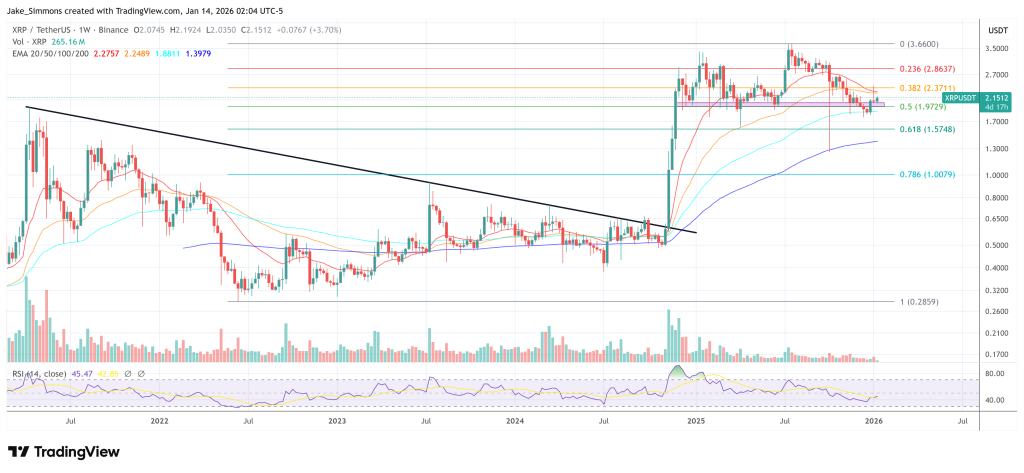
At press time, XRP traded at $2.15.