Bitcoin’s Institutional Tipping Point: CLARITY Act Heads to Senate Floor for Landmark Review

The regulatory dam is cracking. A legislative push that could redefine Bitcoin's place in the American financial system is barreling toward a full Senate review—and Wall Street's playbook is being rewritten overnight.
The Institutional Floodgates
Forget the wild west narrative. The CLARITY Act isn't about taming crypto; it's about building a bridge for the big money. It carves out a regulatory lane for institutions, letting pension funds and asset managers finally engage without the legal gray zone that's kept them sidelined. This isn't adoption by hobbyists—it's adoption by spreadsheet.
Cutting Through the Fog
The bill's core mission? To slice through the jurisdictional spaghetti between the SEC and CFTC. By clarifying which digital assets are commodities and which are securities, it aims to kill the uncertainty that has strangled innovation and scared off conservative capital. No more guessing games. The market gets rules, and institutions get a green light.
The Ripple Effect
Watch the dominoes fall. Clear rules don't just attract capital; they birth new financial products. Think Bitcoin ETFs were a big deal? Wait for the wave of structured notes, index funds, and retirement vehicles built for the 401(k) crowd. The infrastructure boom—from custody to compliance tech—will be staggering. The old guard is about to get a crash course in blockchain, whether they like it or not.
A Cynical Nod from Finance
Let's be real—the same suits who called it a 'fraud' five years ago are now lobbying hardest for these rules. Why? Because nothing soothes a banker's soul like a regulated asset they can slap a fee on. The revolution might be decentralized, but the profits, as always, will be nicely centralized.
The Verdict Awaits
This isn't a done deal. The Senate floor is a battlefield, and amendments are guaranteed. But the mere fact it's reached this stage signals a seismic shift in perception. Bitcoin isn't knocking on the institution's door anymore. The institution is drafting the blueprints to let it in. The next chapter of finance is being voted on—and it's written in code.
On-Chain Signals Point to Patience, Not De-Risking
A report by CryptoQuant, authored by XWIN Research Japan, highlights that Exchange Netflow remains a critical signal in the current environment. Historically, periods of regulatory uncertainty tend to push Bitcoin into exchanges as investors prepare to sell or reduce exposure.
Ahead of the upcoming CLARITY bill discussions, however, this behavior has not materialized. Exchange inflows have stayed relatively muted, suggesting that market participants are not positioning defensively or treating the legislative process as an immediate threat.

SOPR (Spent Output Profit Ratio) reinforces this interpretation. The metric, which measures whether moved coins are sold at a profit or a loss, is hovering around or slightly below the 1.0 threshold. This indicates subdued profit-taking activity. More importantly, it implies that on-chain spending itself remains low. In simple terms, Bitcoin is not being moved aggressively, either to realize gains or to exit positions.

Together, Exchange Netflow and SOPR point to a market posture that is patient rather than defensive. Investors appear willing to hold through uncertainty instead of rotating capital or rushing to de-risk. The time horizon is clearly lengthening.
From this perspective, the CLARITY Act represents more than a policy debate. It marks a potential step toward integrating Bitcoin into the U.S. financial framework as a regulated digital commodity. On-chain data already reflects this shift: before any major price move, Bitcoin is becoming increasingly “sticky,” signaling a transition away from speculative trading and toward institutional-grade holding behavior.
Bitcoin Price Consolidation Continues
Bitcoin price action remains constrained within a well-defined consolidation range, following the sharp correction that began in November. After rejecting from the $120K–$125K region, BTC experienced an impulsive sell-off that found a local bottom NEAR the mid-$80K zone, where demand visibly stepped in. Since then, price has been carving a higher low structure, suggesting that downside momentum is gradually weakening.
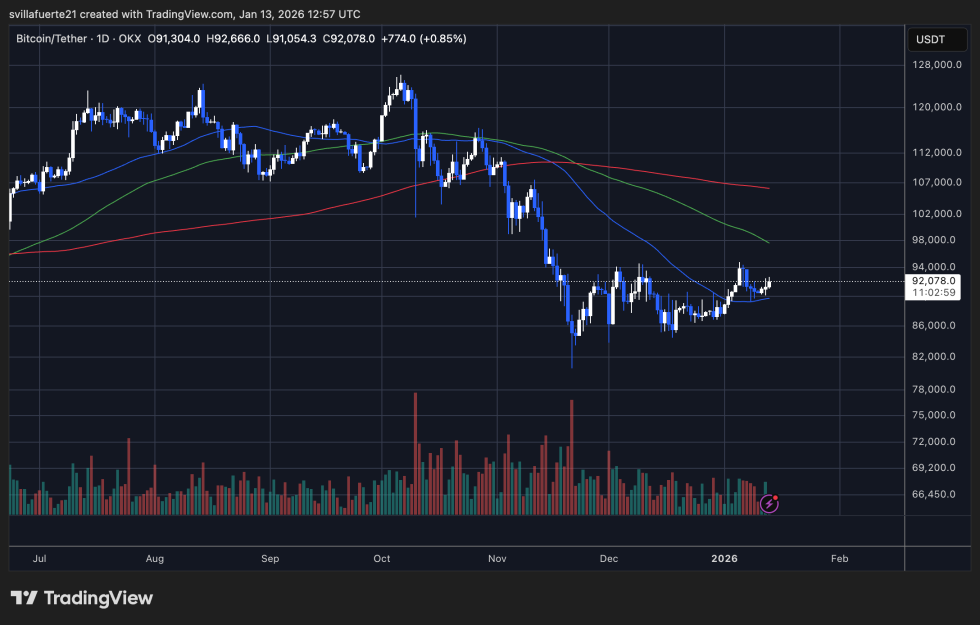
On the daily chart, Bitcoin is now attempting to stabilize above the $92K area, which aligns closely with a former support-turned-resistance level. This zone has acted as a pivot throughout the current range and remains critical for short-term direction. A sustained hold above it WOULD strengthen the case for a broader recovery toward the $98K–$100K region, where the declining short-term moving averages converge.
However, the broader trend remains technically fragile. Price is still trading below the 100-day and 200-day moving averages, both of which are sloping downward. This indicates that the medium-term structure has not yet shifted back to bullish. Volume also remains relatively muted, reinforcing the idea that this MOVE is corrective rather than impulsive.
As long as Bitcoin remains trapped between roughly $88K and $95K, the market is likely to remain range-bound. A decisive break above resistance or a loss of current support will be required to resolve this consolidation phase and define the next directional move.
Featured image from ChatGPT, chart from TradingView.com
