Ethereum’s Quiet Crisis: Retail Participation Plunges to One-Year Low in Network Activity

Ethereum's network just hit a silent alarm. The chatter of everyday users has faded to a whisper, with retail participation collapsing to its lowest point in a year.
The Ghost Chain?
Active addresses are down. Transaction volumes are thinning. The digital playground for DeFi degens and NFT collectors feels quieter—like a party where the music's still on but half the guests left. The data doesn't lie: the network's pulse, measured by daily active participants, has flatlined at a one-year nadir.
Where Did Everyone Go?
Blame high gas fees acting like a velvet rope at an empty club. Or point to the seductive simplicity of layer-2 solutions siphoning off activity. Maybe it's just market fatigue—the kind that sets in when Lambo dreams meet a sideways chart. It's the classic crypto cycle: institutions build in the bear, while retail waits for the bull horn to scream 'FOMO' again. After all, why pay a premium to transact when your portfolio's doing its best impression of a flatline? Some call it efficiency. Others call it boredom.
A Turning Point or a Tuning Point?
This isn't necessarily a death knell. It's a stress test. Low activity can mean consolidation, a network shedding speculative froth for more substantive, built-to-last utility. The developers haven't left; they're heads-down. The upgrades haven't stopped; they're rolling out. This lull might be the deep breath before the next wave of adoption—or a stark lesson that even the smartest contract platform needs users, not just potential.
The bottom line? A network's health isn't just measured in transactions, but in who's transacting. Right now, Ethereum's story is being written by a smaller, possibly sharper, crowd. The retail exodus is a warning shot across the bow: build a better, cheaper experience, or watch your most vocal community become your quietest lurkers. It's a humbling moment for the chain that aims to settle the world's financial contracts—proving that in finance, even the most revolutionary tech still bows to the oldest rule: if you build it, they will come... but only if the price is right.
On-Chain Signals Point to Exhaustion, Not Capitulation
According to CryptoOnchain’s analysis, Ethereum’s sharply depressed on-chain activity aligns with a classic phase of seller exhaustion rather than active capitulation. In this regime, selling pressure gradually diminishes as participants willing to exit have largely done so, yet fresh demand has not meaningfully returned. The result is a fragile equilibrium where price may stabilize, but upside remains limited in the absence of new buyers.

The lack of retail participation plays a central role in this dynamic. Retail Flow typically provides the initial momentum during early rebounds, amplifying price moves once confidence begins to recover. With active sending addresses at one-year lows, that catalyst is currently missing, which helps explain why upside attempts have been shallow and short-lived.
However, this same environment has historically attracted larger, long-term participants. Institutional and high-conviction holders often accumulate during periods of low activity, when liquidity is thin, and sentiment is decisively negative.
Importantly, a credible recovery signal WOULD not emerge from price action alone. CryptoOnchain emphasizes that a sustainable shift would require a gradual rebound in active sending addresses alongside price stabilization.
That combination would point to returning demand and improving network utilization. Conversely, continued stagnation or further declines in address activity would increase the risk of ethereum entering a deeper consolidation or even a demand-destruction phase.
While current conditions highlight clear short-term weakness and retail disengagement, similar on-chain setups have historically formed NEAR structural bottoms, creating the potential for medium-term trend shifts if activity begins to recover.
Ethereum Price Struggles at Key Structural Support
Ethereum’s price action on the 3-day chart reflects a market caught between structural support and persistent bearish pressure. After failing to hold above the $3,200–$3,300 region, ETH has rolled over and is now consolidating near the $2,850 area, a zone that aligns closely with the 200-day moving average. This level has historically acted as a medium-term inflection point, making it critical for bulls to defend in order to avoid a deeper trend shift.
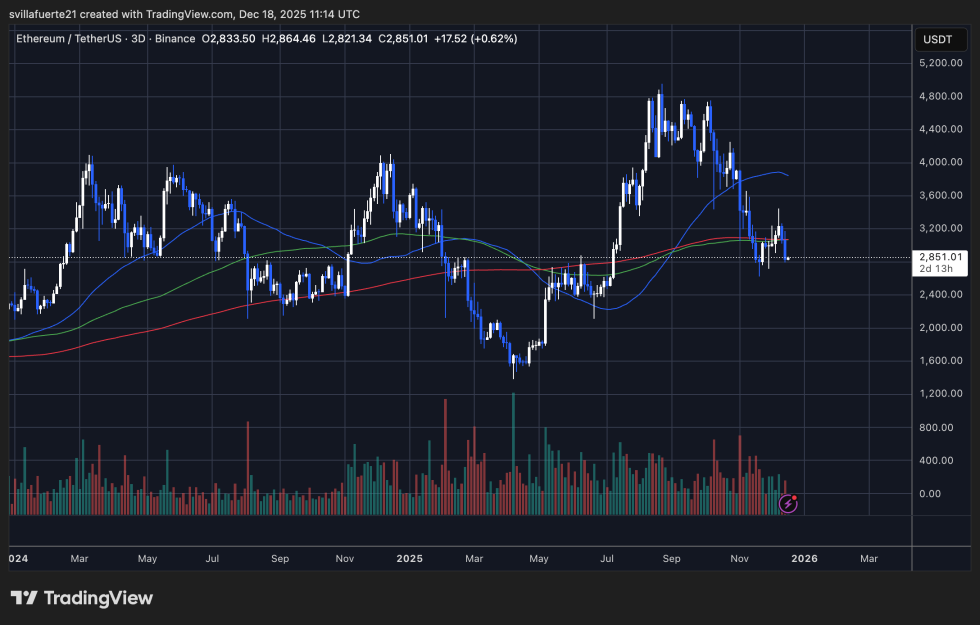
The recent rejection from the $4,000–$4,800 highs marks a clear lower high within the broader structure, reinforcing the idea that momentum has weakened since late 2025. While price briefly reclaimed the 100-day moving average during the mid-year rebound, it failed to sustain acceptance above it, and ETH has since slipped back below the shorter-term averages. This suggests that rallies are still being sold into rather than accumulated aggressively.
Price action aligns with a market transitioning into consolidation rather than immediate capitulation. If ETH loses the $2,800–$2,750 support zone decisively, downside risk opens toward the $2,400 region, where the long-term trend support converges.
Conversely, any bullish recovery would require ETH to stabilize above the 200-day moving average and reclaim the $3,200 level with expanding volume. Until then, the chart favors a cautious, range-bound outlook with downside risks still present.
Featured image from ChatGPT, chart from TradingView.com
