Jimmy Carr’s Bitcoin Brainwave: UK Should Mine Crypto With Wasted Night-Time Energy

Comedian Jimmy Carr drops a serious proposal: Britain's idle overnight power could fuel a Bitcoin mining revolution.
The Off-Peak Power Play
Picture this: while the nation sleeps, power stations keep humming. Grids maintain baseline generation that often goes unused—energy literally vanishing into thin air. Carr's suggestion turns that waste into digital gold. Bitcoin mining rigs don't care what time it is. They'd happily consume that stranded electricity, transforming a cost center into a revenue stream.
Economics That Don't Need a Punchline
The math is startlingly simple. Mining operations secure the Bitcoin network and mint new coins. Using power that would otherwise be curtailed or sold at a loss makes the economics compelling—even before considering Bitcoin's potential appreciation. It's a hedge that could make a central banker smirk, assuming they understand it.
The Grid Gets an Upgrade
This isn't just about making money. Flexible, interruptible Bitcoin mining load acts as a dynamic demand buffer. It can soak up excess renewable generation when the wind blows but demand is low, stabilizing the grid. Suddenly, mining isn't an energy villain—it's a potential grid-balancing tool, turning a political headache into a strategic asset.
A Nation's Digital Fort Knox
Imagine the UK Treasury accumulating Bitcoin, mined with native energy, as a strategic reserve asset. While politicians debate digital pound prototypes, the state could be quietly stacking sats on the balance sheet—a move so shrewd it would make the old bond traders in the City spill their tea.
The proposal cuts through the usual crypto noise. It's not speculative frenzy; it's industrial pragmatism. Using waste to build a digital asset reserve is the kind of financial alchemy that bypasses traditional skepticism. In a world where monetary policy often feels like a comedy routine, this idea might be the straight man that finally gets a laugh from the ledger.
Will The UK Mine Bitcoin With Excess Energy?
Carr made the comments in a Dec. 11 TRIGGERnometry interview recorded on “the day of the budget,” where he questioned why the UK has never created a sovereign wealth fund and argued that some revenue-generating assets should be treated as collectively owned.“
There are certain things that should belong to everyone,” he said, pointing to “the oil and gas that sit under the UK” and “the wind farms around the coast.” Carr claimed that “all of that money goes to the Crown,” and asked why it shouldn’t accrue more directly to the public.
He extended the argument to infrastructure such as “mobile phone masts,” while stressing he wasn’t making a socialist case. “I’m not a socialist. I’m not even for state capitalism,” Carr said, before arguing that some assets “should belong to everyone.”
From there, Carr offered bitcoin mining as a concrete example of a non-tax revenue lever the government could explore. “I would not mind it if our government said, yeah, we’re going to mine for Bitcoins,” he said. “Our power stations, they don’t do anything at night, so we’re going to mine for Bitcoins.” He added: “Great. New gold standard. Fine.”
Jimmy Carr is the United Kingdom’s most popular comedian and celebrity. Carr says, “I WOULD not mind it if our government mines for bitcoins. Our power stations don’t do anything at night, so we’re going to mine for bitcoins. Great. New gold standard. Fine.” pic.twitter.com/GZRvQT8mua
— Documenting ₿itcoin (@DocumentingBTC) December 17, 2025
Carr did not propose a formal policy design, cite figures on spare capacity, or address governance questions around state-run mining. The point, as he presented it, was directional: use underutilized national infrastructure more aggressively and stop treating taxation as the default answer to funding pressures. “Do something radical, something interesting with the finances of the country,” Carr said. “Why does it all have to come from taxation?”
While the remarks come from an entertainer rather than a policymaker, the framing is notable for how it positions bitcoin in a nation-state register: not only as a tradable asset, but as something a government could plausibly produce using excess energy capacity, then hold as an alternative FORM of reserve value.
Carr’s “mine with spare power” idea has real-world analogs: Bhutan has quietly built a state-linked bitcoin mining operation powered largely by hydropower, a model often described as a way to monetize seasonal surplus generation.
El Salvador has also leaned into the “excess energy” narrative. The country mined nearly 474 BTC over roughly three years using 1.5 MW of geothermal energy from a state-owned plant tied to the Tecapa volcano. And in places like Iceland, miners have long been drawn by plentiful renewable supply (and the economics of cheap, clean power), making it one of the most mining-dense jurisdictions globally.
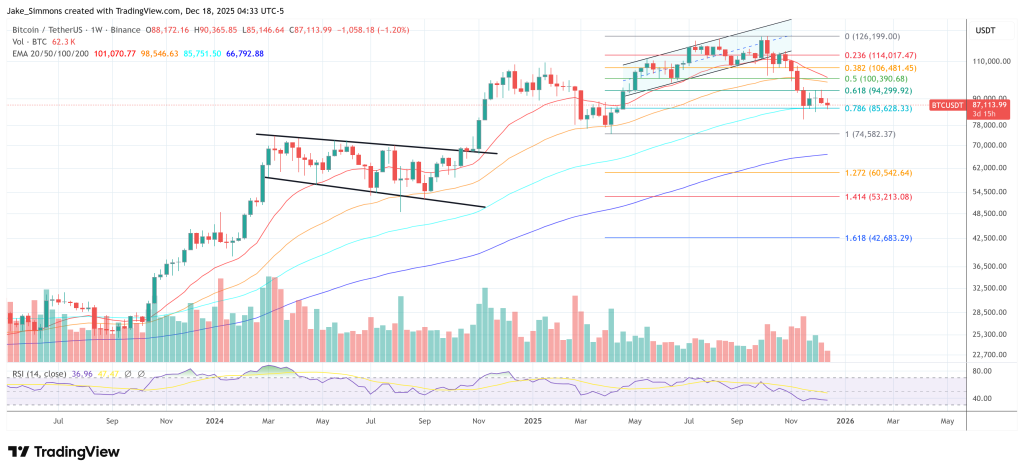
At press time, BTC traded at $87,113.