XRP Ledger Integrates Military-Grade Security With New Payments Engine Standard

Forget 'secure enough.' The XRP Ledger just deployed a payments engine standard that borrows its playbook from defense contractors.
Fort Knox-Level Transactions
This isn't just another protocol upgrade. The new standard bakes security directly into the payment rail's architecture. Think cryptographic protocols so robust they'd make a central banker's legacy system blush. It transforms the ledger from a fast settlement layer into a hardened financial fortress.
Why Wall Street Should Care
Speed meets ironclad security. The standard cuts settlement times while making transaction tampering a near-impossible feat. It bypasses the fragile, patchwork security of traditional payment networks, offering institutions a one-stop shop for moving value that's both instant and immutable. (Finally, a blockchain feature that might actually justify the hype for the suits in the corner office.)
The move signals a clear pivot: XRP isn't just playing the crypto game; it's building the infrastructure to replace the plumbing of global finance. One cynic might note it's a smart way to get noticed by regulators who are more concerned with stability than memecoins. The ledger just raised the bar. Everyone else is now playing catch-up.
A Turning Point For XRP Ledger Security
That is the tone throughout: less victory lap, more engineering debt disclosure. For much of XRPL’s life, the C++ implementation (xrpld) has effectively acted as the only definitive source of truth for Core behavior. Ripple’s post calls out a practical problem with that model: “The code tells us, in very precise C++ terms, what it does. It does not always tell us why.” In other words, when code is the spec, it becomes difficult to separate intentional design choices from historical behavior that simply persisted because nothing broke.
That gap starts to matter more as new amendments arrive. Ripple points directly to a pipeline of complex features — including lending, DEX-related work tied to Multi-Purpose Tokens (MPTs), batch transactions, and permissioned DEX concepts — and warns that the number of possible system states expands quickly as new modules “weave into the decades-old logic of the ledger.”
The published specification is hosted on GitHub and labeled as work in progress, but it is already framed as a serious technical artifact: “a technical specification document intended for developers implementing or verifying XRPL payment system behavior.” It also spells out the heart of the system in plain language: the Payment Engine is what “figures out how value should travel and then carries out those moves,” enabling payments to draw across “trust lines, MPTs, order books, AMMs, and direct XRP.”
The deeper point, though, is what this enables next. Ripple’s post lays out a two-part target. First, a human-readable specification that reduces ambiguity and becomes the canonical reference for builders and researchers. Second, a machine-verifiable model — a mathematical representation of the spec — that can support mechanical proofs about system properties and whether proposed changes violate CORE safety guarantees.
It is also explicit about scope discipline. Ripple argues that specifying the entire ledger in one shot is not realistic: “It WOULD be prohibitively expensive and time-consuming to specify the entire system at once.” So the work focuses on what it describes as the two most critical and complex components: the Payment Engine and the Consensus Protocol.
Consensus, in particular, is framed as non-negotiable infrastructure. Ripple describes it as “the heart of the ledger,” adding: “Its correctness is non-negotiable and underpins the safety and liveness of the entire network.”
The stated objective is to formally model the mechanism to prove properties such as liveness, safety, and finality. On timing, Ripple is clear that this is the starting line, not the finish. After publishing the Payment Engine specification, the team says it intends to begin formal verification work on the Payment Engine and the Consensus Protocol in 2026.
The closing line captures the direction of travel: “The shift from code-as-truth to mathematics-as-truth is underway.”
In the XRP community, the announcement landed with predictable euphoria. “Absolute freaking game changer! … Aerospace & military grade security incoming,” wrote XRPL validator and community member Vet, adding: “The XRP Ledger is receiving its first formal specification for the payments engine. By mathematically specifying key protocol components […] Basically, this is the enabler for the endboss of audits AND for other things like complex features or client diversity.”
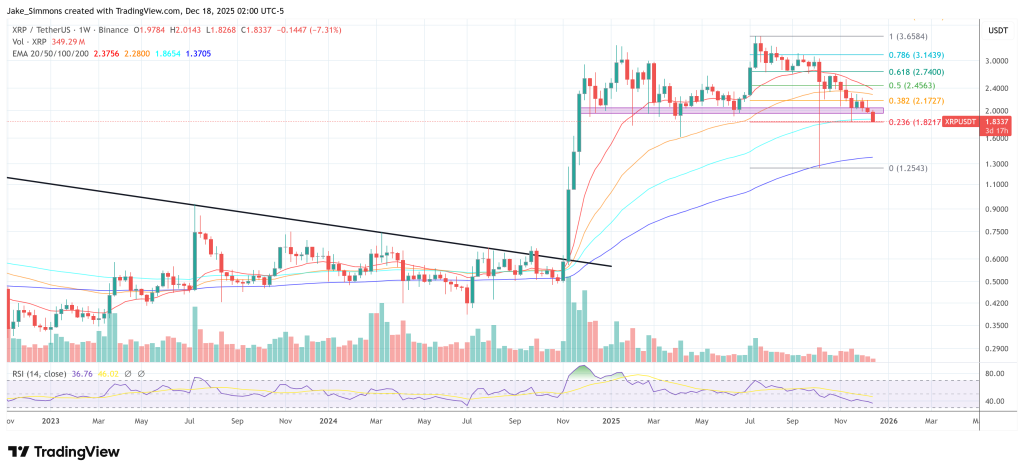
At press time, XRP traded at $1.83.