Analysts Reassess Hyperliquid’s Long-Term Potential as Large-Scale HYPE Burn Comes Into Focus

Hyperliquid just lit a match under its tokenomics—and analysts are scrambling to update their models.
The Mechanics of Scarcity
A massive HYPE burn is now the central talking point. The protocol systematically removes tokens from circulation, tightening supply while demand narratives shift. It's deflationary mechanics in action—no central bank required.
Market Calculus Shifts
This isn't just a technical adjustment; it's a signal. Reducing the floating supply pressures the price equation, forcing a reevaluation of intrinsic value. Long-term projections, once conservative, are getting aggressive revisions. Some models now bake in scarcity premiums that would make a traditional equity analyst blush—if they understood the code behind it.
The New Valuation Playbook
Forget discounted cash flows. Tokenomics is the new fundamental analysis. Burns, staking yields, and governance utility form a tri-factor model that's rewriting finance—or at least the speculative corner of it. The 'digital gold' thesis gets a software upgrade.
One cynical take? It's the ultimate financial alchemy: creating value by destroying assets. On-chain, it's innovation. On a balance sheet, it's arson. The market, as always, will decide which narrative pays.
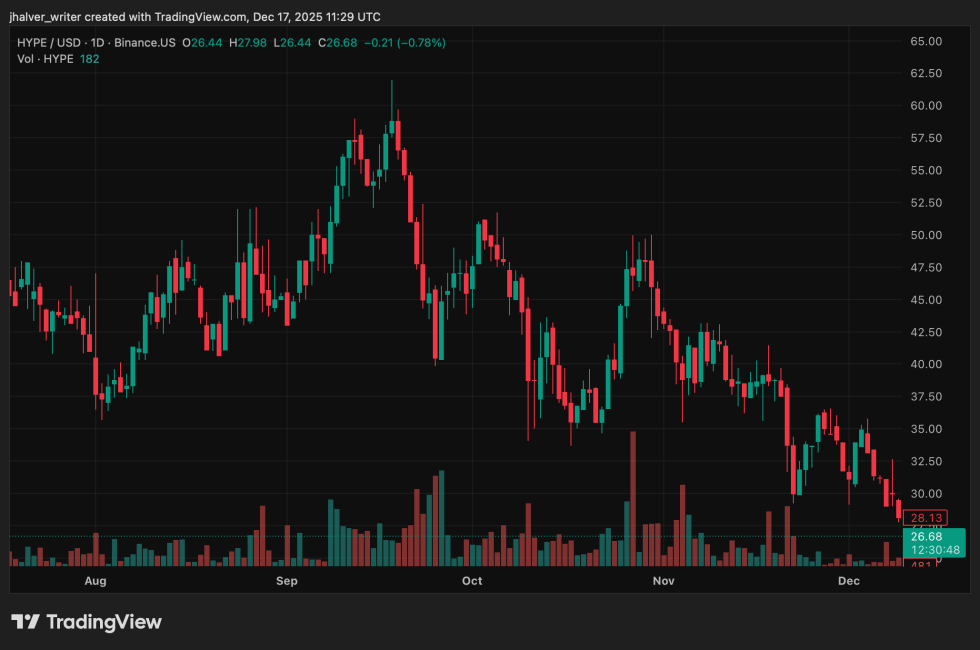
Governance Vote Puts Hyperliquid Supply Structure in Focus
The Assistance Fund accumulates HYPE through an automated mechanism that converts trading fees generated on Hyperliquid’s perpetuals exchange into the native token. These tokens sit in a system address that has never been controlled by a private key, making them inaccessible unless a protocol-level upgrade is authorized.
Under the current proposal, validators are being asked to establish a binding social consensus that no such upgrade will ever occur. Voting is stake-weighted, with validators signaling their positions by December 21, and final results are expected on December 24.
Approval would effectively lock in a more restrictive supply model, preventing the Assistance Fund from being used for grants, liquidity support, or emergency measures in the future.
The proposal follows earlier, unadopted discussions around broader supply cuts in 2025, suggesting a renewed effort to clarify HYPE’s long-term monetary framework rather than pursue incremental adjustments.
Market Reaction and Longer-Term OutlookHyperliquid (HYPE) has stabilized NEAR the $26 level after several days of losses, with market data suggesting the proposed burn is not yet fully priced in. Futures open interest has climbed above $1.5 billion, and funding rates have turned positive, pointing to growing bullish positioning ahead of the validator vote.
In contrast, spot market activity remains muted, as trading volumes have edged lower and technical indicators continue to reflect lingering bearish momentum.
Beyond short-term price action, analysts are increasingly focused on Hyperliquid’s longer-term valuation framework. Cantor Fitzgerald has cited the protocol’s fee-driven and deflationary design as a potential driver of sustained growth, projecting billions in annual fees if adoption expands.
From this perspective, the Assistance Fund burn is seen as a test of whether stricter supply discipline can help rebuild confidence, with the vote outcome likely shaping how Hyperliquid’s economic model is evaluated into 2026.
Cover image from ChatGPT, HYPEUSD chart from Tradingview
