XRP Loses Its Mojo: Why Crypto Traders Are Suddenly Playing It Safe

The speculative frenzy around XRP has hit a wall. Once a darling of the derivatives market, the digital asset is seeing its big-money bets dry up—a stark shift in sentiment that's got the entire crypto corridor talking.
The Great Unwind
Open interest is collapsing. Trading volumes are thinning. The crowd that once piled into leveraged positions for a quick moonshot is now quietly exiting stage left. It's not a crash, but a slow, deliberate retreat—the kind that often precedes a major directional move.
Beyond the Legal Headlines
Sure, everyone points to the regulatory overhang—the ghost of lawsuits past. But that's old news. The real story is unfolding in the charts and order books. The institutional 'smart money' that flirted with XRP is now chasing hotter narratives elsewhere, leaving retail traders holding the bag and wondering what's next. It's a classic case of capital rotation, where yesterday's winner becomes today's sidelined asset.
A Market Growing Up (Or Just Getting Bored?)
This cooling-off period might signal a maturing market, one less driven by hype and more by utility. Or, it might just be that traders have the attention span of a goldfish and found a shinier object to chase—another reminder that in crypto, fundamentals often take a backseat to the narrative du jour. After all, why bet on a settled lawsuit when you can gamble on the next vague AI-token merger?
The momentum has stalled. The big bets are off. For XRP to recapture its former glory, it needs more than legal clarity—it needs a reason for traders to care again. Until then, the money will keep flowing to where the action is.
XRP Leverage On Binance Drops To Multi-Year Lows
One of the clearest signals of the sentiment among traders comes from CryptoQuant data tracking the Estimated Leverage Ratio of XRP on Binance, the world’s largest crypto exchange.
The Estimated Leverage Ratio measures how much borrowed capital traders are using relative to exchange reserves. High readings of the ratio usually mean high activity trades where traders are willing to open positions. On the other hand, declining values indicate that traders are closing leveraged positions or avoiding them altogether.
According to data from CryptoQuant, the estimated leverage ratio for XRP is currently sitting around 0.187, its lowest reading since November 2024. To put this in context, the estimated leverage ratio was at a 0.59 reading in July 2025, right when the altcoin was pushing toward new all-time highs and trading activity was at its peak.
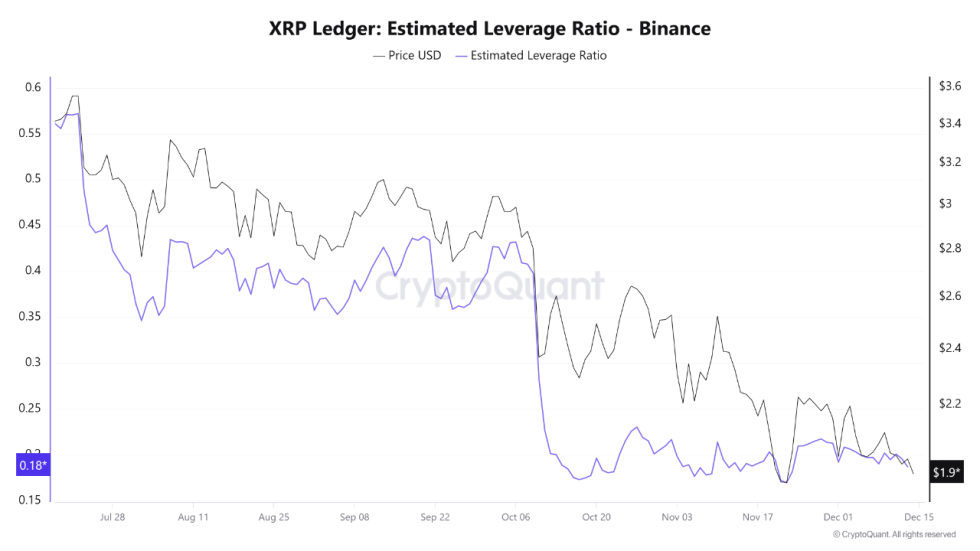
Therefore, the current low means that the token has moved into a de-risking phase, and traders are prioritizing reduced exposure over aggressive upside bets. This is in contrast to the performance of Spot XRP ETFs, which have been on a streak of inflows.
Futures Open Interest Collapses From July Highs
A similar story of crypto traders no longer betting big on XRP can be seen from the futures data from Coinglass.
Data from Coinglass figures show that Exchange XRP Futures Open Interest is currently around 1.81 billion XRP, which is worth approximately $3.47 billion. This number is notable because open interest was around $10.94 billion in July during the cryptocurrency’s march to a new all-time-high price of $3.65. Therefore, the 68% decline from $10.94 billion to $3.47 billion is a massive contraction in speculative participation across derivatives markets.
Open interest tracks the total value of outstanding futures contracts and is also a direct gauge of trader engagement, comparable to the estimated leverage ratio. Rising open interest alongside price strength usually confirms bullish trend momentum, while falling open interest shows traders are closing positions and fading appetite for futures contracts.
Interestingly, the decline seen in this metric since July indicates that traders have largely exited leveraged positions rather than rotating from longs to shorts.
A positive reflection from the combination of these two data points is that the token is no longer dominated by aggressive speculative flows, which lowers the risk of cascading liquidations, but it also removes a major source of bullish momentum for the cryptocurrency.
