Crypto Market Plunge Deepens as Senate Delays Landmark Regulatory Framework Bill

Capitol Hill's cold feet send a chill through digital asset markets.
The Regulatory Vacuum
Markets hate uncertainty more than they hate bad news. The Senate's decision to kick the can on a comprehensive crypto framework bill—something the industry has been begging for—created a perfect storm of regulatory limbo. It's not just a delay; it's a signal that clear rules of the road are still miles away. Traders and algorithms reacted to that signal with a collective sell order.
Liquidity Takes a Hike
When major legislative clarity gets postponed, institutional money gets nervous. The 'wait-and-see' capital—the kind that was tentatively eyeing entry points—pulls back to the sidelines. This sudden drop in buy-side liquidity amplifies any downward move, turning a pullback into a sharper correction. It's a classic case of the market pricing in prolonged ambiguity, with all the volatility that entails.
A Bullish Silver Lining?
Here's the contrarian take: this sell-off is fueled by political process, not a fundamental crack in crypto's thesis. The demand for a framework hasn't vanished; it's been deferred. Once a path forward eventually materializes, the pent-up institutional demand could unleash a ferocious rally. In the meantime, weak hands get shaken out, and strong hands accumulate—it's the oldest play in the book, just with a modern, digital wrapper. Sometimes you have to take a step back before the leap forward.
Delays from D.C. create discounts on-chain—a temporary disconnect that savvy investors live for. After all, Wall Street has built entire fortunes on buying when there's 'blood in the streets,' even if that blood is just bureaucratic red tape.
Senate Pushes Crypto Market Structure Talks Into 2026
The Senate Banking Committee confirmed it will not hold a markup hearing on the crypto market structure billbefore Congress adjourns for the holidays.
While committee leadership says bipartisan negotiations are progressing, lawmakers acknowledged that time has run out to MOVE the bill forward in 2025. Chairman Tim Scott’s office reiterated that discussions with Democratic counterparts are ongoing, with a markup now expected in early 2026.
The proposed legislation is designed to clarify how digital assets are regulated in the U.S., including defining the respective roles of the Securities and Exchange Commission and the Commodity Futures Trading Commission.
Under current drafts, the CFTC would oversee spot crypto markets, while securities laws would be more clearly applied to token issuers and intermediaries. Parallel efforts in the Senate Agriculture Committee, which also oversees the CFTC, have yet to reach a markup stage, further slowing the process.
Market Reaction Highlights Fragile Sentiment
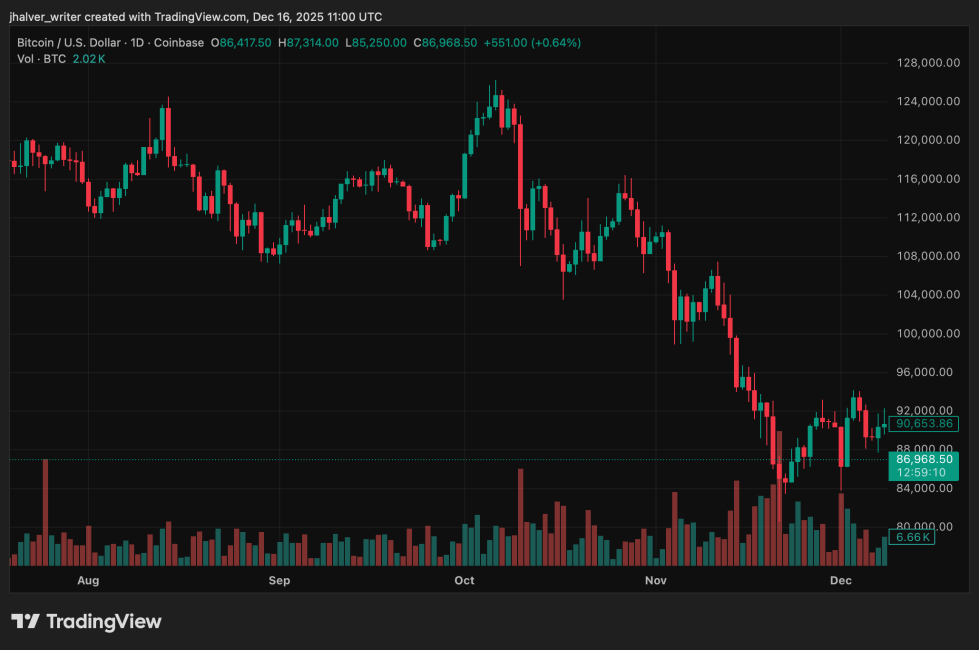
The legislative setback quickly translated into market pressure. Bitcoin fell from near $90,000 to the mid-$85,000 range, while ethereum dropped below $3,000. Additionally, the average crypto RSI fell to around 32, indicating that the market is within oversold territory.
Analysts pointed to elevated derivatives positioning and heavy open interest around key price levels as factors amplifying downside moves. Exchange-traded products reflected the shift, with Bitcoin and Ethereum spot ETFs recording significant outflows as institutional investors reduced exposure.
Some market observers noted that unrealized losses have risen sharply, while funding conditions and leverage remain stretched, making prices more vulnerable to negative catalysts such as policy delays.
Regulatory Uncertainty Persists Despite Agency ActionsDespite the legislative pause, regulators have continued to act within existing frameworks. The SEC has issued staff guidance and hosted public discussions on how current securities laws apply to crypto activities, while the CFTC has taken steps to expand supervised spot market participation.
However, industry participants say these measures fall short of the comprehensive clarity the market structure bill is meant to deliver.
Related Reading: Terra Founder Do Kwon Could Face 30-Year Sentence In Potential South Korean Trial
The Senate’s decision reinforces a familiar pattern for crypto markets: policy delays translating into heightened volatility. With negotiations set to resume in early 2026, investors will be left to navigate another extended period where regulatory questions remain unresolved.
Cover image from ChatGPT, BTCUSD chart on Tradingview
