Bitcoin Mining Takes 10% Hashrate Hit as China Shutdowns Ripple Through Network

China's latest regulatory crackdown just slashed Bitcoin's global computing power by a tenth. The network's backbone—its miners—are scrambling.
The Great Hashrate Migration 2.0
Remember 2021? This feels familiar, but different. Back then, an outright ban sent miners fleeing for Kazakhstan, Texas, and beyond. This time, it's targeted shutdowns—less noise, more precise impact. The result is the same: a double-digit percentage of the network's security muscle vanishes almost overnight.
Decentralization's Stress Test
A 10% hashrate drop isn't just a statistic. It's a live-fire drill for Bitcoin's core promise. Can the network truly absorb a major geopolitical shock without a hiccup? Transaction times might creep up. Fees could see a temporary spike. The protocol's difficulty adjustment will eventually kick in, but there's lag—and markets hate lag.
Short-Term Pain, Long-Term Gain?
Here's the bullish twist every crypto practitioner is whispering about. Major disruptions purge inefficient operators. The miners left standing are the ones with cheap, sustainable energy and agile operations. They get a bigger slice of the block reward pie. Network security, after the initial shock, often emerges leaner and more geographically dispersed. It's a brutal, Darwinian upgrade.
Meanwhile, traditional finance analysts will likely blame the next market wobble on this—conveniently ignoring the trillion-dollar bond market moves happening in the background. Some things never change.
The hash rate will recover. It always does. But each time it gets knocked down, it gets back up looking less like a concentrated industry and more like the unstoppable, decentralized network it was meant to be.
China Mining Instability
Based on reports, China remains a volatile source of hashrate. Before 2021, China supplied a majority of the network’s computing power. Now estimates place its share closer to 14% to 20% depending on the data provider.
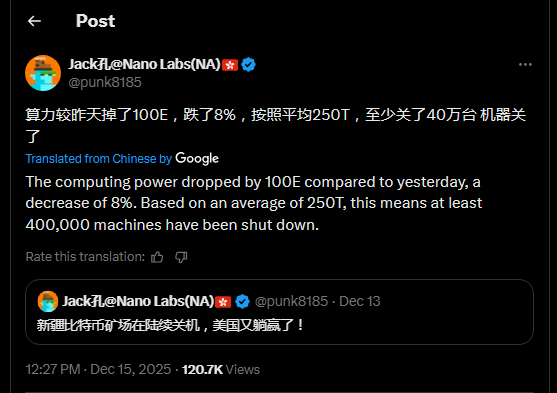
Cheap power has drawn miners back, but political and regulatory swings can push large clusters off the grid with little warning.
Kong framed the recent shutdowns bluntly, saying the temporary loss hands an advantage to other countries, adding that “the US wins without lifting a finger.”
Impact On Network
Data recorded the drop from 1,053 TH/s to about 943 TH/s, a decline of just over 110 TH/s and roughly 10%. That kind of MOVE can change mining conditions.
Blocks may be found a little slower until the next difficulty adjustment. The network’s total hashrate is always an estimate inferred from on-chain data, so exact figures are not precise, but the size of this swing is large enough to show how concentrated pockets of mining can still move global metrics.
Kong’s machine-count estimate — and the 250 TH/s-per-ASIC figure he used — are his calculations, not a confirmed inventory count from operators on the ground.
Bitcoin Mining Operations And Market ShiftsReports have disclosed that US mining companies are expanding capacity as global hashrate reallocates.

Hut 8 announced it is building four new mining sites in Texas, Louisiana and Illinois, adding 1.5 gigawatts of power capacity.
American Bitcoin, a company tied to the TRUMP family, is now part of that growth story; the firm acquired a fleet of 16,299 Antminer U3S21EXPH units from Bitmain and its board includes Eric Trump, the second-eldest of US President Donald Trump’s three sons. These moves underline a clear shift in where large-scale mining is happening.
Featured image from Unsplash, chart from TradingView
