Bitcoin Wholecoiners Retreat as Binance Inflows Dry Up – The Hidden Market Shift

Bitcoin's bedrock holders are quietly moving to the sidelines. A notable pullback from wholecoin wallets coincides with a sharp contraction in exchange inflows—particularly to Binance. This tandem shift signals a deeper change in investor posture, one that's more about strategic repositioning than panic selling.
The Whale Watch
Wholecoiners—investors holding at least one full Bitcoin—aren't dumping. They're simply not adding at the same pace. This cohort's behavior often acts as a leading indicator, separating speculative froth from genuine accumulation. Their current hesitation suggests a market catching its breath, evaluating the terrain after the last rally.
Exchange Liquidity Evaporates
Simultaneously, the pipeline of fresh Bitcoin into major exchanges is narrowing. Shrinking inflows typically precede a supply squeeze. When fewer coins are available for quick sale, even modest buying pressure can amplify price moves. It's a classic setup where scarcity, not just sentiment, starts to drive value.
The Custody Calculus
This isn't mere profit-taking. The data points toward a deliberate shift from hot wallets to cold storage. Investors are opting for self-custody, effectively locking away liquid supply. It's a vote of long-term confidence disguised as short-term inactivity—a move that would give any traditional finance bean-counter heartburn, obsessed as they are with quarterly turnover.
What's really driving it? A maturing market learning to hold through noise. While Wall Street frets over daily ticks, crypto's core is playing a different game—one where patience is the ultimate edge over the frantic churn of traditional markets.
Binance Sees Sharp Drop In BTC Wholecoiner Inflows
While the price of Bitcoin pulls back this new week, there is one key metric that is currently standing out. This metric is the BTC Wholecoiners Inflows on Binance, which is starting to tell a different story about investors on the largest cryptocurrency exchange in the world.
After examining this metric, Darkfost, a market analyst and author at CryptoQuant, revealed that on the Binance platform, wholecoiner deposits are drying up. Specifically, wholecoiner inflows imply transactions larger than 1 BTC, which provides vital insight into both current selling pressure and the broader evolution of the market.
Data shows that the inflows from this cohort are declining when compared to past years. Presently, BTC’s yearly average now sits around 6,500 BTC, representing a level not seen since 2018. Meanwhile, on the shorter time frame, the weekly average is situated NEAR 5,200 BTC, marking one of its lowest readings of this cycle.
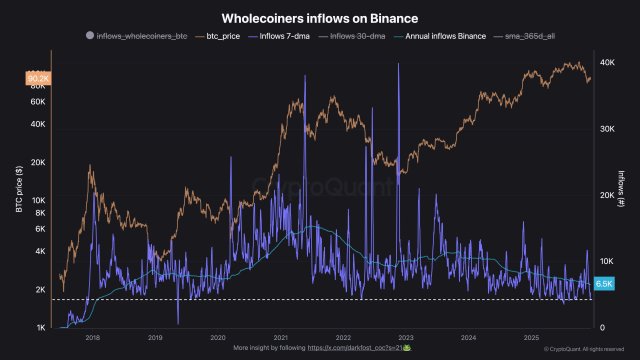
While the wholecoiner inflows dry up, the pattern that inflows have followed this cycle in comparison to previous ones is very intriguing. Even as Bitcoin continued to rise, wholecoiner inflows to Binance have steadily decreased rather than rising as they once did.
Beyond indicating that investors with sizable bitcoin holdings are less inclined to sell, this trend could also point to a deeper structural shift in the market. With Bitcoin’s valuation experiencing a steady increase, owning a full BTC has become extremely difficult, which naturally decreases the total number of transactions larger than 1 BTC.
At the same time, Darkfost highlighted that there are now more options available in the ecosystem for owning or trading Bitcoin. Even crypto exchanges have multiplied, and the steady growth of Decentralized Finance (DeFi) provides more venues, a trend that is likely to redirect flows that previously went nearly exclusively to major exchanges such as Binance.
BTC Still Trading Below Short-Term Cost Basis
Bitcoin is still trading below the Short-Term Holder Cost Basis located at $105,400. What this means is that the crypto king has been trading below the level for nearly 2 months now. However, Darkfost stated that staying beneath the level for such an extended period is not uncommon.
During previous corrections, the duration of these phases has ranged from two months to over four months, making the present correction fall well within a typical range. However, since this indication tends to stay negative for much longer after the market actually enters a bear phase, it WOULD be crucial to prevent Bitcoin from declining any further.
In the meantime, this does not invalidate the notion that these periods remain a signal for accumulation opportunities. Nevertheless, caution is still crucial, and access points should be carefully optimized. Darkfost believes that an accumulation of this type is only appropriate for long-term investors.
