Billion-Dollar Manager Bets Big on XRP: Here’s What the Smart Money Is Really Doing

Forget the noise—the real money just placed its cards on the table. A major asset manager, overseeing billions, has confirmed a massive position in XRP, signaling where institutional confidence is flowing.
The Smart Money Playbook
This isn't retail FOMO. The move mirrors a quiet accumulation trend among sophisticated investors who've been positioning ahead of the herd. They're not reading tweets; they're analyzing settlement layers and regulatory pathways.
Why XRP, Why Now?
The asset cuts through traditional finance's sluggishness. It bypasses correspondent banking tangles and offers a bridge currency for institutions moving value across borders—something legacy systems still treat like a multi-day odyssey. The recent clarity (or lack of catastrophic opposition) from regulators has apparently been read as a green light, or at least a yellow one, by funds with real firepower.
A Cynical Nod to Finance
It's the ultimate finance irony: the same industry that once scoffed at 'internet money' now quietly allocates to the token promising to streamline its own most profitable inefficiencies. The fees they stand to displace are the very fees they've collected for decades.
The bottom line? When a billion-dollar fund moves, it's not a speculative bet—it's a calculated deployment. They're not betting on hype; they're betting on infrastructure. And right now, their ledger says XRP.
XRP Dominates Institutional Inflows Across Europe And The Globe
According to an X post by crypto expert Stern Drew, the latest WisdomTree report shows that XRP is the only digital asset attracting consistent institutional demand worldwide. In Europe, XRP has attracted over $549 million in new institutional capital this year, more than three times the inflows into Ethereum. This figure surpasses the total for every altcoin in the market and multi-asset products except Bitcoin.
In a continent traditionally known for conservative investment strategies, these flows into XRP represent a decisive vote of confidence from European institutional investors. Drew has revealed that the demand for XRP has also extended beyond Europe. Outside the United States, XRP has captured roughly $252 million in fresh institutional capital just this year.
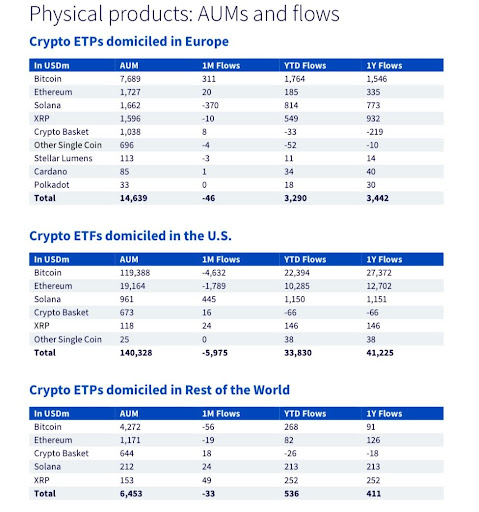
By comparison, Bitcoin products absorbed only $268 million in smart money capital. Given that BTC products are more than 25 times the size of XRP products, this suggests that institutions have directed nearly 25 times more new capital into XRP than into Bitcoin. Drew has suggested that this increase in flows indicates careful, deliberate positioning rather than short-term speculative activity, which highlights the market’s growing preference for XRP.
US Adoption Signals Broader Shift
In his post, Drew also revealed the growing institutional interest in XRP within the US. This year, a new synthetic XRP product attracted $241 million, surpassing flows into Solana and all other altcoin products in the same category. This surge came at a time when the two largest cryptocurrencies, bitcoin and Ethereum, collectively saw $6.4 billion exit their ETF structures.
Drew revealed that the dramatic outflows from BTC and ETH signaled that institutional investors were diversifying from established assets while selectively accumulating XRP. The WisdomTree report also showed that, excluding Europe and the US, regions such as Asia and other global markets are increasing their exposure to XRP.
Surprisingly, this surge in global institutional demand is occurring during periods of market stress rather than euphoric rallies. The XRP price is currently down by more than 15% this year and trading at just $2.1. The cryptocurrency has also been experiencing significant choppy action over the past few months, failing to reclaim former highs above $3.
Despite this structural weakness, institutions continue to accumulate XRP in large quantities, indicating a clear bias toward the cryptocurrency. Drew has also revealed that smart money views XRP as a settlement-grade asset, well-suited for integration into the future architecture of regulated digital finance. He highlights that, as global institutional preference increasingly concentrates on XRP, price movements might follow later.
