XRP Makes History: Listed Japanese Company Adopts It as Treasury Asset – A First Of Its Kind

A Tokyo-listed firm just rewrote the corporate playbook. Forget cash reserves or gold—its balance sheet now holds XRP.
The Regulatory Green Light
This isn't a speculative punt from a crypto startup. It's a deliberate treasury strategy by an established, publicly-traded entity navigating Japan's strict Financial Services Agency (FSA) framework. The move signals a seismic shift in how institutional assets are defined.
Why XRP Cuts Through the Noise
Amid a sea of thousands of digital assets, the company's choice wasn't random. XRP's architecture—built for settlement speed and minimal cost—bypasses the traditional financial plumbing that bogs down cross-border transactions. It offers a liquidity profile distinct from both volatile cryptocurrencies and stagnant fiat holdings.
The Ripple Effect for Corporate Finance
Watch one boardroom's decision send shockwaves through others. This adoption creates a tangible, auditable precedent. It pressures CFOs globally to justify why their treasury isn't exploring digital asset diversification, especially for firms with international exposure. Expect analysts to start adding 'crypto holdings' to their standard valuation checklists.
Finance's New Reality Check
While traditionalists scoff at 'internet money,' a public company just bet a portion of its sovereign financial health on it. This legitimizes crypto as a strategic reserve asset, not just a trading sardine for retail speculators. It proves regulatory hurdles are navigable, not insurmountable.
One cynical finance jab? This probably happened faster than getting approval for a new corporate credit card policy.
The bottom line: A major barrier has fallen. The question is no longer if blue-chip companies will hold digital assets, but which one follows next—and how long before the laggards look hopelessly archaic.
Japan-Listed Firm Goes Crypto With XRP Treasury
As a leading asset in the cryptocurrency and financial landscape, XRP is making notable inroads into the Asian region. A publicly traded corporation in Japan has chosen to include the token directly on its balance sheet, causing a new uproar in the country’s corporate sector.
Specifically, this move, which has sent ripples throughout the community, is being carried out by AltPlus, a company that focuses on the design, creation, and running of mobile and social games. The Japanese company has decided to engage with the altcoin by including it in its official treasury strategy, bolstering the XRP Treasury initiative.
In the report shared by BankXRP, a crypto and DeFi enthusiast, outlined that the token is now officially part of the corporate strategy of AltPlus, marking its shift into the ever-evolving cryptocurrency landscape. This MOVE reflects an act of conviction among institutional investors in an environment where the majority of corporations still keep a wary eye on digital assets.
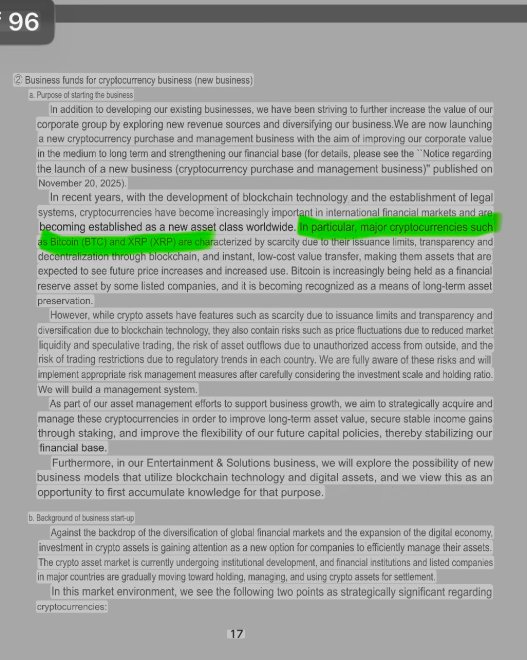
According to the pundit, the move was revealed in the company’s new shareholder filing. This new document confirms that the firm will purchase and hold XRP alongside Bitcoin, the flagship cryptocurrency, as a strategic asset. AltPlus aims at acquiring value in the long run, diversification, and staking-based income.
The filing details a complete transition of AltPlus into digital assets as the company expands into crypto operations. In this way, the firm is improving its balance sheet and navigating Web3 connections across its gaming and Internet Protocol (IP) ecosystem.
A Huge Wave Of Capital Flowing Into The Asset
While the crypto market is slowly recovering, several major assets witnessed a massive wave of capital, with XRP being among the leaders in inflows. A significant inflow into the altcoin reflects the growing conviction among retail and institutional investors.
Data from CoinShares disclosed by Coin Bureau on X shows that the altcoin pulled in capital worth $289 million in a week, which marks one of its biggest yet. The large inflow coincides with an improvement in investors’ sentiment toward the token, driven by strategic advancements in the larger ecosystem and expanding usefulness throughout international payment corridors.
Meanwhile, the total net inflows for digital asset Exchange-Traded Funds (ETFs) recorded in a week were more than $1 billion, signaling intensifying market interest. As more liquidity pours into digital assets, on-chain activity and market depth seem to be rising dramatically.
