Sony Bank’s Game-Changer: Stablecoin Launch Targets Anime & Gaming Payments

Sony Bank just dropped a bombshell—it's building a stablecoin designed for the anime and gaming worlds. This isn't just another digital token; it's a direct play for the wallets of millions of fans and players.
The Play for Payments
Forget clunky credit card fees and slow cross-border transfers. Sony's stablecoin aims to slash transaction friction, letting users pay for in-game items, digital collectibles, and subscription services with the speed of crypto and the stability of traditional currency. It bypasses the old financial plumbing entirely.
Why This Cuts Through the Noise
While other banks dabble in blockchain theory, Sony is targeting a ready-made, digital-native economy. The move signals a major institution betting that the future of entertainment payments is on-chain—a stark contrast to the usual corporate 'crypto research' that goes nowhere.
A Provocative Edge for Finance
If successful, this could funnel billions in micro-transactions through Sony's own ecosystem, creating a closed-loop financial network. It's a masterclass in vertical integration, turning every game download and anime stream into a potential financial touchpoint. Let's see if it works better than their last attempt to revolutionize a wallet—looking at you, Betamax.
Sony Bank To Issue Stablecoin As New Payment Method For Games & Anime
As reported by Nikkei Asia, Sony Bank could issue a stablecoin pegged to the US Dollar as early as fiscal year 2026. Sony Bank, a subsidiary of Sony Financial Holdings, is one of the largest online banks in Japan. It applied for a banking license in the US back in October.
The bank’s parent company went public in September and spun off into its own entity separate from Sony Group. The firm, however, is continuing to support the group’s business developments. The stablecoin project is one such avenue, as Sony Group envisions that the USD-pegged token will be used by customers to pay for content like games and anime in its ecosystem.
Sony Group is a well-known name around the world, controlling multiple large media-related businesses like Sony Interactive Entertainment, the company behind the PlayStation, and Sony Pictures Entertainment, a filmmaker.
In the fiscal year that ended in March 2025, US customers made up 30% of the group’s overall sales to external customers. With Sony Bank’s stablecoin, the multinational conglomerate is now hoping these users can start paying in the ecosystem with digital assets, cutting back on the transaction fees paid to credit card companies.
The bank has formed a partnership with Bastion, an American stablecoin infrastructure solutions provider, to help with the project. “The bank plans to establish a subsidiary to handle its stablecoin business,” noted Nikkei.
The move from Sony comes a few months after President Donald TRUMP signed the GENIUS Act, establishing a regulatory framework for stablecoins in the US. These cryptocurrencies have also been gaining momentum in other parts of the world recently. Hong Kong launched its stablecoin legislation in August and plans on handing out issuer licenses next year. Japan saw the launch of its first yen-backed coin in October.
Major European banks have come together to FORM a consortium to launch a euro-pegged stablecoin, aiming a rollout in the second half of 2026 in a bid to challenge the currently USD-dominated market. Over the past year, the fiat-tied cryptocurrencies have enjoyed some sharp growth, but in the last month, they have suffered a slowdown as part of the downturn in the digital assets sector as a whole.
Below is a chart from DeFiLlama that shows how the market cap of the stablecoins has changed over the last several years.
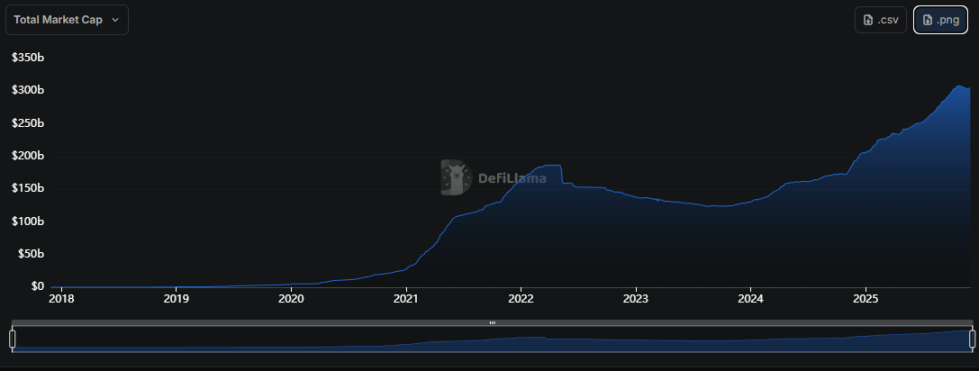
The stablecoin market cap set a new record of $309 billion in late-October. Since then, the metric has seen a small decline to $306 billion. USDT and USDC, the two largest tokens in the space, alone account for about $261 billion of this figure.
Bitcoin Price
At the time of writing, Bitcoin is trading around $86,700, down nearly 6% over the last 24 hours.
