Bitcoin Under Siege: Mass Liquidations Trigger Accelerated Sell-Off

Liquidation cascades are hammering the flagship cryptocurrency, turning a correction into a steeper rout.
The Domino Effect
When leveraged positions get forcibly closed, they don't just vanish—they create fresh selling pressure. That pressure triggers more liquidations, and the cycle feeds on itself. It's a classic, brutal mechanism in crypto markets where high leverage meets high volatility.
Beyond the Price Chart
The real story isn't just the falling number on the screen. It's about market structure stress. Funding rates, open interest, and exchange flows all tell a tale of a market rapidly deleveraging. Traders chasing yield with 10x or 20x leverage discover, yet again, that gravity still works.
A Necessary Purge?
Every major bull run has been punctuated by these violent shakeouts. They flush out weak hands, reset overextended derivatives, and—for those with dry powder—create potential entry points. It's the market's ruthless way of transferring assets from the impatient to the patient.
For now, the machines are in control. Algorithmic liquidations don't care about fundamentals, narratives, or your favorite influencer's price prediction. They just execute. It's a stark reminder that in crypto, you're not just trading an asset; you're navigating a system of interconnected risks where one margin call can echo across the entire ecosystem. Consider it a very expensive lesson in risk management, courtesy of the free market—or as Wall Street veterans might call it, just another Tuesday.
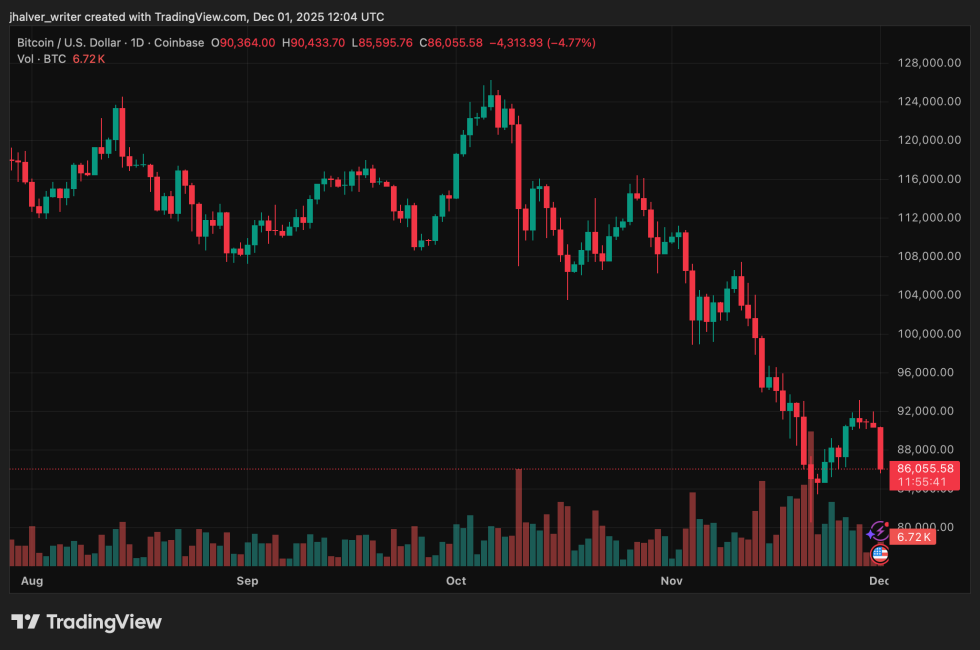
Liquidation Wave Accelerates Downtrend
Data from multiple exchanges shows that more than $640 million worth of leveraged positions were wiped out within 24 hours, triggering a sharp breakdown below Bitcoin’s recent trading channel.
The pullback followed a breach of a major liquidation cluster under the $90,000 level, which rapidly thinned liquidity and intensified the MOVE toward the mid-$80,000 region.
On the charts, Bitcoin lost short-term structural support after falling below the lower boundary of its ascending channel. Indicators such as the Chaikin Money Flow (CMF) and the monthly MACD have weakened, with the latter printing a bearish crossover historically associated with extended downturns.
Analysts say support now lies around $84,500–$84,800, with deeper levels NEAR $82,000 and $80,500 if selling pressure continues.
Altcoins reflected the volatility, with Ethereum dropping to around $2,800 while Solana, XRP, Binance Coin, and Dogecoin recorded losses between 5% and 7%. The total crypto market cap declined by nearly 5% to $2.95 trillion.
Bitcoin ETF Outflows and Macro Signals Add Pressure
The correction comes as bitcoin spot ETFs recorded significant outflows through November. The month saw about $3.5 billion leave Bitcoin ETF products, with major issuers facing sizeable withdrawals.
Analysts attribute the trend to portfolio rebalancing and profit-taking, rather than a broad exit from digital assets; however, the timing has added pressure to an already fragile market.
Global macro developments have also shaped sentiment. The Bank of Japan is signaling a possible rate hike in December, contributing to volatility across risk assets.
In the US, traders are awaiting new guidance from the Federal Reserve after the end of Quantitative Tightening. A shift toward easier policy could help stabilize liquidity conditions, but uncertainty remains ahead of upcoming FOMC communications.
Market Awaits Fed Direction as Key Levels HoldDespite the downside momentum, some analysts argue that the broader cycle remains intact, calling the current pullback a shakeout rather than the start of a prolonged bear phase.
For now, BTC’s ability to hold the $86,000–$87,000 zone will be closely watched. A recovery above $89,000 could ease immediate pressure, while a break below support may open the path toward the low-$80,000 range.
Cover image from ChatGPT, BTCUSD chart from Tradingview
