Ethereum’s Core Chain Ignites: Mainnet Usage Shatters All-Time Highs

Ethereum's mainnet isn't just busy—it's on fire. Network activity has surged past every previous peak, signaling a fundamental shift in how value moves across the digital landscape.
The Engine Is Redlining
Forget gradual growth. This isn't a gentle uptick in transactions; it's a full-throttle demand spike that's pushing the core protocol to its limits. Every metric that matters—from gas fees to daily active addresses—tells the same story: the world's premier smart contract platform is handling more real economic activity than ever before.
What's Fueling the Frenzy?
The surge isn't coming from one place. It's a convergence. DeFi protocols are processing more volume, NFT marketplaces are buzzing with new collections, and institutional settlement layers are finally going live. The 'world computer' narrative is transitioning from theoretical to operational, and the network is feeling the strain—and the validation.
A Network Under Pressure (And Why That's Good)
High usage creates high fees, a pain point that's ironically a sign of robust health. It proves there's something worth paying for. This congestion is the ultimate stress test, highlighting the urgent need for—and proving the value of—ongoing scalability upgrades. It's the market voting with its wallet, even if that vote costs a small fortune in gas.
While traditional finance wrestles with legacy systems and quarterly reports, Ethereum's ledger keeps cutting settlements in seconds, bypassing gatekeepers, and quietly building the open financial infrastructure of tomorrow. The numbers don't lie, even if your broker still does.
Historic Lift-Off For Ethereum Mainnet Utilization
Ethereum is undergoing a shift in network adoption. In a significant landmark that cements its dominance, the Ethereum Maninnet usage has increased to the point where it feels more like a structural awakening than regular growth.
Leon Waidmann, the founder of On-Chain Foundation and market expert, reported that the ETH mainnet’s utilization is currently at an all-time high. This kind of spike in network traffic may indicate the return of activity from the periphery to the center of the chain, new applications, or even a resurgence of trust in the network’s long-term prospects.
Data shared by the market expert shows the network’s usage in the past 30 days ROSE to 1.97mags/s, marking its highest level in history. The chart reveals that the rise to a new peak represents a more than 57% increase in Year-Over-Year (YoY), indicating that ETH is moving with intent once again.
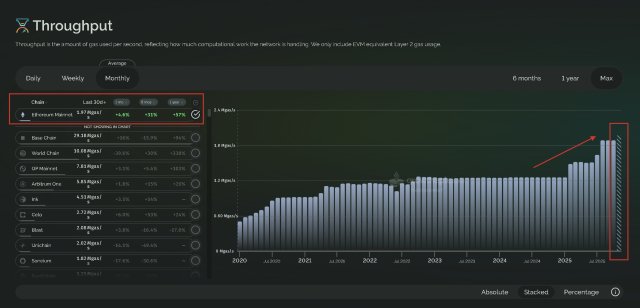
While weak network effects and parasitic LAYER 2s are being debated within the community, Waidmann highlighted that the Ethereum Mainnet continues to display strong growth and strength. This robust growth is evidenced by the increase in activity, spiking gas fees, and the surge in the number of ETH being burned.
By combining these key factors about the network, Waidmann claims that ETH could attract more economic load. As a result, the leading altcoin may gradually shed its old skin and take on a more rigid financial function.
Waidmann has declared that ETH could become harder money and a settlement collateral. As a result, ETH is starting to resemble the foundation of a future financial structure rather than just a utility token.
ETH Layer 2s Dominates Network’s Transactions
In the midst of surging network activity and adoption, Ethereum layer 2s are now dominating in terms of transactions at a speed that makes the base layer feel nearly slow in contrast. While the center might still hold, the edges are undeniably where users’ action currently resides.
Last week, Waidmann noted that the total Transaction Per Second (TPS) across the Ethereum network reached over 358.21. Meanwhile, a more significant portion of these transactions was carried out on layer 2 networks. According to the data shared by the on-chain Foundation founder, layer 2s controlled over 95.2% of the overall throughput.
Such a development implies that execution has largely moved to the layer 2 chains. A major reason for this might be that users, liquidity, and developers are looking for quicker and less expensive channels to carry out transactions, transforming ETH’s scaling stack into the ecosystem’s actual heartbeat.
