Wall Street Embraces Stellar: U.S. Bancorp Partnership Ignites XLM’s Next Bull Run

Traditional finance giants are finally waking up to blockchain's potential—and Stellar's getting the institutional nod.
The Banking Breakthrough
U.S. Bancorp's strategic move onto the Stellar network signals a seismic shift. No longer just crypto-native projects—mainstream financial institutions are building on decentralized infrastructure. The partnership validates XLM's real-world utility beyond speculative trading.
Market Momentum Builds
Trading volumes spike as institutional money flows in. Price action suggests this isn't another retail-driven pump—the charts show sustained accumulation patterns typical of professional investors. Liquidity depth improves dramatically across major exchanges.
The Regulatory Dance
Bancorp's compliance-first approach demonstrates how traditional finance can navigate crypto waters without triggering regulatory alarms. They're playing the long game—unlike some meme coin projects that treat regulations as optional suggestions.
Wall Street's embrace brings credibility, but remember—these are the same institutions that once called crypto a fraud. Now they're building the infrastructure to profit from it. The irony's thicker than a blockchain ledger.
U.S. Bancorp Selects Stellar for Bank-Grade Stablecoin Infrastructure
The Minneapolis-based banking giant has partnered with PwC and the Stellar Development Foundation (SDF) to test programmable deposits and stablecoin payments on Stellar’s public blockchain.
What sets Stellar apart, according to U.S. Bank’s digital assets head Mike Villano, is its built-in ability to freeze assets, unwind transactions, and enforce compliance at the protocol level.
These capabilities are essential for regulated banks that must adhere to KYC, AML, and consumer protection standards. Unlike traditional “business logic” solutions, Stellar offers these controls directly at the blockchain layer, giving banks the confidence needed to explore tokenized finance.
The pilot arrives amid a resurgence of institutional interest. Banks, including Citi, Goldman Sachs, and Bank of America, have begun designing stablecoin frameworks. U.S. Bank recently relaunched its digital assets division to tap into opportunities in custody, tokenisation, and blockchain-based payments.
Institutional Momentum Could Drive Mainstream Stablecoin Adoption
If successful, U.S. Bancorp’s trial could pave the way for fully regulated, deposit-backed stablecoins issued directly by banks, unlocking new efficiencies for cross-border transfers, treasury operations, and global settlements.
With projections suggesting that stablecoin payments could reach $1 trillion annually by 2030, banks are racing to claim their share of the digital payments market.
Stellar’s high uptime, low-cost settlement, and remittance-focused architecture make it an appealing choice for real-world financial applications. As institutions embrace public blockchains, Stellar stands positioned as one of the few networks offering both decentralization and the regulatory controls banks require.
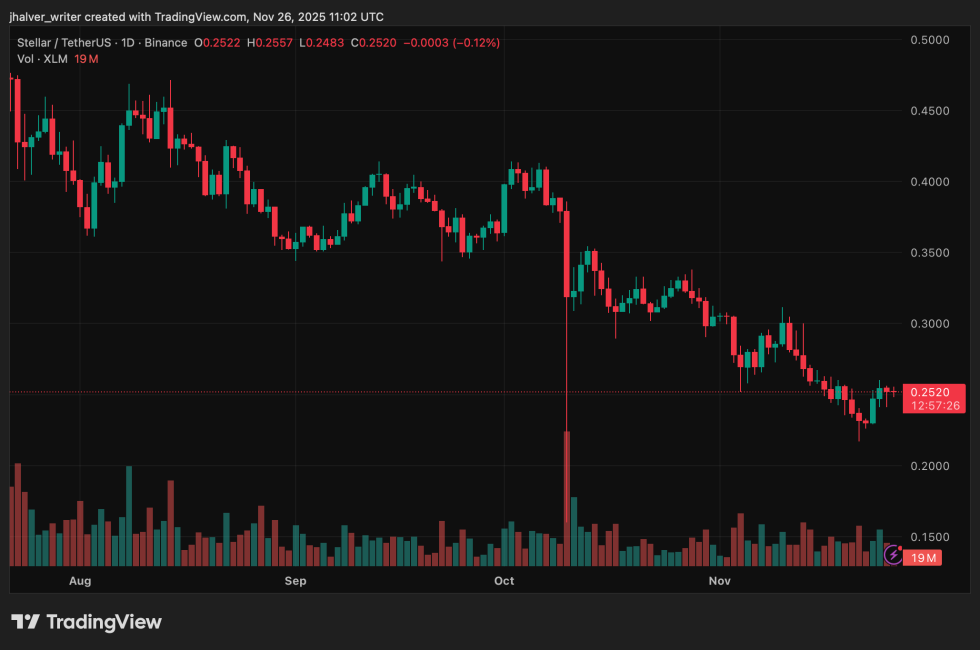
XLM Price Outlook: Analyst Targets Signal 24–36% UpsideThe U.S. Bancorp announcement has arrived at a pivotal time for Stellar’s native token, XLM. Trading NEAR $0.25, the asset is showing early signs of bullish momentum, supported by:
- MACD bullish divergence
- Neutral RSI at 42, offering room to climb
- Price sitting on 20-EMA support
- Breakout potential above $0.28–$0.31
Analysts expect XLM to target the $0.31–$0.34 range within the next 2–4 weeks, a potential 24–36% upside, if volume expands and the broader crypto market remains stable. A break below $0.22 would invalidate the bullish thesis.
Related Reading: South Korea Risks Stablecoin Legislation Delay As Financial Authorities Clash With BOK
As Wall Street experiments with Stellar’s blockchain, institutional utility could become a significant driver for XLM’s long-term valuation. With new banking-grade use cases emerging, Stellar’s relevance in the digital-asset ecosystem continues to grow, positioning XLM for potential year-end strength.
Cover image from ChatGPT, XLMUSD chart from Tradingview
