Stablecoin Supply Shrinks as Bitcoin Soars Past $105K: Is Liquidity Drying Up?

Stablecoins are bleeding supply just as Bitcoin punches through $105K—classic 'risk-on' behavior or a warning sign for liquidity?
Market watchers note the inverse correlation: When BTC rallies, stablecoin reserves often contract as traders rotate into volatile assets. This time feels different though—Tether's market cap dropped 3% in November alone.
Key question: Are we seeing organic demand for Bitcoin, or just leveraged players recycling dwindling stablecoin liquidity into perpetual swaps? (Spoiler: Wall Street analysts will claim it's 'institutional adoption' either way.)
One cynical take: The 'stablecoin yield complex' always unravels when BTC gets exciting—like hedge funds selling money-market holdings to YOLO on meme stocks.
Stablecoin Contraction Signals Caution — or Capital Rotation?
According to top analyst Maartunn, data from CryptoQuant shows a notable shift in market liquidity conditions. His chart comparing USDT Market Cap Change with Bitcoin’s price reveals that after several months of consistent expansion, the total stablecoin market capitalization is now trending downward. Historically, such a contraction has often acted as an early warning sign of cooling liquidity in the crypto market — meaning less fresh capital is entering the ecosystem.

Stablecoins, particularly USDT, play a crucial role in fueling market momentum. When their supply grows, it typically reflects increased buying power and capital inflows. Conversely, a shrinking supply can indicate a pause in demand or a period of risk aversion among investors. This decline could therefore be interpreted as a sign that traders are pulling liquidity out of the system, potentially reducing Bitcoin’s short-term upside potential.
However, several analysts argue that this recent trend may not signal weakness but rather capital rotation. As Bitcoin stabilizes above $100,000 and altcoins show renewed volatility, part of the stablecoin supply might be moving into risk assets like ethereum or emerging DeFi plays instead of exiting the market entirely.
If this interpretation holds true, the drop in stablecoin supply may simply mark a transition phase, where capital flows shift within the ecosystem rather than retreating from it. This dynamic WOULD support a more neutral outlook — suggesting that liquidity is being redistributed rather than disappearing.
Bitcoin Eyes Recovery but Faces Key Resistance Levels
Bitcoin (BTC) has managed to recover from last week’s steep decline, with price action stabilizing above $105,000 after dipping below the critical $100,000 level. As seen in the chart, BTC has formed a short-term reversal structure, bouncing from a local low NEAR $98,000 and showing signs of renewed buying pressure. This recovery, however, still faces a cluster of resistance levels between $108,000 and $112,000, where previous rallies have repeatedly stalled.
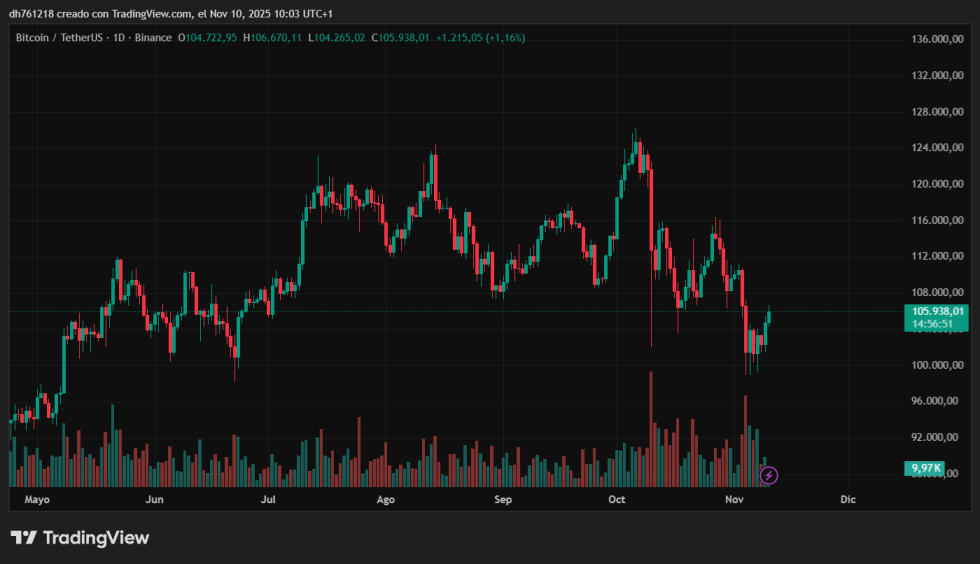
Trading volume has increased moderately during the rebound, indicating that some capital is flowing back into the market — though not yet at levels suggesting strong conviction. The market remains cautious, with traders watching to see if Bitcoin can reclaim the 50-day moving average, which currently acts as dynamic resistance around $110,000.
If BTC breaks and consolidates above that zone, it could trigger a more meaningful recovery toward $117,000–$120,000. However, failure to maintain momentum may lead to another retest of support near $100,000.
Featured image from ChatGPT, chart from TradingView.com
