Bitcoin Miners Breathe Easy: 7-Straight Difficulty Jumps Finally Break - What’s Next?

Bitcoin's relentless mining difficulty climb hits the brakes—and miners couldn't be happier.
The relief is palpable across mining operations worldwide as the network's adjustment mechanism finally cuts operators some slack. Seven consecutive increases had pushed hardware to its limits, squeezing profit margins thinner than a trader's patience during a sideways market.
Why This Adjustment Matters
Network difficulty serves as Bitcoin's built-in thermostat—automatically adjusting to maintain consistent block times regardless of how much mining power comes online. Those seven straight jumps represented unprecedented computational growth, forcing miners to upgrade equipment or face getting squeezed out entirely.
Now the pressure valve releases. Mining operations can finally catch their breath without immediately racing to deploy next-generation hardware. The break comes just in time for smaller players who were watching their electricity bills outperform their Bitcoin yields.
What Comes Next for Mining Economics
The pause doesn't mean the race is over—just that everyone gets to run the next lap with the same shoes. Miners will use this breathing room to reassess operations, optimize efficiency, and prepare for the next difficulty adjustment cycle.
Smart operations are already calculating how long this respite might last. Because in crypto mining, today's relief is just tomorrow's preparation for the next squeeze—kind of like traditional finance, except the numbers actually mean something.
Bitcoin Mining Difficulty Is Expected To Go Down Over 3%
According to data from CoinWarz, the Bitcoin Difficulty is expected to see a decline in the upcoming network adjustment. The “Difficulty” here refers to a metric built into the BTC blockchain that controls how hard miners would find it to mine a block on the network.
Its value is entirely controlled by the code Satoshi wrote, meaning no third party has any say on how the Difficulty will change. The BTC creator established one simple rule for the chain to follow: the block production rate (that is, the speed at which miners are performing their task) should remain constant at 10 minutes per block.
Whenever miners mine faster than this speed, the network responds by raising the Difficulty to slow the validators back down to the standard rate. Similarly, it lowers the metric instead if miners are having a hard time meeting the quota.
The network makes these changes in biweekly events known as adjustments. The next adjustment is set to occur on Thursday, October 16th. Miners have been slower than the chain needs since the last adjustment, so the Difficulty will go up tomorrow.
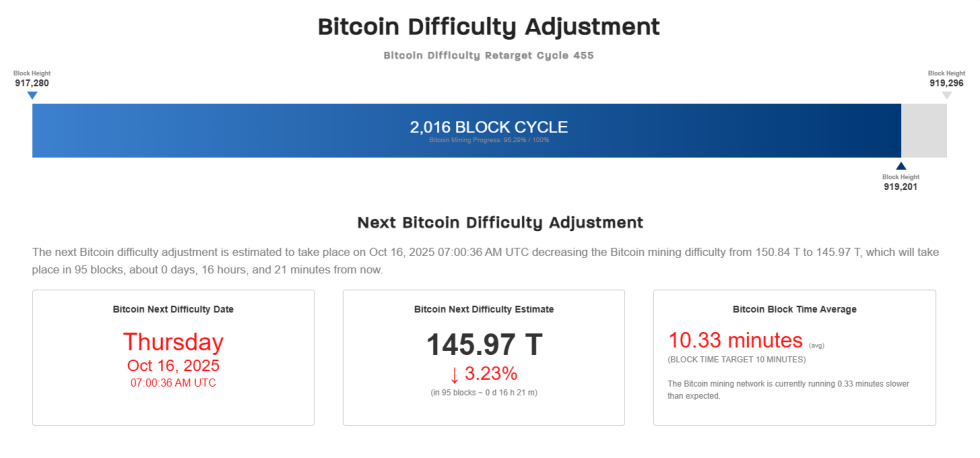
As is visible above, miners have produced a block at an average interval of 10.33 minutes in the last two weeks, which is 0.33 minutes slower than the standard block time. To correct for this, the network is estimated to drop its Difficulty by around 3.2%.
While this decrease isn’t too big, the fact that the indicator is reversing course is still notable, as the last seven adjustments all led to an increase in its value. The below chart shows how the metric’s value has changed during the last six months.
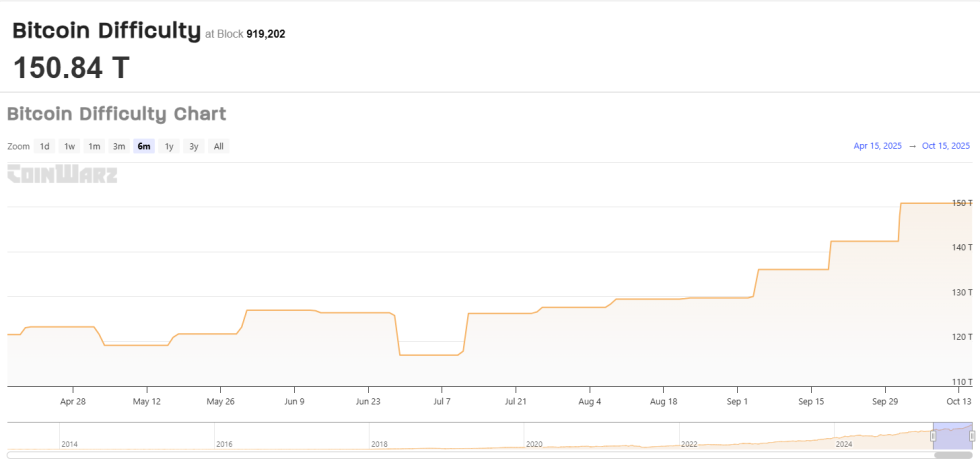
From the graph, it’s apparent that not only has the bitcoin Difficulty been climbing recently, the last six adjustments have in fact resulted in a new all-time high (ATH).
Whenever the metric rises, things become economically tougher for the miners. This is because these validators earn the majority of their income through the block subsidy, which they only receive when they add the next block to the chain. Since the Difficulty ensures block time doesn’t diverge too much from 10 minutes, miners still earn the same even if they add more computing resources.
Whenever new players join the space, Difficulty usually pushes up to compensate for the speed increase that comes with extra power, thus making it so that the same reward has to now be fought over by a larger pool of miners.
Considering this context, the upcoming drop in the Bitcoin Difficulty will be a welcome relief for the miners.
BTC Price
At the time of writing, Bitcoin is trading around $110,400, down more than 9% over the last week.
