US and China Exploit Europeans’ Personal Data — Can Blockchain Really Stop Them?

Your data's being laundered across borders—and traditional safeguards aren't cutting it.
Transatlantic Data Heist
American tech giants and Chinese surveillance firms treat European privacy laws like mild suggestions. They bypass consent requirements, ignore deletion requests, and monetize personal information with impunity. GDPR fines become just another cost of doing business—cheaper than actually complying.
Blockchain's Promise
Immutable audit trails could change everything. Distributed ledger technology creates tamper-proof records of every data transaction. Smart contracts automatically enforce privacy preferences—no middlemen, no loopholes. Users finally gain real ownership over their digital identities.
Finance's Cynical Take
Wall Street would probably try to securitize data privacy tokens—because if there's value to be extracted, you can bet someone's building a leveraged derivative around it.
The Verdict
Blockchain doesn't just add another layer of compliance—it rewrites the rules entirely. The question isn't whether the technology works, but whether governments and corporations will actually let it disrupt their lucrative data trafficking operations.
Digital Privacy Violations In Europe
Since its earliest days, the crypto community has had a strong interest in digital privacy. Bitcoin was created to be trustless, anonymous, and decentralized, after all.
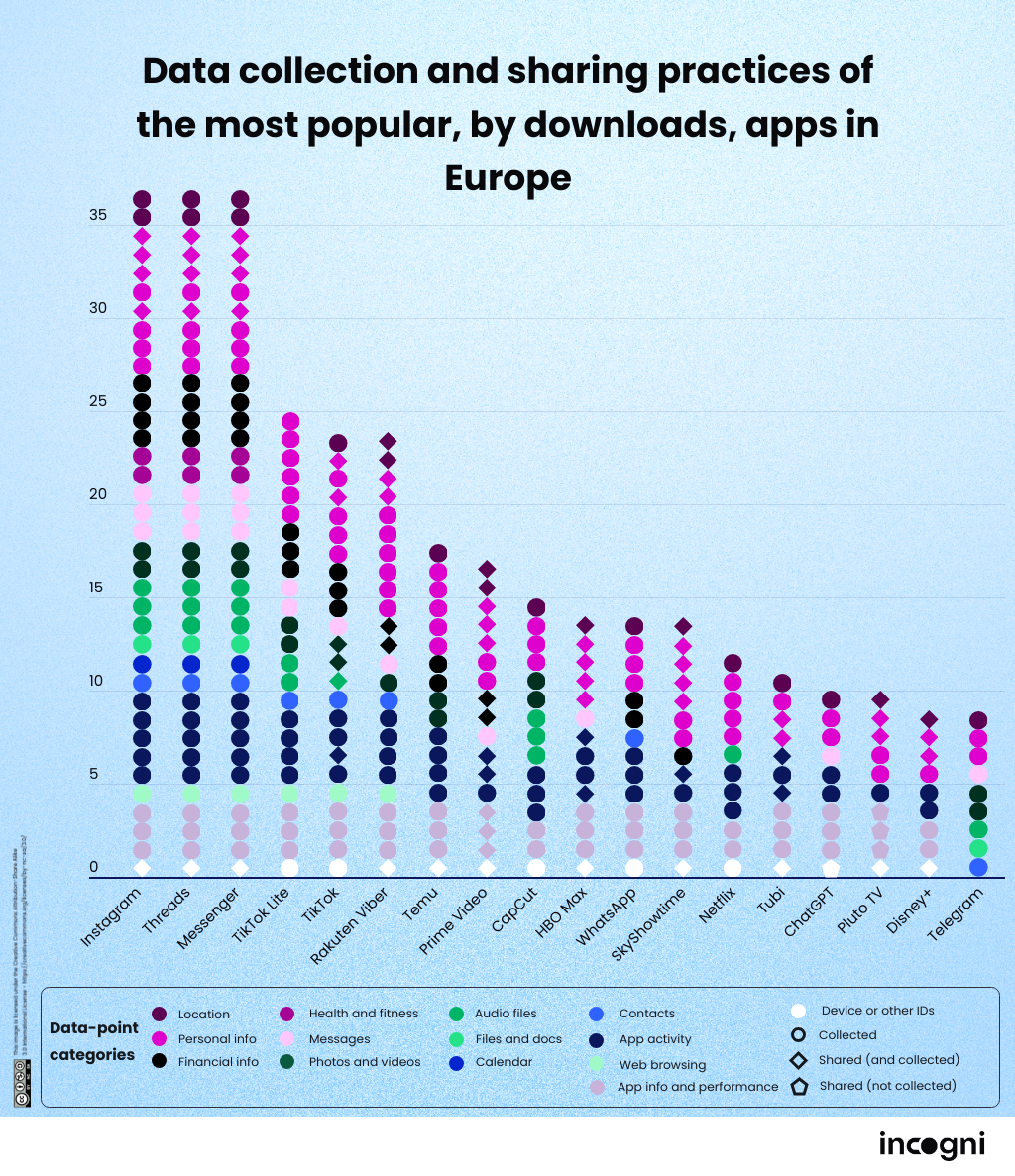
However, the internet in 2025 is a very different place compared to 2009. A select number of platforms control much of the traffic, and they’re all harvesting data:
Despite Europe leading with personal data protection laws, Incogni’s researchers reveal concerning practices of foreign-developed applications and how they handle European citizens’ data. Applications developed by foreign entities can easily operate in gray areas that leave EU and UK citizens’ personal data wide open to third-party access,” Darius Belejevas, Head of Incogni, told BeInCrypto.
According to new research published by Incogni, major platforms based in the US and China engage in systematic violations of digital privacy. The government frequently surveys American social media apps, and we can easily assume that China employs similar methods.
Incogni’s study focused on Europe, and its conclusions on app-based data collection are fairly stunning. Although the continent ostensibly has stringent digital privacy laws, these foreign platforms control a huge share of data.
It’s easy to imagine how this problem could be much worse in other regions.
Could Blockchain Help?
So, how can blockchain technology ensure digital privacy? Web3 applications such as self-sovereign identity (SSI), decentralized identifiers (DIDs), and tokenized data marketplaces provide a model where users control and selectively disclose information via cryptographic proofs, preventing bulk harvesting and cross-border leakage.
Unlike centralized apps, blockchain systems keep verification local and transparent. By embracing crypto’s origins as a radically decentralized system, citizens in the UK, EU, or any other country may be able to protect their digital privacy.
However, this optimistic scenario seems highly unlikely. Cybersecurity experts are concerned about a trend in crypto scams: what use is a warning if nobody heeds it?
These platforms probably won’t simply permit huge numbers of users to flaunt their data collection methods. Privacy-focused enthusiasts may need to build parallel structures.
Can blockchain-based platforms really replace messaging, entertainment, social media, and more? These replacements WOULD require significant user adoption—a messaging app where you can’t message anyone, a streaming app with no content, and so forth, would be useless.
Government-Imposed Hurdles
As the recent US plan to put economic data on the blockchain shows, motivated governments are capable of using this technology for powerful new use cases.
If this sort of plan had some real buy-in from EU governments, privacy experts could force these platforms to permit blockchain-based user obfuscation technologies.
There’s just one question: are EU governments interested in digital privacy? MiCA regulations suggest that they are not, but other recent incidents provide further evidence.
The Online Safety Act (OSA), Britain’s attempt at digital age verification, has proven hideously unpopular, even sparking human rights criticism.
It requires websites to abandon any pretense of digital privacy and check every potential user’s identity before they can access the platform. It seems the EU is testing similar requirements.
In short, the internet’s prevailing headwinds do not favor digital privacy. Committed developers could build Web3-based solutions, but it’ll be a long and uphill battle. Still, blockchain technology is the best way to achieve this dream.
