220,000 Bitcoin Wallets at Risk: US Government Uncovers Revolutionary Security Flaw

Federal cybersecurity teams expose critical vulnerability affecting nearly a quarter-million Bitcoin addresses—raising alarms across the crypto ecosystem.
The Exploit Breakdown
Government researchers discovered a novel attack vector that bypasses conventional wallet security measures. The vulnerability doesn't require private key theft—it targets transaction validation protocols at their core.
Massive Exposure Scale
With 220,000 addresses potentially compromised, the scale rivals some of crypto's largest historical breaches. Security analysts are scrambling to patch systems before malicious actors weaponize the discovery.
Market Implications
Bitcoin's price dipped briefly on the news before recovering—because nothing makes traditional finance types happier than seeing crypto stumble, even temporarily. The timing couldn't be more ironic as institutional adoption hits record highs.
Protection Protocols Activated
Major exchanges and wallet providers have already implemented emergency safeguards. The government's responsible disclosure gives the industry crucial lead time—a rare moment of public-private coordination in digital asset security.
This revelation proves even Bitcoin's battle-tested infrastructure isn't bulletproof—and that the arms race between security researchers and potential exploiters just entered its next phase.
A New Bitcoin Wallet Flaw
The crypto community has been full of questions after the US government seized $15 billion in Bitcoin this week. The assets were taken from a known heist in 2020, but sleuths were mystified as to how law enforcement obtained the private keys.
Now, however, one DeFi developer revealed the nature of a new bitcoin wallet vulnerability:
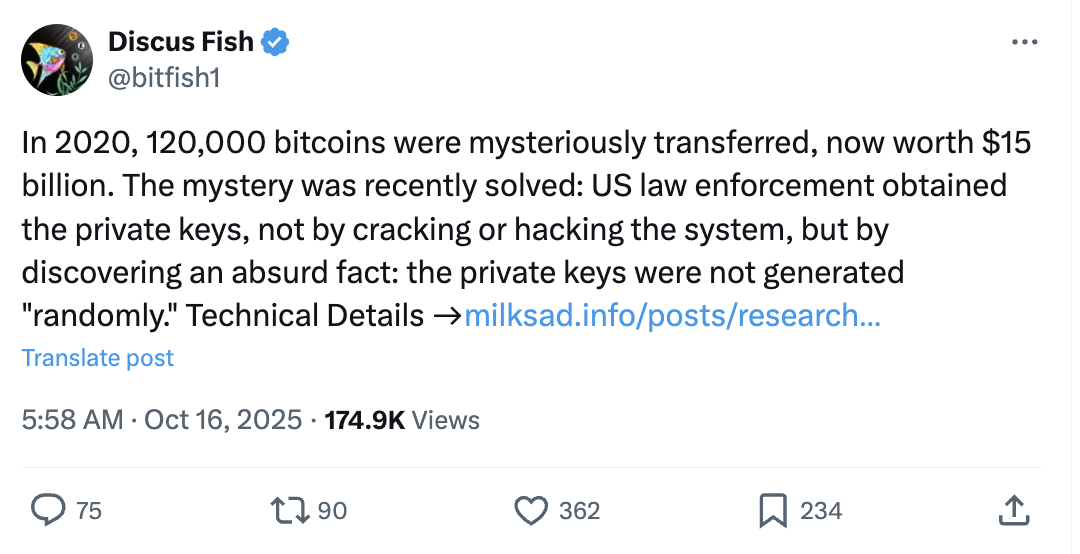
Apparently, the hacker’s wallets contained a crucial error that made it easy for anyone to steal this Bitcoin. The analyst characterized these wallets as “doomed from the start,” as the Pseudo Random Number Generator that created the private keys had major technical flaws.
Some analysts have even theorized that law enforcement knew about this Bitcoin wallet vulnerability for several years without publicizing it.
Either the government knowingly kept the secret and only revealed it when prosecuting criminals, or someone else discovered it. In that case, the US may have learned of this flaw recently.
A Dangerous Secret
Either way, it’s clear why crypto crimefighters WOULD want to keep this knowledge from general circulation. An estimated 220,000 Bitcoin wallets contain this error, too. Many of these addresses are still active, and it would be trivially easy for hackers to penetrate them.
Readers may wish to check the list to see if their own Bitcoin wallets are vulnerable. If you are storing any crypto in one of these defective addresses, you should MOVE it to safer storage immediately.
BeInCrypto has many resources to help its readers protect their assets, and can recommend solid security plans.
Still, full-blown hysteria might be inappropriate. Prominent sleuths have claimed in unequivocal language that “you will not have this issue if you use a reputable wallet.”
The failed number generation is most common in self-programmed wallets, especially those with AI-generated code.
However, many professionals take wallet security very seriously in their products.
All that is to say, if your Bitcoin wallets come from any leading firm, they’re probably safe. If, however, you’re using an obscure third-party creation or have attempted to generate one yourself, you may not be aware of these serious problems.
The exploit is public, and hackers could come probing at any moment.
