FTX Demands $53 Million From Upbit in Explosive ’Secret Account’ Scandal

Bankrupt crypto giant FTX claws back $53 million from Korean exchange Upbit—exposing hidden accounts and questionable transfers.
The Legal Battle Heats Up
FTX's estate lawyers claim Upbit processed massive withdrawals through undisclosed accounts during the platform's collapse. They're demanding every penny back—plus interest.
Where Did the Money Go?
Court documents reveal the $53 million moved through shadow channels while other creditors got locked out. Upbit maintains they followed standard procedures, but FTX argues the timing screams insider advantage.
Industry-Wide Implications
This case could set precedent for how exchanges handle funds during bankruptcy proceedings. Watch for ripple effects across global crypto markets as regulators take notes.
Another day, another crypto firm treating customer funds like monopoly money—some things never change on Wall Street's wilder cousin.
Why Is FTX Suing Dunamu?
The lawsuit filed by FTX against Dunamu is a “complaint for the return of assets and violation of automatic stay.” The Core of the claim is that Dunamu, through its Upbit exchange, is holding FTX’s assets and should return them.
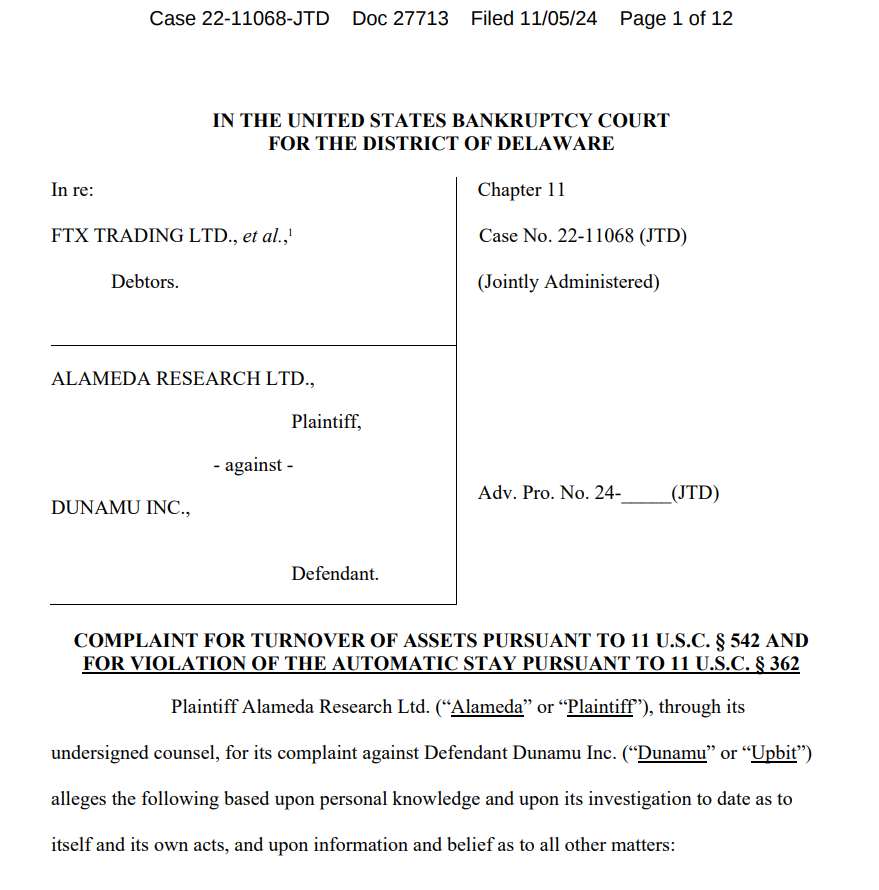
According to Alameda Research, the company opened digital asset storage accounts on crypto exchanges worldwide. It opened these accounts not only in its own name but also under employee names or shell companies. The purpose was to create a type of secret nominee account.
Unraveling a “Secret Account”
Alameda claims that someone opened one of these secret accounts on Upbit under Yang Jai Sung’s name, and an email address, [email protected].
FTX alleges the account was a secret Alameda account. This is based on an internal messenger conversation from March 2022, where an Alameda employee said, “Upbit authentication is complete.” The firm also noted that the seoyuncharles88 email address automatically forwarded to an Alameda address.
Additionally, FTX claims that Yang Jai Sung is the father of Charles Yang, the head trader for Genesis Block. This is an Alameda affiliate, and the claim is based on a lawsuit between FTX and Genesis Block.
FTX entered bankruptcy proceedings in November 2022 after revelations of customer fund misuse and accounting irregularities. Misusing customer funds through its affiliate, Alameda, was a significant point of contention. As a result, founder Sam Bankman-Fried (SBF) was sentenced to 25 years in prison in March 2024.
FTX claims it requested the return of the assets from Dunamu multiple times, but Dunamu has not complied without a valid reason. FTX made the first request on November 16, 2022, and a second one in January 2023, but received no response.
The Case Heats Up
According to the complaint, Dunamu responded in July 2023, saying it could not even confirm the Alameda Research account existed. It demanded proof that Alameda Research actually controlled the account.
Although Alameda Research provided documentation, Dunamu notified them that the “submitted materials were insufficient.” The company WOULD not proceed without a document proving a contract between Alameda and Yang Jai Sung.
FTX explained that SBF’s criminal trial testimony included a statement that an “$8 billion debt was hidden through the seoyuncharles88 account.”
FTX also attached an affidavit from former Alameda Research CEO Caroline Ellison. In the affidavit, she stated that “one of the Alameda accounts was an Upbit account registered using the seoyuncharles88 email, and Alameda controlled, used, and funded this account.”
A Dunamu representative told BeInCrypto that “the questioned account is currently frozen due to anti-money laundering issues,” adding, “Dunamu is in the role of safekeeping the frozen VIRTUAL assets.”
