BTC Regroups at $79K as PCE, Nvidia Earnings Loom

On August 26, global markets are focused on easing U.S.-Iran tensions, U.S. PCE inflation data, Nvidia’s earnings, and elevated volatility across crypto assets. International oil prices and U.S. Treasury yields retreated after U.S.-Iran negotiations showed positive signs, while U.S. stocks closed modestly higher. The crypto market, meanwhile, remained relatively strong, with Bitcoin briefly surging above $81,000 before pulling back to around $79,000.
Oil Prices Retreat as PCE Data and Nvidia Earnings Loom
Easing U.S.-Iran tensions have become a key macro theme. Reports suggest that the United States and Iran have reached consensus on the terms of a ceasefire agreement, including provisions to ensure freedom of navigation through the Strait of Hormuz. Oil prices fell sharply on the news. BTCC market data showed Brent crude falling to $85 per barrel, while WTI crude dropped to $80 per barrel. Lower oil prices eased concerns over renewed energy-driven inflation and also pushed U.S. Treasury yields lower.
On the macro front, markets will closely watch the U.S. PCE inflation report, scheduled for release at 8:30 a.m. ET on August 26. If core PCE comes in below expectations, Treasury yields could fall further, potentially supporting growth stocks and crypto assets. A hotter-than-expected reading, however, could prompt markets to raise expectations for a September rate hike, amplifying volatility across the U.S. dollar, Treasury yields, and risk assets.
Among safe-haven assets, spot gold remains near elevated levels. Gold briefly climbed to $4,696, its highest level in more than three months, before retreating to around $4,630. The recent simultaneous strength in gold and Bitcoin suggests that investors remain focused on inflation, purchasing-power risks, and changes in liquidity conditions, while increasing exposure to alternative assets.
U.S. stocks ended Tuesday higher across the board, with the Dow Jones Industrial Average gaining 0.30%, the S&P 500 rising 0.32%, and the Nasdaq Composite advancing 0.66%. Nvidia, which had fallen for seven consecutive sessions, rebounded more than 2%, helping improve sentiment across semiconductor and AI-related stocks.
The most important tech event today will be Nvidia’s earnings. The company is scheduled to report fiscal 2027 second-quarter results after the U.S. market closes on August 26. Market expectations broadly point to revenue of around $92.0 billion to $92.3 billion, nearly double the level from a year earlier. Investors will focus on data center revenue, AI chip demand, progress on the Rubin platform, and whether AI infrastructure orders can continue to justify elevated valuations.
BTC Pulls Back After Rally as $80K Becomes Key Near-Term Resistance
The crypto market remains stronger than many traditional risk assets. According to BTCC market data, BTC is currently trading at $78,831, down 2.14% over the past 24 hours. Bitcoin previously broke above $81,000 before retreating below $79,000, indicating increased selling pressure in the 80,000-81,000 range and pushing the market into a period of high-volatility consolidation.
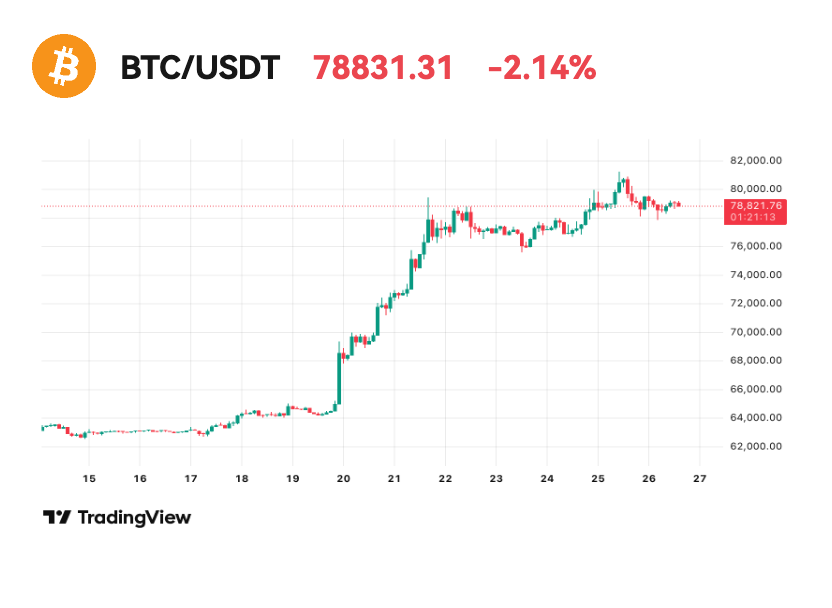
The latest rally has been driven by a combination of sustained ETF inflows, improving liquidity expectations, a more favorable regulatory outlook, and short covering. Fund flows remain a major source of support. On August 25, U.S. spot Bitcoin ETFs recorded $314 million in net inflows, marking their seventh consecutive day of positive flows. Last week, spot BTC and ETH ETFs attracted a combined $2.6 billion in net inflows, their strongest weekly performance since October 2025, signaling renewed institutional demand for crypto assets.
From a technical perspective, $80,000 is now the key near-term battleground between bulls and bears. If BTC can reclaim and hold above this level, attention could shift toward resistance around $83,000. If Bitcoin fails to recover $80,000, the market could first retest the 77,000-78,000 area, with further support around 75,000-76,000.
CryptoQuant’s Bull Score has risen from 30 to 80, with eight of its ten indicators now flashing bullish signals. However, the 365-day moving average around $83,000 remains an important level for confirming a new sustained trend.
On-chain data also shows that BTC long positions have remained relatively stable, while the market has moved into neutral consolidation following the rally. At the same time, BTC short positions have continued to decline, suggesting that some bearish traders are still withdrawing from the market. Analysts note that bulls have yet to significantly increase their exposure, meaning the next directional move may depend partly on whether the decline in short positioning continues.
BTC is currently trading within a high-volatility range, making the $80,000 breakout level and $77,000 support important areas to watch for trend-following opportunities. BTCC is currently running its “First Copy Trade, Losses Covered” campaign, allowing new users to follow strategies from experienced traders. Position sizing and risk management remain important, particularly during periods of sharp market volatility.

Momentum Builds Across Major Altcoins
Beyond Bitcoin, capital is beginning to rotate into highly liquid assets such as ETH, SOL, and HYPE. According to BTCC market data, ETH is currently trading at $2,459, down 1.51% over the past 24 hours. Ether is consolidating around the 2,450-2,500 range. While near-term momentum has cooled, its broader market structure remains stronger than in previous weeks.
Institutional flows also continue to improve. U.S. spot Ethereum ETFs recorded more than $180 million in net inflows yesterday, marking a seventh consecutive day of positive flows. SOL is also attracting greater investor attention. Solana-related ETFs recorded approximately $33.49 million in daily net inflows, the highest level of 2026, bringing cumulative net inflows to around $1.22 billion. The simultaneous improvement in ETF flows and on-chain activity suggests that risk appetite for highly liquid Layer 1 assets is strengthening.
Other major altcoins are also showing selective opportunities. Hyperliquid’s AQAv2 mechanism began accruing yield on August 26. Returns generated from stablecoin reserves will periodically be directed to the Assistance Fund and used to buy back HYPE. HYPE remains relatively strong, trading at around $82.
Overall, capital rotation is gradually extending from BTC into ETH, SOL, and HYPE. However, Bitcoin’s price action and ETF flows remain the market’s primary pricing drivers. A sustained stabilization above $80,000 could provide more room for capital to rotate further into major altcoins.
What to Watch Next
In the near term, markets face three major variables at the same time: U.S. PCE inflation data, Nvidia’s earnings, and developments in U.S.-Iran relations. Macro liquidity, risk appetite in technology stocks, and crypto-specific fund flows could reinforce one another over the next several trading sessions, potentially driving Bitcoin volatility even higher.
Three signals will be particularly important to watch: whether BTC can reclaim and hold above $80,000, whether spot ETF inflows remain positive, and whether Nvidia’s earnings can stabilize risk appetite across AI and technology stocks.
This content is for informational and educational purposes only and does not constitute investment advice related to BTCC. BTCC makes every effort but cannot guarantee the truthfulness, accuracy, or originality of the content above.