U.S. Stocks Reach a Crossroads as the AI Bull Market Faces a Difficult Week
 BTCCAuthor: furrykon
While crypto markets continue to surge, U.S. stocks have settled into a holding pattern this week, with investors first cutting valuations and then waiting for earnings.
The Nasdaq fell 0.8% on August 24 as semiconductor stocks led the decline. Technology shares staged a brief recovery on August 25, lifting the Nasdaq by 0.66%. As of the U.S. pre-market session on August 26, investors had moved to the sidelines, with attention centered on NVIDIA's after-hours earnings. Whether the AI trade can recover may depend on the company's data center demand, forward guidance, and capital expenditure signals.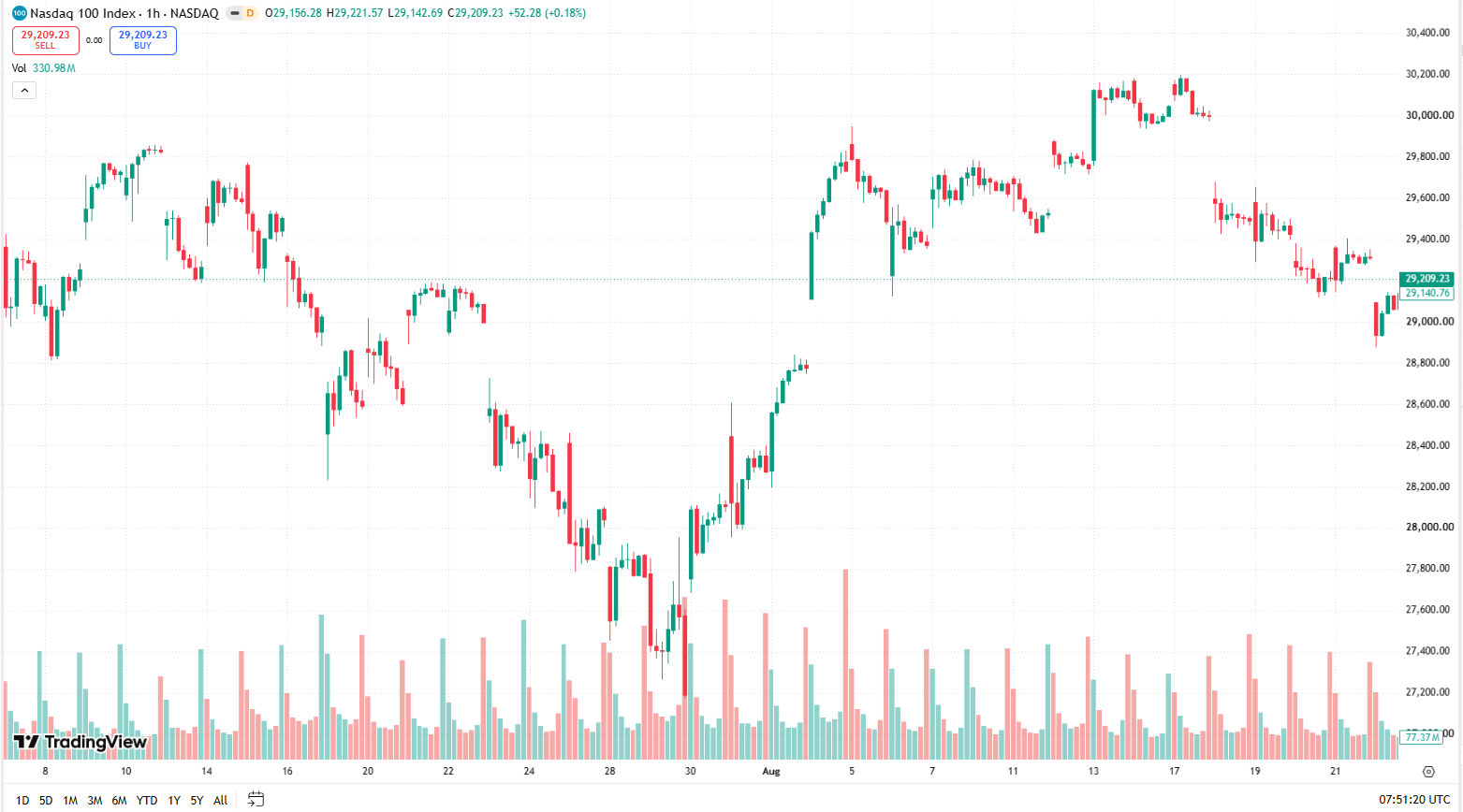
Investors were previously willing to pay higher valuations for AI's long-term growth story. Now, rising long-term Treasury yields and expanding AI financing needs have left the market demanding greater certainty before extending the rally. With NVIDIA's results approaching and the Jackson Hole symposium just ahead, several major forces are converging on U.S. equities at the same time.
Long-Term Treasury Yields Become the First Pressure Point for the U.S. Bull Market
The most important variable for U.S. stocks is now long-term Treasury yields.
Global bond yields have risen rapidly in recent weeks, with the 30-year U.S. Treasury yield reaching its highest level since 2007. This has raised concerns about higher financing costs for households and businesses, while adding pressure on companies making large investments in AI infrastructure.
Long-term yields matter because AI is fundamentally a long-duration trade. Investors are paying for the expected growth of data centers, computing capacity rentals, enterprise AI applications, and model inference demand over the next several years. When the 30-year Treasury yield remains near 5%, however, the discount rate applied to future cash flows must rise, putting technology valuations under pressure.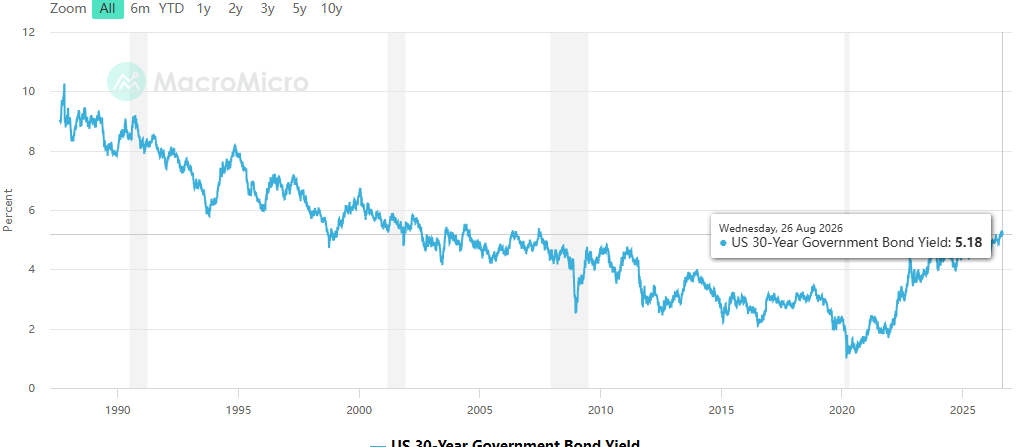
Reuters noted that NVIDIA's earnings and the Jackson Hole symposium will jointly test the two main pillars of this year's equity rally: AI profit growth and interest rate expectations. The larger AI capital expenditure becomes, the more demanding investors will be about returns. This also leaves AI stocks more vulnerable to declines, even when most companies are still delivering respectable results.
NVIDIA Earnings Preview: Expectations Turn Cautious
NVIDIA's earnings this week will determine whether the AI trade can stabilize short-term sentiment. Market performance over the previous five trading sessions already points to a more cautious and pessimistic outlook.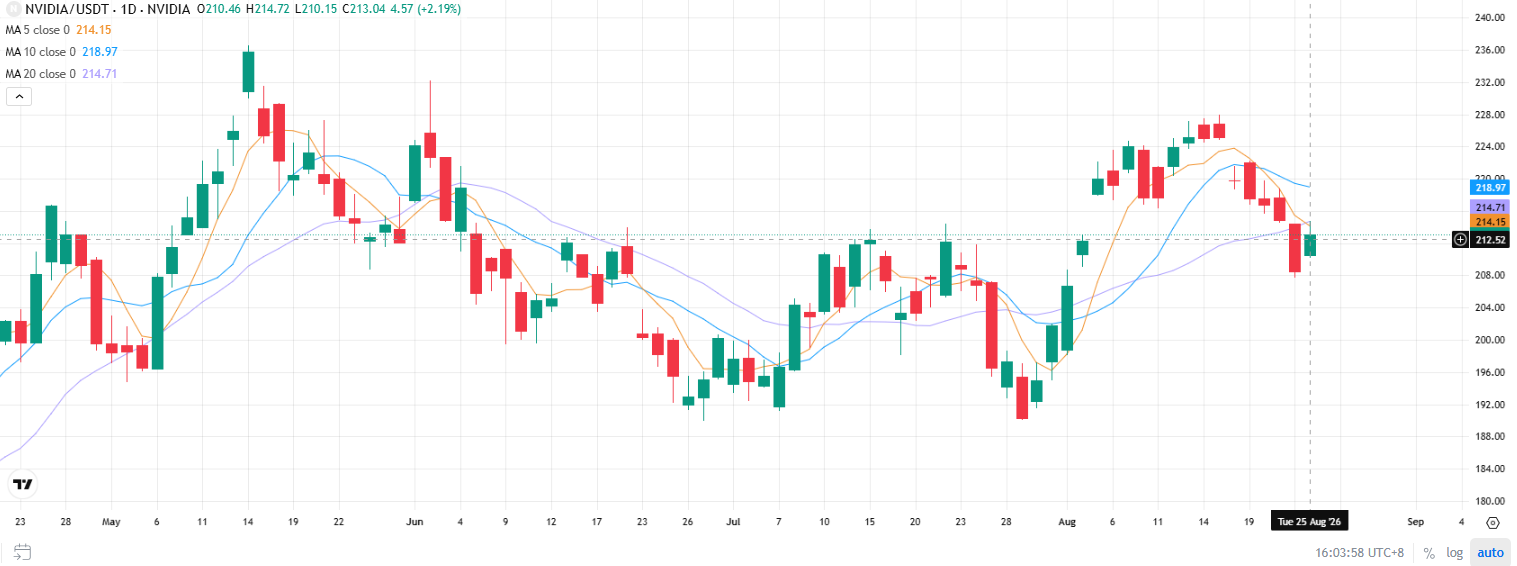
Analysts expect NVIDIA to report second-quarter revenue of nearly $92.18 billion. Third-quarter revenue is projected to rise about 82.8% year over year to $104.2 billion, with gross margin remaining around 75%. Data center revenue is widely expected to exceed $80 billion, with hyperscale and enterprise customers each contributing roughly half.
Those forecasts are already demanding, but earlier optimism has pushed NVIDIA's threshold for success even higher. Goldman Sachs analysts have explicitly warned that expectations are now stretched to the limit. Only results that significantly exceed forecasts are likely to deliver an incremental positive surprise.
Beyond the headline results, investors are likely to focus on three areas:
● The pace of the Blackwell architecture ramp and NVIDIA's ability to sustain gross margins, including whether the current margin of around 75% can be maintained or improved;
● Whether management further strengthens its capital expenditure and revenue guidance for the coming quarters;
● Details of the $500 billion AI computing financing platform launched by NVIDIA and Wall Street institutions.
Reuters also reported that investors will be watching whether NVIDIA's Rubin chips can sustain the momentum of AI growth, and whether the company's large-scale financing commitments for AI infrastructure could distort expectations for underlying demand.
NVIDIA's earnings are a mirror of the market's transition from AI enthusiasm to a more rational assessment of the industry. If its results and guidance do not fall materially short of expectations, the release of bearish positioning could produce a temporary recovery. Even so, the market may not return to the earlier golden age when investors could embrace the AI story without closely examining the risks.
Opportunity Alert: BTCC continues to offer its Copy Trading Loss Protection Campaign. By tracking how experienced traders adjust their positions across U.S. equity-linked assets, BTC, ETH, and popular futures contracts, users can follow a clearer trading rhythm and participate more flexibly during periods of elevated volatility.
Jackson Hole May Not Change the Direction, but It Could Amplify Volatility
Jackson Hole is another major variable for markets this week.
Federal Reserve Chair Kevin Warsh has adopted a restrained communication style, making it harder for markets to anticipate the direction of monetary policy and position in advance as they did in previous years. Investors will watch whether he addresses criticism that his communication has been overly limited, while still avoiding policy guidance that is too explicit.
Bloomberg reported that Warsh will deliver his first major public speech since taking office at Jackson Hole. The press conference following the July policy meeting failed to generate a sufficient bond-market recovery, while long-term Treasury yields continued to rise. That has significantly increased the pressure surrounding this speech.
If Warsh can convince investors that inflation remains under control and the policy path will remain orderly, long-term yields could retreat temporarily and risk appetite in U.S. equities could recover. If his remarks are too vague, or if investors conclude that the Fed lacks a plan to address disorder in the long end of the Treasury market, stocks may continue trading on the theme of higher rates compressing valuations.
Because the speech is scheduled for Friday, the main market reaction is likely to emerge next week. This week is more about the contest between competing expectations. The symposium itself will not change the policy rate, but it could determine whether investors continue to trade the theme of high rates pressuring valuations or temporarily shift toward a policy-driven recovery in risk appetite.
A Side Note on Crypto's Recovery and the Equity Market
The crypto recovery has occurred at the same time that U.S. technology stocks have come under pressure, suggesting that the previously strong positive correlation between the two markets may be weakening.
As crowded AI trades cooled, traders began looking again for greater upside responsiveness in crypto-related assets. Reuters reported on August 21 that Coinbase rose 9.8%, Robinhood gained nearly 13%, and Strategy advanced 7.2%, even as the broader U.S. equity market remained under pressure from rising yields. The gains came as Bitcoin reached its highest level since late May.
The divergence between technology stocks and crypto is likely to remain temporary. AI stocks are trading on high valuations and elevated financing costs, while crypto markets are pricing in regulatory improvement, renewed ETF inflows, and expectations of dollar depreciation. Their immediate drivers have started to differ, but both remain constrained by global liquidity conditions.
The current crypto rally began largely with a series of policy moves by the Trump administration. With comprehensive crypto legislation stalled in Congress, the administration's regulators are trying to fill the gap through agencies such as the SEC and CFTC, taking over some of the role that the CLARITY Act was expected to play. These rules could still prove controversial and may be reversed by a future administration.
The durability of the policy-driven rally depends on three conditions. First, the CLARITY Act or a similar regulatory framework must make genuine progress rather than remain a political statement. Second, the SEC and CFTC must provide clearer rules for token issuance, perpetual futures, custody, ETFs, and RWA products. Third, ETF inflows must continue instead of fading after a single weekly burst driven by short covering.
This content is for informational and educational purposes only and does not constitute investment advice related to BTCC. BTCC makes every effort but cannot guarantee the truthfulness, accuracy, or originality of the content above.