Opinion: Bull Market Is Here—How to Position?
 Blockbeats
Original title: "A 26-Year Bull Market Begins? How to Position for This Cycle?"
Original author: Da Yu, crypto KOL
Every bull market is different, and only those who continuously embrace change can thrive in a bull market—so trying to predict what a bull market will look like is difficult, but I believe there are still patterns to follow.
There is still debate over whether the bull market has arrived, but my view is very clear: the bull market is already here!
I believe we are now in the early stages of a bull market. Based on past bull market patterns, there will likely be a pullback of 20% or more later on, hopefully before $90,000, giving those who missed out a good entry opportunity. Before that, everyone needs to prepare a plan in advance, so that when the opportunity truly arrives, you won't hesitate again.
1. Why do I say the bull market is already here?
1. The cycle has not failed
Many people think the halving's actual impact on the crypto space has diminished, and that's true, but the halving is essentially an anchor of the cycle that resonates with sentiment, narrative, and consensus.
After the last halving, Bitcoin took over a year to rise from around $60,000 to nearly $120,000, and then another year to fall back to just above $60,000, nearly halving. The bubble has been squeezed out, and only then is there room for a new cycle. The crypto space remains a market deeply influenced by sentiment, consensus, and narrative. The direct buying pressure brought by the halving signal itself is not important; what matters is that around this node, capital and attention will refocus.
2. Favorable macro and liquidity conditions
The bear market of the past two years essentially stemmed from liquidity contraction; now the direction has reversed. With the US midterm elections approaching, along with expectations related to the Trump administration and recent fiscal actions, these are essentially disguised rate cuts, with the core goal of stabilizing financial assets: "If you won't ease, I'll ease myself."
3. Internal momentum and sentiment resonance in crypto
In recent weeks, crypto trading volume dropped to historic lows, and Binance even experienced a full hour with no Bitcoin trades. At the end of a bear market, this means those who wanted to sell have already sold, and those who want to buy are waiting on the sidelines. Under this structure, once a short squeeze or rally occurs, it will trigger extremely frenzied market action.
This is one of the reasons I dared to go all-in on BTC at around $60,000—also because miners' cost price is generally near this level. But the timing of the rise was much earlier than I expected; I thought we would have to endure for a few more months.
This week's price action saw a run from just above $60,000 to nearly $80,000. Those who missed out are rushing to chase the rally, those who got in want to add leverage, and shorts are desperately fleeing and covering.
The market is often most frenzied not when everyone is bullish, but when everyone starts to fear missing out.
2. Can this sharp rally continue?
First, the cyclical patterns of crypto have basically not changed, and the external environment supports this shift. After the AI concept rotated from optical modules to storage, capital began to hesitate, and concepts like SpaceX struggled to sustain upward momentum. The stock market places more emphasis on fundamentals, and a large amount of capital that made money—or didn't—in US stocks and AI will flow here as soon as the first clear signal appears in crypto.
Second, liquidity signals are clear. On-chain data shows that the daily minting of USDT and USDC stablecoins reached billions of dollars, a level rarely seen in recent years. Look at OKX and Binance's C2C markets: it's now hard to buy USDT. Previously, orders of millions, tens of millions, or even hundreds of millions were easily filled; now the largest sell order is only 200,000 USDT—USDT is in short supply. But as long as there are buyers, the rise will be accompanied by more USDT issuance.
Whether from a liquidity or sentiment perspective, the characteristics of a bull market start are very clear, so I am very bullish on the future.
3. How to position for this cycle?
In past cycles, we made big money using a leverage theory. By leverage, I mean not putting all capital in one direction: allocate part to certain trends, part to high-odds opportunities, and give up mediocre opportunities in between.
First, what is the biggest change in this bull market? It is the different source of capital.
In previous bull markets, retail FOMO drove entry, a game of dumb money, and crypto was seen as low-end, get-rich-quick, and casino-like. But since the last cycle, things have changed. Whales are not as easy to fleece, retail investors have become smarter, they only play MEME, and there are fewer bagholders.
Even though this cycle has just begun, the following trends have emerged and will become increasingly pronounced:
1. Institutional capital dominance
In the past, saying institutions were coming to crypto sounded like a joke. But not anymore. Whether it's the approval of ETFs for BTC, ZEC, etc., or native crypto projects like HYPE, they are attracting significant Wall Street institutions and institutional capital from mainland China, Hong Kong, and elsewhere—projects they can understand. Taking China as an example, traditional VCs like Oriental Harbor and Banyan Capital are entering crypto, but they won't buy any VC coins or pay attention to MEME coins; they will bet on on-chain finance.
Note the term "on-chain finance." Institutions are not buying a "crypto project that can go up"—many things can go up, and they don't need to come to crypto for that. They are mainly bullish on projects that can occupy key positions in on-chain finance.
On-chain finance has a background: the US GENIUS Act, the Clarity for Payment Stablecoins Act, the SEC's recent ICO framework, the 24X6 securities trading mechanism, and DTCC's full on-chain migration of US stocks—all are continuous and coherent parts of on-chain finance.
So this reminds us that in this cycle, we must focus on on-chain finance-related infrastructure. I have also been following some very small and new projects that bring many traditional finance practices to crypto. Whoever can make this business work smoothly and capture users will have huge opportunities, possibly even producing projects on the level of Hyperliquid.
2. Real value dominance
In the past, crypto imitated the stock market by issuing tokens to raise funds, but in the end, products were not delivered, tokens had no utility, and it was a mess. Project teams just dumped tokens, and retail investors passed the bag to each other—this playbook came to an end in the last cycle. Binance, as the biggest proponent of this playbook, also felt powerless at the end of the last cycle. Retail investors simply couldn't take it anymore, leading to a mass exodus of users to the stock market, and trading platforms began offering stock-related services.
The essence is not that users suddenly fell in love with stocks, but that users were repeatedly fleeced and became afraid.
After countless crypto projects were washed out, many good projects from the last cycle remain. They generally have revenue, token buybacks, and burns, and are promising. There are now nearly 20 such projects, and I'll briefly list them later.
3. MEME will still be a major focus
After TRUMP was issued, Meme coins peaked for the phase, and that was the time to exit the MEME market. But now that the bull market is back, we need to adjust with the market and must pay attention to Meme. There is inherent logic: crypto users are naturally speculative. Everyone comes to crypto for money and wealth effects; otherwise, they might as well go trade stocks or buy index funds. This demographic determines that perpetual contracts and Meme will remain mainstream.
Plus, the thrill of gambling is timeless. MEME coins, like perpetual contract trading, embody the famous saying: "Speculation is as old as the hills."
The traditional "Binance listing" playbook may gradually become outdated. In the past (and even now), MEME whales on BSC would create a good concept, control 70% to 90% of the supply, and wait to dump on Binance spot. But Binance is not stupid and doesn't want to be the bagholder. Most of the time, they only list perpetual contracts for speculation and don't allow spot listings for users to take over.
Here, I think rather than betting on specific Meme coins, it's better to focus on their base assets, such as SOL or Pump platform tokens. If you're bullish on BSC MEME, you can also consider holding BNB directly (personally, I prefer HYPE, as I think it represents the future trend, and I no longer like BNB). But although BNB is old, its influence remains, and it cannot be ignored in a bull market.
For high-risk appetites, you can look at the "PUMP-like platform" on the Robinhood chain. The platform token is called Pons, and its risk and odds should be more than 5 times that of PUMP.
Because Robinhood is a new chain, I recommend downloading the FOMO platform, which is currently the most used for MEME trading. It was built by the DYDX team, with strong financial experience, plus US-compliant custody of funds and a no-private-key third-party solution. Funds always remain in your own hands; even if the platform ceases operations, users' money will not be lost. It's very safe and indeed easy to use. You can deposit any on-chain token to buy all on-chain assets, which is pretty cool.
Overall, buying platform tokens for MEME is like buying a casino, which is more stable than buying MEME itself.
4. Mediocre VC coins
These assets are actually riskier than Meme. If you buy Meme early, at least you're risking a little for a lot; if you buy VC coins in small amounts, you simply can't make money.
This category mainly consists of various VC coins that rely on shilling, FOMO, and herd mentality to fleece the gullible.
The whales' core is not to build good projects, but to harvest retail investors effectively. Most crypto projects—say 90% of Binance spot listings—at best harvest once per bull market, and at worst, after listing, they just stagnate and continuously dump until the project goes to zero. In comparison, projects that can keep doing things (harvesting) are considered decent, as their tokens can still be played with and there are still opportunities.
So VC coins cannot be judged by story alone. My three filters are: Are there real users? Is there sustained revenue? Does the team truly intend to build long-term? If a project fails these three, no matter how hot the rally, don't touch it.
4. Key projects to watch
This cycle, priority should be given to real-yield projects. I've listed a table with some representative ones and brief comments. Many may surprise you, including UNI, which people used to think was pure air but has quietly changed. First, look at the table (not exhaustive, just examples):
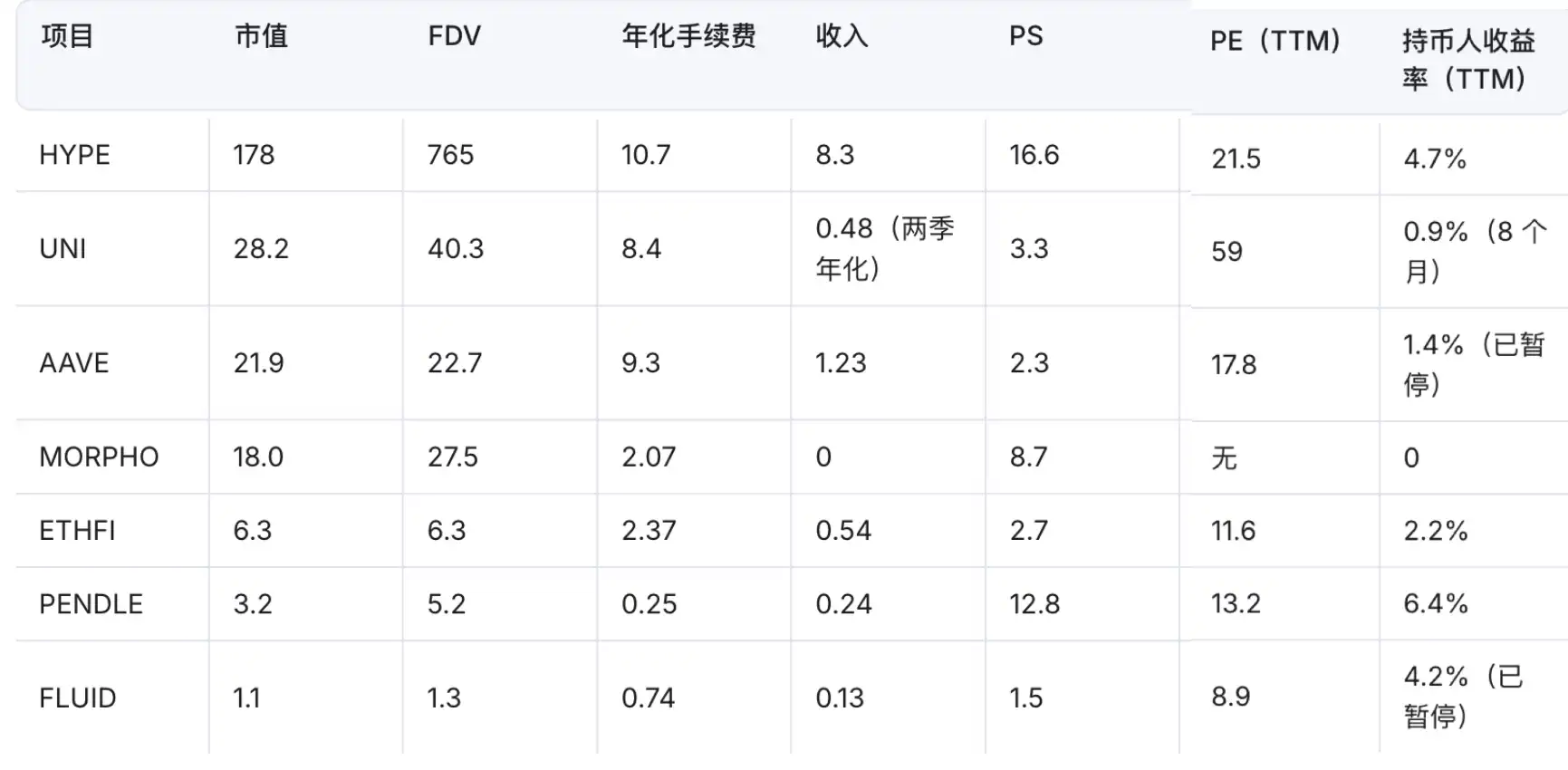
The table may be a bit hard to read, so I'll summarize in text:
· HYPE: This is the most impressive project in crypto, an outstanding representative. High revenue, aggressive buybacks, grand vision, strong innovation, fast iteration, and a handsome founder. Not much to say—the project is walking steadily on the path of on-chain financial infrastructure. The only regret is that the current price is already reasonably expensive.
· UNI: It used to be an air token, but now it actually has a buyback mechanism. Recent buyback amounts have hit new highs as the market recovers. However, from a PE perspective, it is still more expensive than the lofty HYPE, so it's old and not sexy, but as the leader of crypto AMMs, it can be put on the watchlist.
· AAVE: Needless to say, it's the top on-chain lending protocol. When it bottomed out, including core developers leaving and protocol parameter errors, I indeed didn't dare to buy—who knew that for good projects, even big negative news is an opportunity, just like HYPE when it was criticized heavily during JELLYJEELY and fell to around $10.
· MORPHO: This project is extremely strong on the institutional side. During the bear market, top institutions significantly increased their holdings at market prices, making it seem like it never went through a bear market. It is now more suitable for the watchlist.
· ETHFI: This is an older project originally focused on staking, but one admirable thing is that it chose to do the right and difficult thing, making a beautiful transformation. It is now more focused on on-chain payments—actually, it seems to be the only one among token issuers. Like RedotPay, which was valued at $2 billion in the bear market but probably won't issue a token, ETHFI is listed on Binance and is very, very worth watching this bull market!
· PENDLE: The team is strong, and this project is in a positive spiral in a bull market. No need to say more; it will definitely perform well.
· FLUID: This could be an overlooked gem. PE/PS are good, and it recently went through some negative news. Worth tracking; I already have some positions.
In addition, projects with revenue and buybacks include JUP, PUMP, etc., but due to space constraints, I won't list them all.
5. Final thoughts
After the first sharp rally of the early bull market, a pullback can come at any time, with a magnitude of around 20%. A pullback is not a risk; it's an opportunity for those who missed out to get in.
Be prepared before opportunities arise: decide what to buy during the pullback, in how many batches, and how much each batch. Then just follow the plan without hesitation.
Over the past couple of cycles, my community members have generally recognized my ability to seize opportunities. We have basically not missed any major opportunities. This cycle, we set sail again and must rake in a few hundred million!
This content is for informational and educational purposes only and does not constitute investment advice related to BTCC. BTCC makes every effort but cannot guarantee the truthfulness, accuracy, or originality of the content above.