Vitalik's First Token Buy in Two Years: A ZEC Competitor
 Blockbeats
“Vitalik bought.” How much is that story worth?
Amid a hot market, Vitalik finally made a move again after two years.
Last month, Vitalik put 16 ETH (about $28,000) into The Interfold’s first CCA public auction on Uniswap. His last significant public investment in a new project token or related asset dates back to November 2024, when he put 32 ETH (about $107,000) into the NFT public sale of the prediction market Truemarkets.
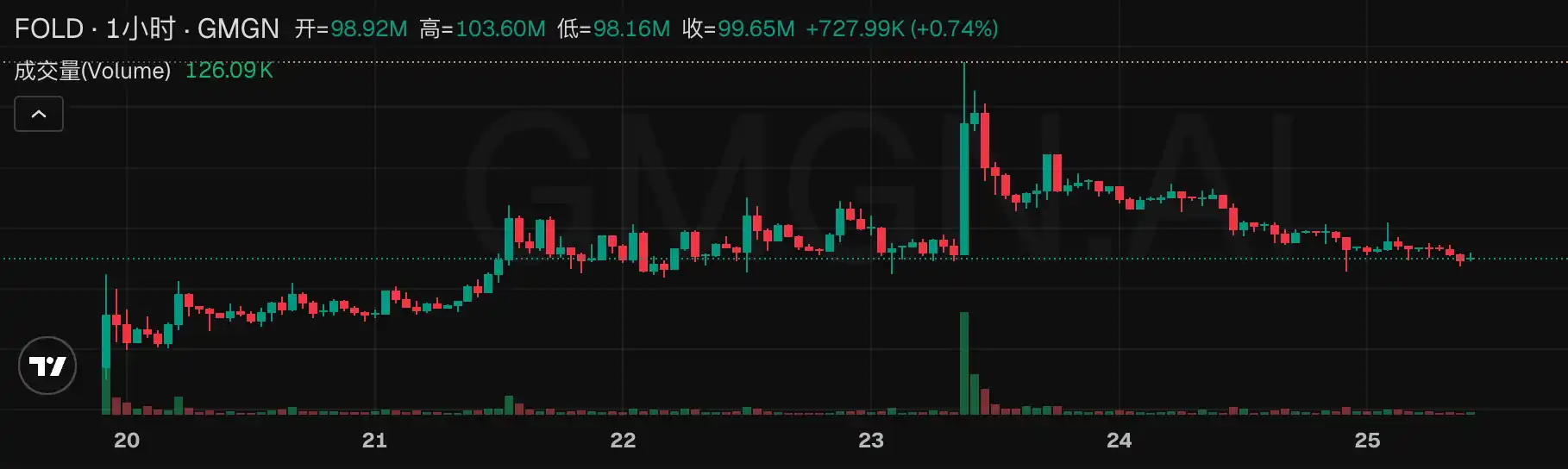
On Aug. 19, $FOLD had its TGE, and then surged more than 7x at its peak. We need to look at this rise in two stages. On Aug. 23, Upbit listed $FOLD, instantly doubling the price and briefly reaching a market cap of about $230 million. Before that, the rise was almost entirely driven by the “Vitalik bought” narrative. On-chain players spontaneously formed a consensus around this narrative, pushing the token from a market cap of about $28 million to a peak of about $140 million.
After the sudden positive news of the Upbit listing, $FOLD did not continue higher with the market, but pulled back to where it was before the news. So we can roughly say that the token has now returned to the value range of the “Vitalik bought” narrative:
In fact, the “Vitalik bought” narrative behind $FOLD is bigger than one might think. This is a privacy project—an open-source privacy protocol developed by Gnosis Guild that allows multiple mutually distrusting independent parties to jointly perform verifiable computation and produce a shared result without exposing their private inputs, without relying on a single operator, and without using trusted hardware.
A concrete use case: for a DAO, anyone can vote privately, no one can see any individual vote record, but everyone can verify the authenticity of the final voting result.
Encrypted data inputs are submitted to the protocol’s encrypted execution environment, E3. Each computation involving encrypted data creates an independent E3. After the computation ends, the E3 is shut down, leaving no data traces.
Nodes that perform ciphertext computation and decryption need to stake $FOLD to qualify.
Compared with ZEC, ZEC itself is an asset focused on privacy, while The Interfold is a multi-party privacy computation protocol that allows every party participating in a joint task to complete the work without sharing their respective data. When imagining actual use cases, this feels quite hardcore—hardcore in terms of the demand for privacy protection.
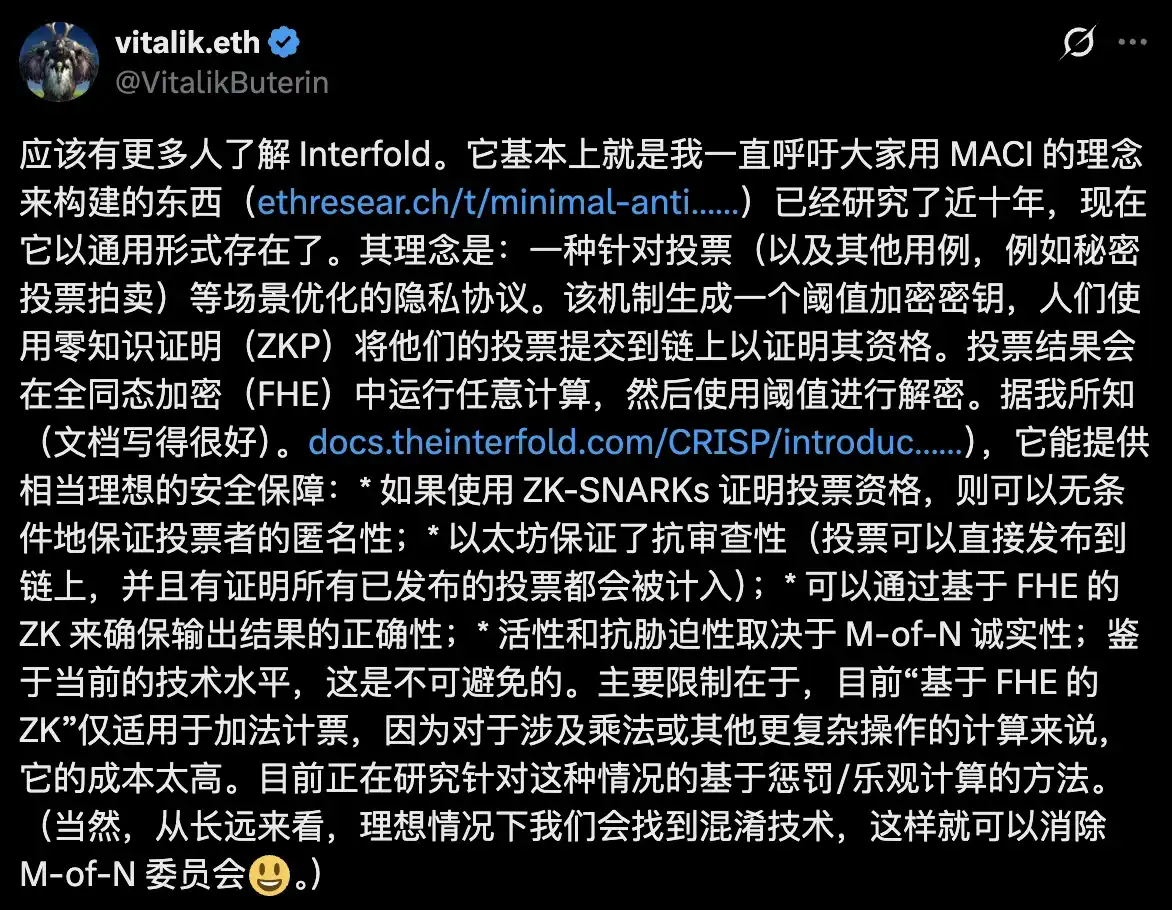
That is, in terms of how easy the narrative is to accept, ZEC is very simple: “a privacy version of Bitcoin, no one sees where my money goes.” But The Interfold has a higher barrier to understanding. Vitalik promoted this project very directly on X at the end of May this year, and looking at his reasons for recommending it, you can tell it’s not easy to understand…
At dappcon in July this year, Vitalik mentioned the project again on stage:

In addition, Vitalik put 16 ETH into the public auction, but he has not yet claimed the tokens from the sale, let alone sold them. Based on all the above, one can say that players don’t care what The Interfold can actually be used for. They just need to know that this is a project Vitalik is bullish on, has repeatedly mentioned, and has put his own money into.
As for where this token goes from here, I am personally optimistic. First, it’s hard to compare with Truemarkets, the prediction market Vitalik last participated in, because when $TRUE had its TGE last year, the market environment was nothing like now, and $TRUE was not listed on any exchange—neither major nor minor.
$TRUE’s peak fully diluted market cap never exceeded $20 million. $FOLD now has about 27% of supply in circulation, with a circulating market cap of about $27 million and a fully diluted valuation (FDV) of about $100 million. As an asset that was listed on Upbit just days after its TGE, $FOLD seems to have room from this perspective.
For projects Vitalik supports with his own money, in the short-to-medium term, one can assume he won’t sell. At least with Truemarkets, whether at the current price trough or the peak last October, he has never moved. The “Vitalik bought” narrative will continue for $FOLD, especially since he himself keeps mentioning it. The probability of waking up one day to find the narrative has become “Vitalik sold” is indeed low.
Second, although this project is a serious privacy protocol, from a hype perspective, treating it like a meme coin is not unreasonable. The positives we can list now—strong ETH, good overall on-chain market conditions, Upbit listing, Vitalik’s repeated mentions—are all attention logic, betting that in an environment of good overall liquidity, ETH will also be chased into a hot asset of its own.
Its technology and use cases are inherently hard to understand, which also means that for most on-chain players, the attention-grabbing points will not be the technology and use cases themselves, but the multiple attention-driven factors we mentioned above.
But with Robinhood, BSC, Solana, and other chains all showing strong profit opportunities, whether it’s a step ahead or too niche to chase an asset with a circulating market cap already near $30 million on the ETH mainnet—a chain that currently has little heat—is hard to judge right now. At the current level, although $FOLD has Vitalik’s backing, the risk-reward ratio may not be that attractive.
This content is for informational and educational purposes only and does not constitute investment advice related to BTCC. BTCC makes every effort but cannot guarantee the truthfulness, accuracy, or originality of the content above.