


Goldman Sachs Bullish on Robinhood: Rothera Valuation Could Reach $19.5 Billion
 Blockbeats
Ranks Among Global Top Five Within Months of Launch
Robinhood is gradually upgrading its prediction market from a fast-growing brokerage business into a trading infrastructure that it controls through its own participation.
In its latest report, Goldman Sachs focused on Rothera, a prediction market exchange owned 45% by Robinhood, 45% by Susquehanna International Group (SIG), and 10% by MIAX. Robinhood is the controlling party, so it consolidates all of Rothera's revenue and expenses into its financial statements, then allocates 55% of net profit to other shareholders through non-controlling interests.
This means that all revenue generated by Rothera is reflected in Robinhood's revenue, but only 45% of net profit ultimately belongs to Robinhood shareholders. Understanding this accounting relationship is key to assessing Rothera's actual contribution.
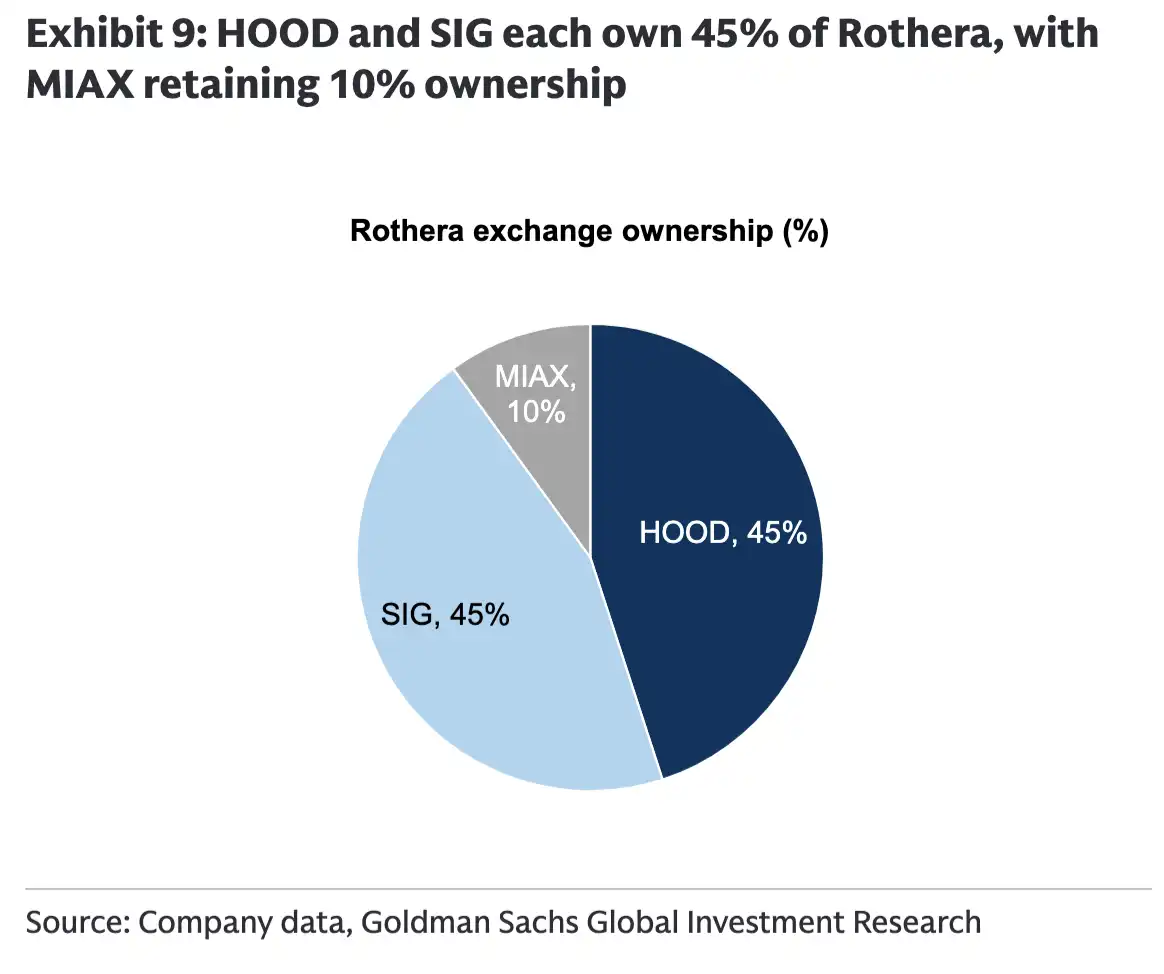
Caption: Robinhood consolidates all of Rothera's revenue and expenses, but only 45% of net profit belongs to Robinhood.
Rothera has ramped up quickly since its launch in late May 2026. In its first 41 days of operation, Rothera generated approximately $17 million in revenue, equivalent to an annualized revenue of about $150 million, and Goldman Sachs estimates its pre-tax profit margin has reached 45%.
The growth in trading volume is even more intuitive. Rothera completed only about 2 million contracts in May, which surged to 2.09 billion in June, approximately 1.688 billion in July, and then fell back to 593 million in August.
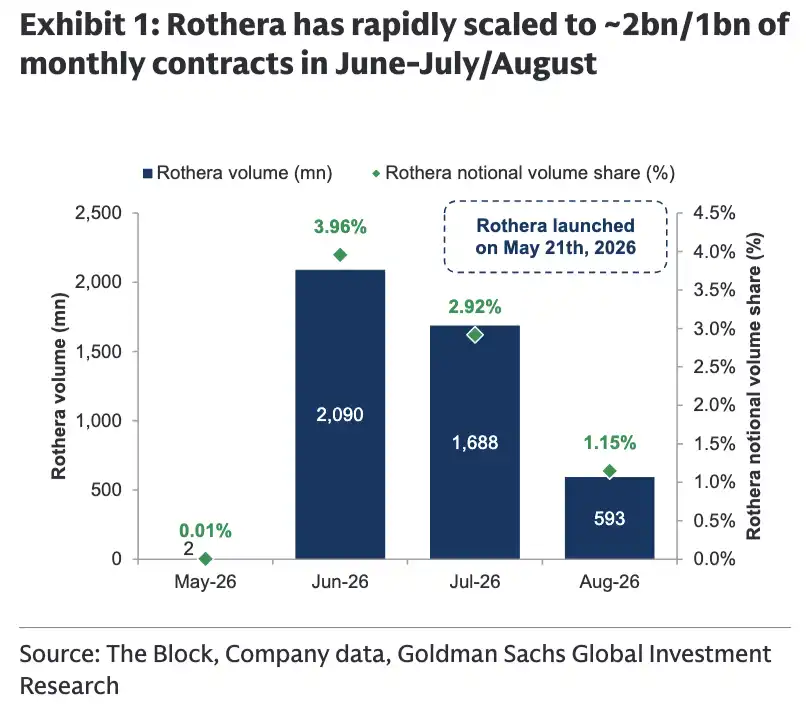
Rothera launched in May 2026, with contract trading volume exceeding 2 billion in June before declining.
By notional trading volume, Rothera became the world's third-largest designated contract market for prediction markets in July 2026 and ranked fifth in August, joining platforms such as Kalshi, Polymarket, Crypto.com, and Opinion in the top tier.
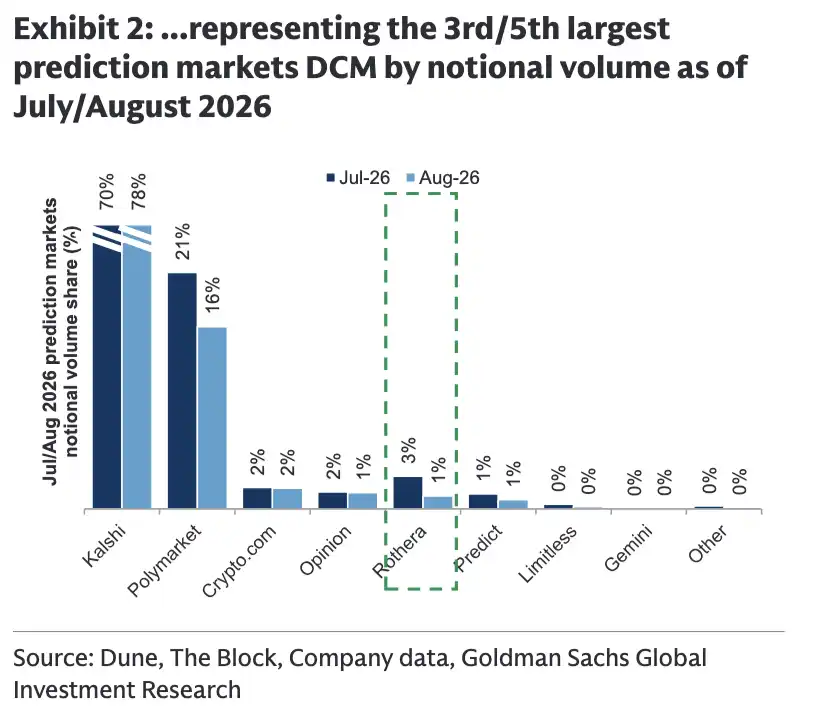
By notional trading volume, Rothera ranked third and fifth globally among prediction market DCMs in July and August 2026, respectively.
However, Rothera is still in an early expansion phase. Its notional trading volume share fell from about 3% in July to about 1% in August, and trading volume and rankings are also susceptible to sports event schedules, popular events, and market cycles. Entering the global top five in the short term demonstrates Robinhood's user acquisition ability, but it is not enough to confirm that it has established a stable market position.
Rothera initially offered almost exclusively sports event contracts, and only began adding political and economic products in August 2026, when these two categories each accounted for about 1% of trading volume. This means that Rothera's current activity is still highly dependent on the sports market, and product diversification has only just begun.
For Robinhood, Rothera's importance also lies in the change in business model. Previously, Robinhood primarily offered prediction market trading to customers as a futures commission merchant, or FCM, and then routed orders to designated contract markets such as Kalshi and ForecastEx. Robinhood collected brokerage fees, while external exchanges collected matching and settlement fees.
After Rothera's launch, Robinhood can participate in both the brokerage and exchange segments, retaining some of the revenue that previously flowed to external platforms within its own system. Prediction markets are thus no longer just a trading product for retail customers, but also an entry point for Robinhood to extend into trading infrastructure.
How Do Low Fees Unlock Liquidity?
Whether prediction markets can scale depends crucially on liquidity. Compared with stock markets, prediction markets have a large number of contracts with different themes, outcomes, and maturities, making trading volume more easily dispersed. If there are insufficient buyers and sellers, spreads widen, user experience deteriorates, and market activity is further weakened.
Goldman Sachs believes that Rothera has two sources of liquidity that are difficult to replicate.
The first source is Robinhood's retail customers. As of the report's publication, Robinhood had approximately 14 million monthly active users. As more prediction market orders are routed to Rothera, these customers can continuously provide retail flow to the exchange.
The second source is SIG's market-making capability. SIG is not only a large global market maker but also holds a 45% stake in Rothera, giving it an incentive to continuously provide quotes and liquidity to the platform. Robinhood supplies retail orders, and SIG is responsible for taking and matching liquidity; the combination of the two forms the foundation of Rothera's early expansion.
Low fees are another advantage for Rothera in attracting more orders.
Goldman Sachs estimates that the transaction prices of most event contracts on Rothera are concentrated in the $0.25-$0.30 range, or the symmetric $0.70-$0.75 range. Based on its dynamic fee model, the average exchange-level fee rate for retail takers is approximately 0.38%-0.42% per $1 of notional contract, significantly lower than the approximately 1.17%-1.31% level at other major prediction market exchanges.
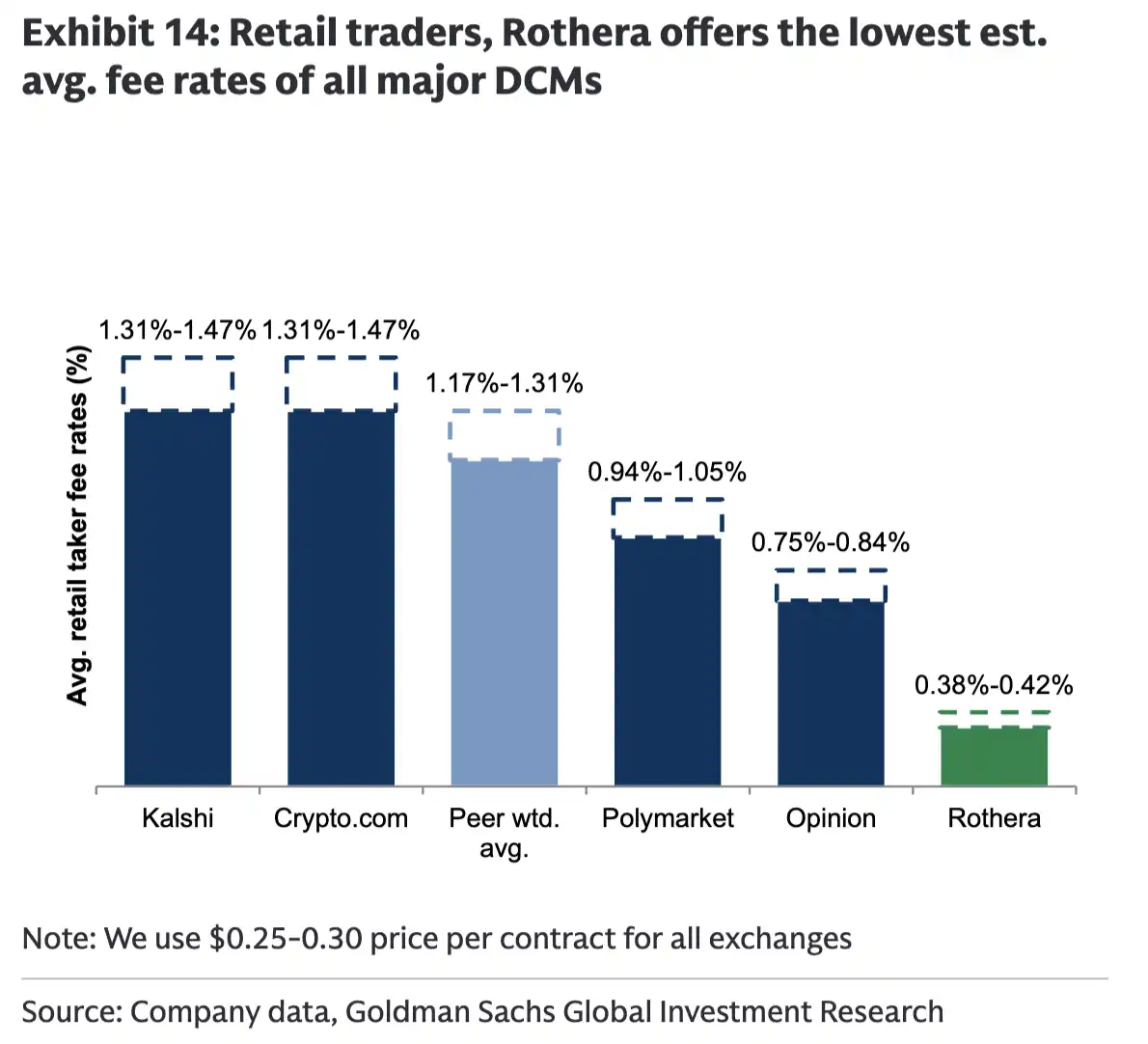
Goldman Sachs estimates that among major prediction market DCMs, Rothera offers the lowest average fee rate for retail traders.
Rothera does not use a uniform fee rate but a dynamic model tied to contract price and trader type. The closer the contract price is to $0 or $1, the lower the trading fee; the closer it is to $0.50, the relatively higher the fee rate. Professional trading firms and market makers also pay higher fees than ordinary retail customers.
The purpose of this pricing approach is to reduce participation costs for retail customers while charging higher fees to professional institutions to support platform liquidity.
Robinhood also adjusted its prediction market fee model after Rothera's launch. Previously, customers paid a fixed total fee rate of about 2%; after adopting floating pricing and routing some orders to Rothera, Goldman Sachs estimates that the average total fee rate paid by customers fell to 1.31%-1.42%, equivalent to savings of about 29%-34%.
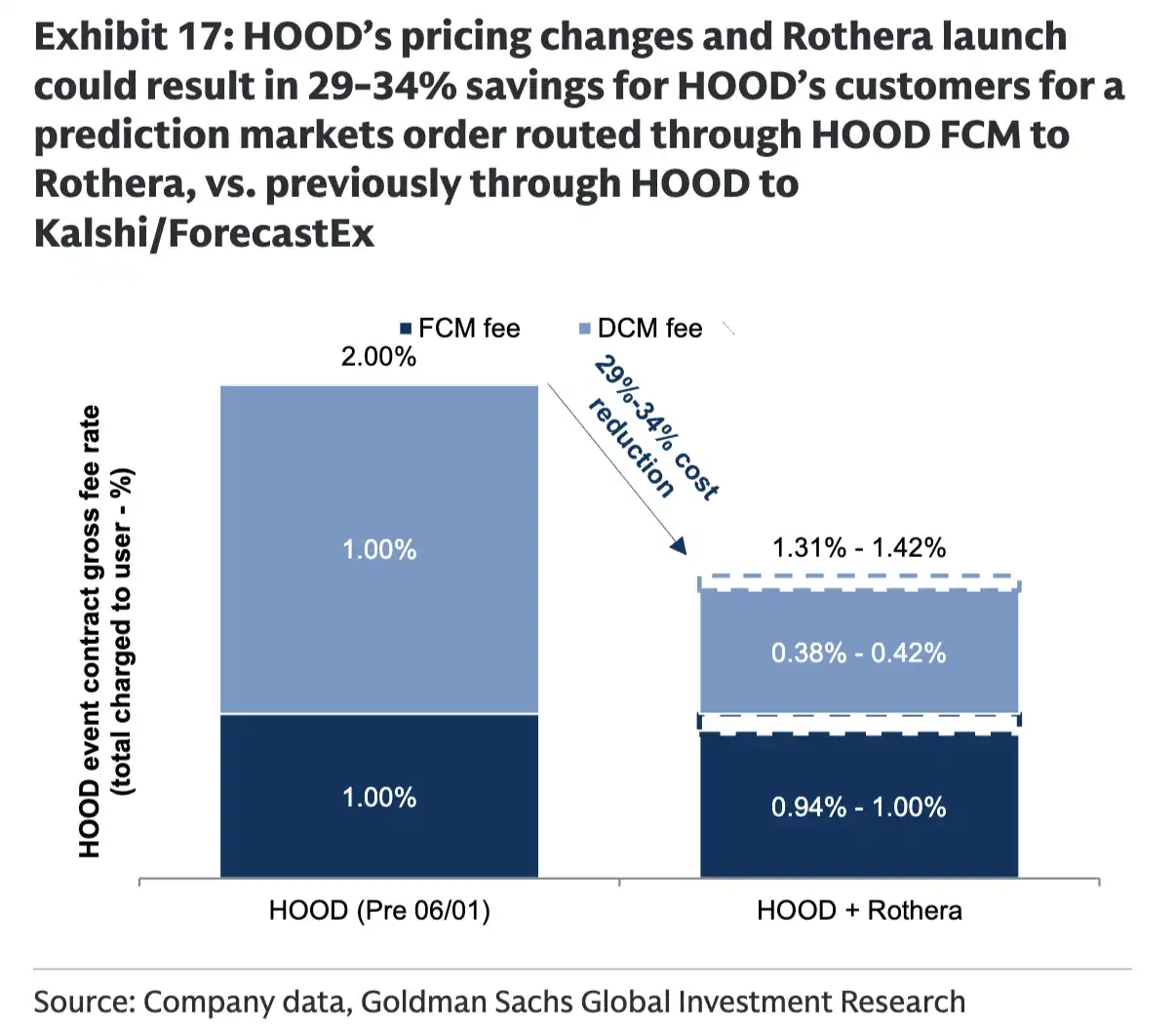
After adopting floating pricing and routing orders to Rothera, the total fee rate paid by Robinhood customers is expected to fall from 2% to 1.31%-1.42%.
For Robinhood, a decline in customer fee rates does not necessarily mean a corresponding decline in platform revenue. Because the company earns both brokerage fees and Rothera's exchange fees, Goldman Sachs estimates that before deducting non-controlling interests, Robinhood's nominal total fee rate may increase from about 1.25% previously to 1.31%-1.42%.
However, only 45% of Rothera's net profit belongs to Robinhood. After accounting for non-controlling interests distributed to other shareholders, Goldman Sachs estimates that Robinhood's effective prediction market fee rate is approximately 1.11%-1.19%, slightly lower than the previous level of about 1.25%.
Therefore, the value of this model comes mainly from long-term scale rather than an immediate increase in effective fee rates. Robinhood is essentially trading some short-term gains for lower customer costs, larger trading volume, and stronger control over trading infrastructure.
Rothera currently has only Robinhood as its sole FCM connection. If low fees can attract other brokers to join, the exchange can obtain orders from outside the Robinhood ecosystem and form a virtuous cycle of "low fees - more flow - deeper liquidity." But until external brokers access it at scale, Rothera remains highly dependent on Robinhood's internal order routing.
How Much Revenue Can Prediction Markets Contribute to Robinhood?
Goldman Sachs expects Rothera's revenue to grow from $87 million in 2026 to $307 million in 2027, and further to $444 million in 2028, accounting for 2%, 5%, and 6% of Robinhood's total revenue in the same periods, respectively.
Over the same period, Rothera's net profit attributable to Robinhood is expected to be $14 million, $58 million, and $94 million, respectively. As early investments decline and revenue scale expands, the fixed cost leverage of the exchange business is expected to be released. Goldman Sachs believes that its profit margin may converge toward the 55%-70% level of mature derivatives exchanges in the long term.
Rothera is only part of Robinhood's prediction market business. In addition to exchange revenue, the company also earns prediction market revenue from the brokerage side. Goldman Sachs expects Robinhood's total prediction market net revenue to reach $657 million in 2026, increase to $943 million in 2027, and reach $1.15 billion in 2028, accounting for 12%, 14%, and 15% of total company revenue, respectively.
Among these, Rothera's share of Robinhood's prediction market revenue is expected to rise from about 13% in 2026 to 33% in 2027, and further to 39% in 2028. This means that Rothera will gradually grow from a supplementary revenue source for the prediction market business into an important part of it.
Prediction markets are also the main reason Goldman Sachs' revenue expectations for Robinhood are higher than market consensus. Goldman Sachs' forecasts for prediction market revenue from 2026 to 2028 are 4%, 10%, and 14% higher than market consensus, respectively, while total revenue forecasts are 2%, 3%, and 3% higher over the same periods.
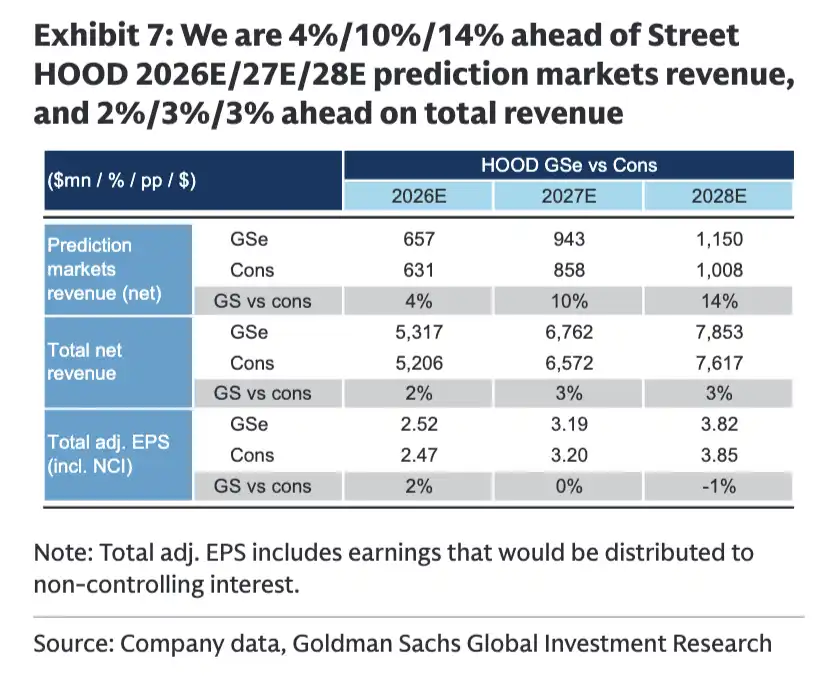
Goldman Sachs expects Robinhood's prediction market net revenue in 2027 and 2028 to be 10% and 14% higher than market consensus, respectively, but the revenue advantage is not fully converted into an EPS advantage.
However, the upward revision in prediction market revenue has not fully translated into earnings per share. Goldman Sachs' forecast for Robinhood's 2027 adjusted EPS is essentially in line with market consensus, and for 2028 it is even about 1% below consensus. This indicates that in addition to revenue growth, non-controlling interest distributions, product investment, and cost structure still affect final shareholder returns.
Rothera may also enter other exchange-traded products in the future. Goldman Sachs specifically mentioned perpetual futures, believing that its exchange license may provide room for product diversification. But this is currently closer to a potential option and is not yet suitable for inclusion in certain revenue. Whether related products can be launched still depends on regulatory approval, market demand, and specific execution progress.
Maximum Valuation of $19.5 Billion: What Does the Bull Case Require?
Goldman Sachs conducted a sensitivity analysis of Rothera's 2027 revenue, profit, and potential value using three scenarios: base, bull, and bear.
In the base case, Goldman Sachs expects Rothera's 2027 revenue to reach $307 million, with net profit of approximately $129 million, of which net profit attributable to Robinhood is approximately $58 million. This corresponds to an overall equity value of approximately $5.1 billion to $5.4 billion for Rothera, with value attributable to Robinhood of approximately $2.3 billion to $2.5 billion, equivalent to $2.50 to $2.69 per share.
In the bull case, Rothera's 2027 revenue could reach $359 million to $906 million, with net profit attributable to Robinhood of approximately $71 million to $195 million, corresponding to an overall equity value of $6.7 billion to $19.5 billion, and value attributable to Robinhood of approximately $3 billion to $8.8 billion, equivalent to $3.30 per share.
In the bear case, Rothera's 2027 revenue could be only $91 million to $242 million, with net profit attributable to Robinhood of approximately $15 million to $44 million, corresponding to an overall equity value of $1 billion to $3.6 billion, and value attributable to Robinhood of approximately $500 million to $1.6 billion, equivalent to $0.52 to $1.76 per share.
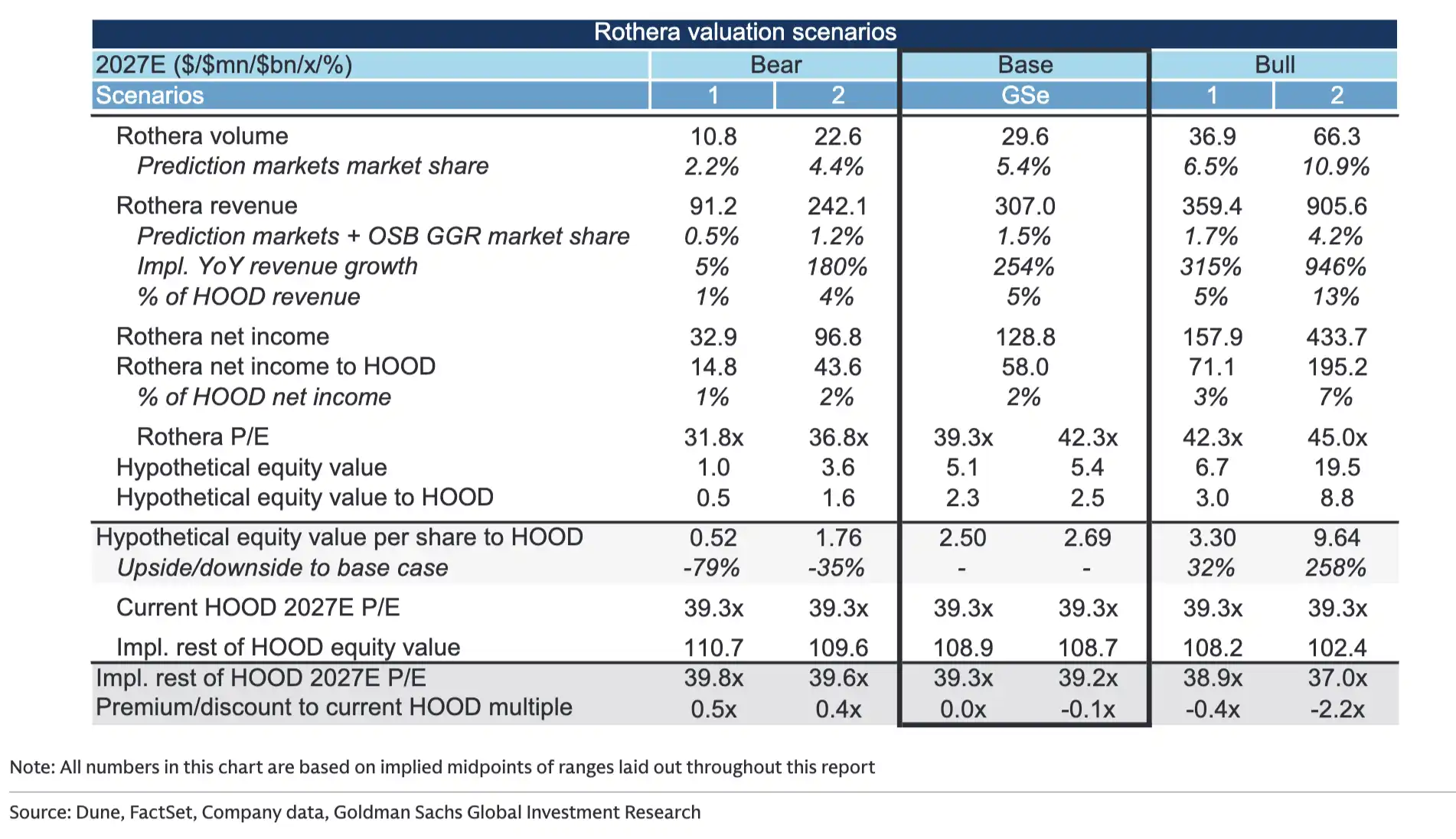
Under different growth scenarios, Goldman Sachs estimates Rothera's overall equity value at approximately $1 billion to $19.5 billion; value attributable to Robinhood is approximately $500 million to $8.8 billion.
Goldman Sachs combined the total gross gaming revenue of prediction markets and online sports betting into a potential market, citing high overlap between the two product categories. Its estimates show that the combined annualized revenue pool in 2026 is approximately $18 billion, and could grow to $20 billion-$21 billion in 2027.
Within this market range, Rothera's base case corresponds to a revenue share of approximately 1.5%; the bull case is approximately 1.7%-4.2%; and the bear case is 0.5%-1.2%.
The maximum valuation of $19.5 billion implies quite aggressive growth assumptions: Rothera's 2027 revenue would need to reach $906 million, a 946% increase from the previous year; Robinhood would need to continue routing large volumes of orders to the platform, SIG would need to maintain market-making support, more external FCMs would need to join, and the product range would need to expand from sports contracts to politics, economics, and other derivatives.
This also explains why Goldman Sachs' valuation range is so wide. Rothera's value depends not only on the overall growth of prediction markets but also on whether it can transform from an internal trading venue for Robinhood into independent infrastructure that can attract other brokers and traders.
Rothera can also partly explain Robinhood's current high valuation. Robinhood currently trades at approximately 39.3x Goldman Sachs' FY+2 earnings forecast, at the 87th percentile of the company's valuation range over the past five years, indicating that the market has priced in high growth expectations.
After excluding the value of Rothera attributable to Robinhood, the remaining business corresponds to an FY+2 P/E of approximately 39.2-39.3x in the base case; in the bull case it falls to 37.0-38.9x; and in the bear case it is approximately 39.6-39.8x.
This does not mean that Robinhood's remaining business is cheap. Even under the base case, the valuation of the remaining business is still at the 87th historical percentile and significantly higher than the average level of brokers and crypto asset-related companies. Goldman Sachs is willing to accept this premium mainly based on Robinhood's expected 22% revenue growth rate from 2026 to 2028 and the company's faster product launch pace.
Rothera provides a new support for Robinhood's valuation, but its investment logic still rests on the continued realization of high growth. Whether trading volume can be sustained, whether external brokers are willing to join, whether non-sports contracts can scale, and whether regulators allow continued product expansion will all determine which end of the $1 billion to $19.5 billion valuation range Rothera ultimately lands on.
What can be confirmed at present is that prediction markets have gradually evolved from a new product at Robinhood into an important variable affecting its revenue expectations and valuation framework. Whether Rothera can convert short-term trading enthusiasm into a stable liquidity network will be key to whether Robinhood's next phase of growth narrative can hold.
This content is for informational and educational purposes only and does not constitute investment advice related to BTCC. BTCC makes every effort but cannot guarantee the truthfulness, accuracy, or originality of the content above.