


Fomo Top 4 Trader AJC: Robinhood Chain Is the Best Play; PUMP and PONS Aren't Either/Or
 Blockbeats
Original title: AJC - Turning an 80% Nuke Into $3 Million on Robinhood Chain
Original source: threadguy
Original compilation: Azuma, Odaily News
Editor's note: This article is a video interview by podcast host threadguy with AJC, the Meme expert currently ranked fourth on Fomo's all-time profit leaderboard. AJC is also a researcher at Blockworks Research and has previously shared in-depth market analysis on multiple occasions.
In this Robinhood Chain rally, AJC is one of the few top traders with a public track record who is willing to share real strategies with the market. In the interview below, AJC not only discusses his own trading experience but also provides deep analysis on topics such as "the rise of Robinhood Chain," "PONS vs PUMP," and "stock & Meme pairings."
The following is the interview video content, compiled and translated by Odaily News:
Career Highlight
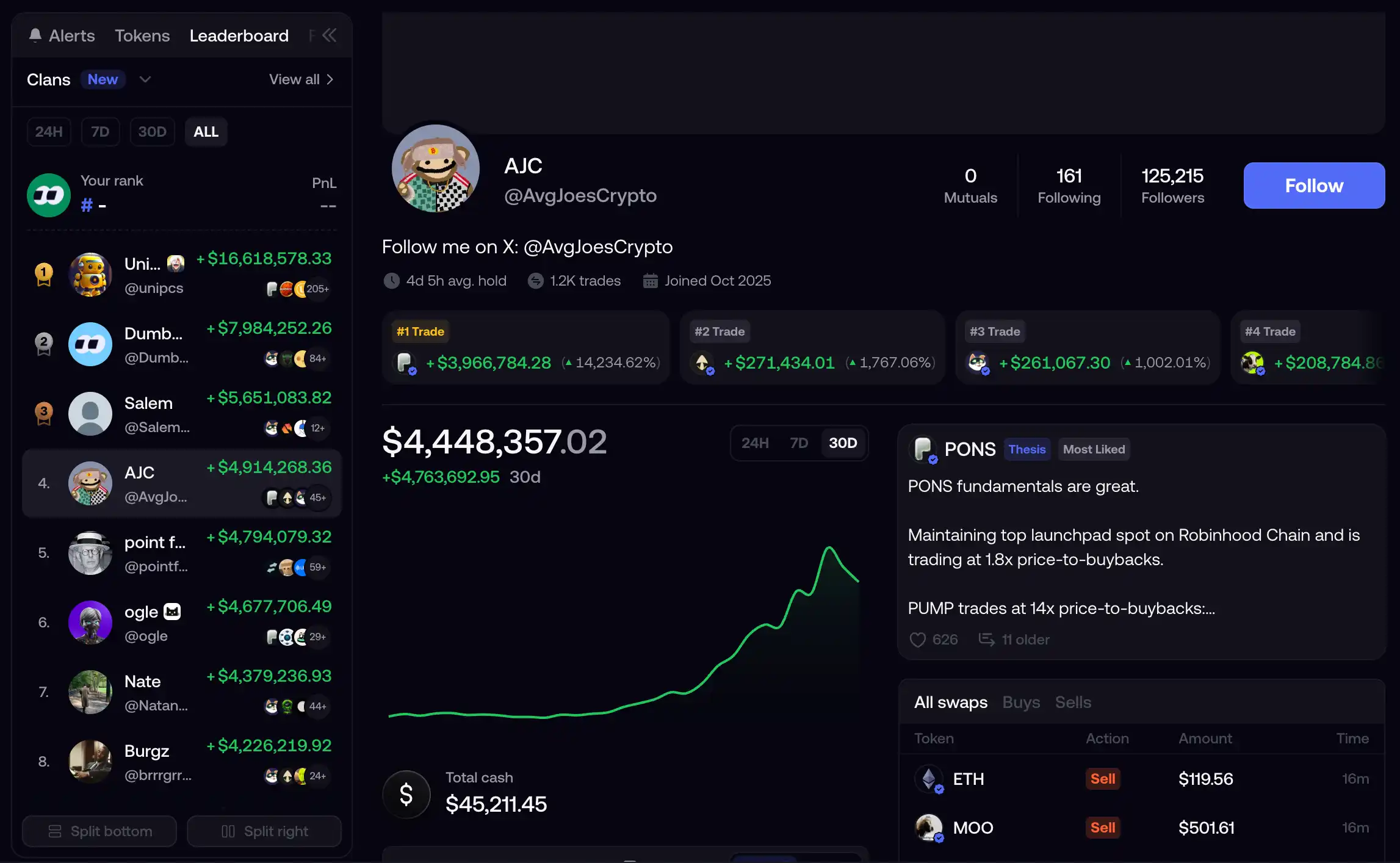
Host (threadguy): First of all, congratulations—this is definitely your moment. We were just looking at your Fomo account, and your assets have grown to nearly $3 million (close to $5 million as of publication), though most of that is still unrealized gains.
AJC: Haha, I have been taking some profits too. I sell gradually, but I'm not the type to dump my entire position at the top all at once.
So basically, every time I open the Fomo app, I might sell $1,000 worth of PONS.
Host: Well, I have to admit, you're better than me. You're already in the top ten on the leaderboard. Can you tell us what you've been through over the past month?
I've always thought you're a very sharp, accurate, and skilled trader, but this time it really feels like you caught a generational market move.
AJC: Okay. Honestly, it's all thanks to Robinhood Chain.
I have to confess, I actually missed the first wave when Robinhood Chain launched. That was right around the time Messari was acquired by Blockworks, and I was settling in over there, not trading very actively.
I knew Robinhood Chain was going to take off, but I thought, "There's still time, this thing won't go up that fast." Then Vlad (Robinhood co-founder and CEO) turned around and followed Cash Cat, and the whole situation changed instantly.
Fortunately, another opportunity came later—NOXA inexplicably shut down, essentially throwing away their own "money printer." At that point, I observed and thought, Robinhood truly values this chain, and you can see that from Vlad's social media. This is definitely not a flash in the pan.
Many people got tripped up by their preconceptions here, because the crypto industry has seen too many failed Layer 1 projects, but Robinhood is a beast of a completely different magnitude.
So I went and looked at the launchpads on the chain and found that besides NOXA, the one with the best data and momentum was PONS. At the time, I was completely in cash, watching it surge all the way to around $18 million market cap.
Then Brian changed his profile picture to that classic Meme avatar...
Host (interrupting): Haha, I remember that. It crashed all the Meme coins.
AJC: Right! It was insane. I was watching the charts too, and PONS dropped 80% in a day. Then I thought, okay, now's the time!
I decided to take a shot. Because by then I had already concluded that the top launchpad on Robinhood Chain should be worth a nine-figure market cap, and it had dropped to $4 million, and it was still the absolute leader. The worst case was I'd lose $25,000, but the risk-reward was just too good to pass up.
The process after that was also full of twists and turns. PONS went all the way up to a $60 million market cap, then fell all the way back to $10 million. During that time, I didn't sell a single token. The launchpads on Robinhood Chain were competing fiercely with each other, but ultimately PONS came out on top. I think a key reason PONS ultimately won is that it actually has its own token, which we can discuss in more detail later.
And in the last two weeks, the market started to reprice it. I basically just kept watching it, looking at the charts, and watching my expectations get fulfilled step by step.
So this period has been very chaotic, but on the other hand, the truly difficult part is already done. Now it's basically just sitting there and watching your "piggy bank" keep growing.
Robinhood Chain's Path to Success
Host: I wrote something in a Telegram group earlier—in crypto, "first-mover advantage" is often a disguised punishment. Look at early NFT launchpads, Vector, and so on. There are too many examples—you start too early, and later entrants can not only learn from your failures but are often more willing to bet big and take risks.
Honestly, when Robinhood Chain first launched, I was completely in a "oh, whatever" mindset—looking back now, that thought was absurd. Because Robinhood's approach is really interesting. If other centralized exchanges' chains launch later, they might adopt similar strategies.
Robinhood came in with an extremely well-thought-out plan, fully embracing on-chain culture, deeply understanding Meme coin mechanics, executing every step with military precision—no mistakes, no cringey over-marketing (triple shill), no weird deployment issues... They avoided all the rookie mistakes we've seen time and time again from traditional Web2 giants building on-chain products. Even the "soft shilling" of Cash Cat on the earnings call was perfectly calibrated. Did this whole playbook impress you, or did you think it was expected?
AJC: Half and half. First, Robinhood is a massive publicly traded giant. If they are determined to make their chain succeed, they have all the necessary resources and trump cards to get it done.
However, how thoroughly they embraced the on-chain native "degen" culture did surprise me at first. But thinking about it more, it makes complete sense, right? Think back to 2021—why did DOGE and SHIB explode into the mainstream? The core driver was Robinhood. Their user base is naturally highly receptive to these high-volatility assets.
So I think, from that perspective, it's only logical that they deeply activated this attribute. We might really have to give the Robinhood team credit—they keenly captured the market's emotional vacuum. At that time, on-chain players were generally deeply hurt by major exchanges and new Layer 1s. Everyone felt ignored, abandoned, and that no one really cared about retail.
And then, the most influential retail trading platform for the younger generation in America came in with its own chain, arms wide open, warmly embracing these on-chain natives. At that moment, everyone was like, "Holy shit." So their choice of entry path was indeed a bit unexpected, but Robinhood Chain's success is logically not surprising at all.
Where Are We in This Meme Cycle?
Host: How are you managing the active positions in your portfolio right now? Where do you think the explosion of the Robinhood ecosystem over the past two weeks fits into the broader narrative evolution? Where exactly are we in the cycle?
AJC: It's hard to predict precisely. My personal strength is keenly sensing the inflection point when something is about to take off, but once the market really gets going, I usually just ride the roller coaster and often end up round-tripping my profits. That's always been my style.
So I might not be the most authoritative person to answer "when to top out," but I think you can absolutely compare this wave to Solana in Q4 2023, or Base in Q1 2024—this is a brand-new ecosystem just emerging, and what's likely to follow is a long and sustained major uptrend, not a short-lived pulse. Right now is probably just the foreplay.
Of course, my portfolio is heavily positioned here, so I naturally want this scenario to play out, but I also genuinely cannot believe that if Robinhood is serious about moving all the US stock assets on their platform on-chain and truly opening the door to real-world DeFi, this chain could be just a flash in the pan.
I watched a podcast with Vlad, and his goal is to tokenize US stocks, collectibles, and even all asset classes in your portfolio on-chain. And these major moves haven't actually landed yet! Since the big guns haven't been fired, I find it hard to believe Robinhood Chain has already peaked.
Admittedly, the Meme coins and related stocks over the past few days have been a bit crazy. I remember yesterday Robinhood Chain captured around $3 million in network revenue in a single day, crushing a bunch of major Ethereum L2s.
So in the short term, due to the previous parabolic run, a local top is entirely possible, but I firmly believe that if the overall crypto market re-enters a bull market and the market is no longer stagnant, then the real alpha and the absolute main battleground will definitely be on Robinhood Chain.
Its retail distribution moat is just too wide. Ordinary people who know nothing about the complex mechanics of crypto naturally trust Robinhood's endorsement. They see US stock tokens on-chain and feel very comfortable and willing to try; and the lending, trading, and Meme derivative ecosystems built on top of these assets will naturally draw them in smoothly.
So my conclusion is that the short-term rally may be too fast and could see some volatility or a local top, but there will absolutely not be a scenario where "after the top, capital scatters and everyone goes back to their old chains." If you are firmly bullish on the crypto market over the next 6 to 12 months, you must allocate heavily to Robinhood Chain. That is the optimal way to capture this cycle's upside.
PONS vs PUMP
Host: Let me interject with a completely unimportant side note, then we'll continue. I saw that Ethereum mainnet now only captures about $4,000 a day in revenue through Robinhood Chain. That really shows how disastrous the L2 model is. But that's not important.
Back to positions—you're holding a massive PONS position. Actually, just a few months ago, I also became very interested in the on-chain ecosystem again, especially Pump.fun. At the time, Anon and Cash, two platform tokens, both went on nine-figure market cap runs, and my first reaction was "on-chain is about to go completely crazy, Pump's money-printing ability is insane." Solana was the obvious beneficiary, but I don't really like holding SOL spot, so I bought PUMP and Anon.
As Bitcoin broke out, the whole ecosystem exploded rapidly. And then the crypto world's narrative shifted faster than any traditional market—in just over ten days, the entire discourse was completely dominated by Robinhood Chain. Now mentioning Solana on a livestream even seems out of place, almost taboo. The speed of this shift is incredible.
So from a current trading perspective, how do you view the relative game between PONS and PUMP, and the Solana ecosystem versus the Robinhood ecosystem?
AJC: If I had to choose, I'd want to be long both. I don't think they are mutually exclusive zero-sum opponents.
Host: Do you currently hold PUMP?
AJC: I don't currently hold any PUMP, but I'm definitely a bull in spirit. I sincerely hope it keeps going up. I'm absolutely not a PUMP hater.
If you take a pessimistic PvP view, yes, PONS and PUMP are indeed competing for the same on-chain users and the same speculative liquidity, but I prefer to take an optimistic "grow the pie" view—Robinhood Chain will bring more brand-new incremental users from outside crypto on-chain, and that overflow of capital and attention will eventually feed back into other chains like Solana. Everyone can coexist and prosper together.
Think back to Q4 2024—while Pump.fun's revenue was growing parabolically, Virtuals was also surging at the same time. Both exploded in the same macro environment. So I would never view them as life-or-death opponents, nor do I think investors have to make an either/or choice. If PUMP goes up another 5x from here and returns to all-time highs, that would be a huge positive for PONS, because it directly raises the valuation ceiling for the entire crypto launchpad sector.
As for the Layer 1 tokens you mentioned, I completely agree. I don't hold any SOL either. If I had to bet on one dog between PUMP and SOL, I'd choose PUMP without hesitation. Because launchpad products are extremely unique—they are one of the few killer apps in the entire crypto industry with the strongest product-market fit (PMF). As you've emphasized many times, even in the depths of a bear market with extremely depressed sentiment, they can still rake in millions of dollars in real revenue per day.
You can mock this user base as a bunch of degens, but these people show up every single day to bet on the platform. You can have moral objections, but that's the reality.
However, the entire crypto capital circle has been obsessed with the so-called "institutional narrative" over the past few years—what do institutions like? How do we tell stories to institutions? This has led to launchpad protocols being severely and persistently undervalued. Everyone thinks "serious institutions won't touch this stuff," but look at Pump.fun's actual captured revenue—how many so-called top-tier institution-backed star projects does it completely obliterate?
Host: Indeed, the data is brutal.
AJC: So for me, this is a perfect target that is rare even in a bear market: it has proven, strong PMF; because of mainstream capital's bias and sidelining, it enjoys historically low valuation multiples; and the protocol's cash flow is abundant.
PUMP is an excellent expression of this logic, and PONS is also a great vehicle. My previous aggressive shilling of PONS was based on very simple logic—compare Pump.fun's revenue with PONS's revenue, and calculate their fully diluted valuation (FDV) multiples relative to buyback scale.
At the time, PUMP's FDV/buyback multiple was around 10 to 15x; and when I built my PONS position, that multiple was only about 2x, and later it even hovered between 1 and 2x.
If you believe the on-chain market is entering a bull market, then the logic follows naturally—both PUMP and PONS are severely undervalued. There's absolutely no need to do any long-short pair trade; if you're going to pair, the strategy should be "long both."
Host: But have you considered this question: when you calculate PONS's platform revenue, the hottest and top tokens on Robinhood Chain right now weren't actually launched from PONS. Isn't that a risk?
AJC: I don't think that's a problem at all.
Host: What if other competitors (like Long) suddenly launch a token?
AJC: I'm not sure if they will. I'm increasingly leaning toward a "horseshoe theory" of token launches—either you launch the token on day one of the product, or you never launch one.
I think this is exactly the core reason PONS was able to break out. There used to be an outdated belief in the industry that "launchpad platforms shouldn't launch platform tokens too early, otherwise the token price would set an invisible ceiling on the platform's ecosystem." But after being burned by so many shitty tokens and teams extracting value, on-chain retail has completely wised up—if you don't see a clear, tamper-proof token binding mechanism on day one, if you don't feel the team's interests are aligned with holders, users have no incentive to stay on your platform long-term.
This is the key to PONS's massive success. When PONS first came out, it wasn't even officially launched by the team—it was community-launched, and then the team directly did a community takeover (CTO), explicitly announcing: "This is our official platform token, and 80% of platform revenue will be used to buy back this token."
Retail immediately understood: "Okay, I can now use your platform with confidence, because you have a token that truly aligns interests, and you won't pocket all the trading fees for yourselves."
This is an extremely profound paradigm shift in the market, a complete 180-degree reversal from last year's logic. So for me now: if you're launching a new product, either bring out a token that empowers users on day one, or don't launch one at all.
The Magic of "Stock & Meme" Pairings
Host: Man, I actually think this might be one of the most important changes to ever happen on-chain. We seem to have finally reached a social consensus on "what makes a good token?"
The answer is: make money, and then use that money to buy back the token. Because tokens have always been the most terrifying cold-start tool for aggregating attention and initial capital. The crypto industry is on a completely different level in this regard. The biggest pain point in the market has always been: after raising money and attracting attention, what does the project actually do with it? Nobody knew.
Until Hyperliquid came in and set the example: "We figured it out—the money we make should be used to aggressively buy back our own token on the open market via TWAP." Of course, Hyperliquid is a special case—they make an absurd amount of money, and the team has no external VC pressure and was already rich, so they don't need to pocket the profits. At the time, the market said, "Don't expect every project to be Hyperliquid; that's an exception."
But then Pump.fun did it too, and then more tokens followed... The entire market has been following this logic: as long as a protocol has real revenue, it is fully capable of, and should, allocate a certain percentage to buybacks. Different projects may have different buyback ratios and different money-printing abilities, but this signal of real capital aligning with token holders has been completely absent for too many years. Before, it was all a bunch of vaporware, with founders dumping on retail through OTC deals, leaving retail completely devastated.
Continuing on the on-chain topic—before you made these latest millions, your social media was already on my must-read list, because your sense of smell for cutting-edge on-chain plays is extremely sharp. From early SocialFi, card packs, to the Railgun privacy narrative, you're always the first to catch new trends.
I've also mentioned on my livestream that the current on-chain game might be the one with the greatest "grand narrative ceiling" in history. Over the past few years, crypto loved to create value out of thin air—from early DeFi yield farming to junk asset lending, constantly getting hacked. Now, the world's most liquid, most trusted, and most solid real-world assets (US stocks, etc.) are being brought on-chain. Crypto's ability to "play with assets" finally has a solid foundation.
So I'm especially curious—what is your core investment thesis on the recently exploding Meme stocks? How high can it go? Are you really super bullish (gigapump) on the paired liquidity pool mechanism between stocks and Meme tokens?
AJC: Yes, extremely bullish.
This is interesting. Last time I was on, we talked about Zora. Actually, my fundamental understanding of Zora is 100% aligned with this. The reason I was extremely bullish on Zora back then was that they very early on grasped the core magic of AMM liquidity pools: you can forcibly bind the value of any two assets together through decentralized pools.
That's what drew me into Zora. Let me give a vivid example—do you remember that influencer guy who made the "aesthetic morning routine" video holding a Saratoga sparkling water?
Host: Yes, that video went viral and became a top-tier Meme.
AJC: At the time, someone on-chain immediately launched a Meme token around him, and the market cap once hit $20 million; meanwhile, the Saratoga sparkling water stock in the US stock market also got pumped and surged 100%.
But in the traditional environment at the time, these two pumped assets were completely disconnected at the fundamental value level—there was no channel for their capital to flow between each other.
Imagine if that influencer's Meme token had been directly paired with Saratoga's US stock token in an AMM liquidity pool? These two assets would instantly form a direct value link. Every time someone buys that Memecoin, the buying pressure would be mechanically transmitted to the underlying US stock.
Therefore, I highly advocate the paradigm of "pairing a Meme token with its true value driver at the base layer." As a counterexample, if you launch an AI-themed Meme token and pair it with ETH, what's the point? Nvidia surges, OpenAI makes a technological breakthrough—what does that have to do with Ethereum? Ethereum isn't going to moon because of the AI revolution.
The rational approach is to directly anchor that AI Meme token to Nvidia, or use platforms like Stock.fun to pair it directly with pre-IPO equity tokens of companies like Anthropic or OpenAI.
From this perspective, I am very confident that we finally have the ability to strongly bind the frenzy of real-world cultural assets with their true value carriers at the base layer. I can't guarantee it will reach hundreds of billions, but I firmly believe this will become the standard paradigm for future on-chain asset issuance—no longer mindlessly pairing with SOL or ETH, but pairing with the underlying benchmark asset that best matches its logical attributes.
Look at how many people on Solana are aping into all kinds of junk dog coins every day. If this massive capital flow shifts to the stock Meme space, the valuation ceiling for tokens will be completely shattered. If you want to be long-term bullish on the US-listed company Hims, you just buy BONER—the underlying logic is the same: if Hims stock goes up 500% in the future, under the liquidity pool mechanism, BONER will also see an astonishing correlated surge.
So I am extremely bullish on this sector from a fundamental mechanism standpoint.
Host: Let's dig into the technical details. I know many people might be afraid to break this down, but you definitely know your stuff—when we use a US stock token (like HIMS stock) to buy an on-chain paired token (like BONER), what exactly happens in the underlying on-chain smart contracts and liquidity pools?
AJC: Let me break it down simply.
First, there is a batch of officially recognized US stock tokens on Robinhood Chain. These tokens must be minted and brought on-chain by whitelisted market makers. For example, Rialto is one of the proprietary AMM market-making institutions on Robinhood Chain.
The specific purchase process is as follows: suppose an ordinary user wants to buy $100 worth of BONER. This is essentially equivalent to indirectly purchasing $100 worth of Hims US stock spot.
1. The user holds a universal stablecoin (like USDG);
2. The system uses this $100 to buy an equivalent amount of on-chain HIMS stock tokens through the market-making channel;
3. These HIMS stock tokens are injected into the BONER/HIMS AMM liquidity pool;
4. Finally, the user receives $100 worth of BONER tokens.
Host: Got it! So on the surface, it looks like you're selling Hims to get BONER, but actually the capital flow is injecting US stock tokens into the underlying liquidity pool, thereby locking in the stock spot.
AJC: Yes, exactly! You can think of it as depositing HIMS.
This also explains another core phenomenon: for example, the recent moves in AMC stock and its on-chain token CINEMA. At the time, the on-chain AMC spot liquidity was very thin, only about $40,000, causing a severe depeg in the on-chain price.
And the only motivation for traditional institutions to bring real-world US stock spot on-chain is "risk-free arbitrage." As long as the frenzied buying of on-chain Meme tokens pushes the price of the stock token in the pool up by even 0.5%, traditional arbitrage market makers will immediately buy spot in the US stock market, mint tokens cross-chain, and dump them on-chain to capture the premium.
This is the underlying flywheel that forcibly drags real US stock liquidity on-chain. Yesterday alone, the total value locked (TVL) of real-world assets (RWA) on Robinhood Chain surged by more than 30%. This mechanism is indeed working at scale, but there is a very fatal risk hidden here: US stock tokens can only be minted and redeemed during regular US stock trading hours (or extended pre-market and after-hours sessions).
On weekends, when the US stock market is closed, all mint and redeem channels are locked. This means that when certain tokens experience a sudden pump on the weekend, the on-chain liquidity pool cannot arbitrage to stabilize the price—for example, the on-chain AMC token was once pushed to a high of $400, while the actual off-exchange stock price was nowhere near that! Market makers cannot enter to arbitrage until the market opens on Monday.
So everyone must be extremely cautious when trading. Never blindly buy these stock-paired tokens on weekends when the US stock market is closed, or when on-chain pool liquidity is extremely scarce, otherwise you are simply handing market makers a huge profit opportunity.
Host: What if HIMS stock suddenly hits a black swan during US trading hours and crashes 50% in 15 minutes? Will BONER crash with it? Why?
AJC: It will definitely crash.
Because AMMs follow the classic constant product formula (x * y = k). The pricing logic of the two assets in the pool is strongly bound. Under a pure vacuum assumption with no additional retail buying or selling, if the external fair fiat value of one asset (HIMS stock) is cut in half by 50%, then to maintain the relative balance of the pool, the fiat-denominated book value of the other asset (BONER) will also instantly lose 50%.
Host: So they are truly 1:1 deeply bound at the physical mechanism level!
AJC: Yes. Of course, in actual trading, retail buying and selling will disturb the ratio. For example, if the stock is halved, but retail develops faith in BONER at that level and frantically buys the dip, the decline might be partially offset; but if you completely remove external buy/sell variables, the two are 1:1 mirror-linked at the fundamental value level.
Host: This design is genius! It perfectly confirms the Saratoga case you mentioned earlier.
I was also obsessed with AMC a few months ago. AMC is extremely good at playing games with its stock price. In 2022, in order to raise funds and dilute without directly issuing more common stock, they created a preferred stock called APE, airdropped 1:1 to all AMC shareholders. That thing ultimately failed miserably and went to zero, but they managed to extract hundreds of millions of dollars from it.
If it were today, why couldn't AMC directly issue an official APE token on Robinhood Chain? AMC's current actual total market cap is only about $2 billion—now an AI Meme that runs on-chain can reach $300 million, GOAT once hit $1.5 billion, not to mention other top-tier Memes. If AMC management wanted to inject endless buying liquidity into the common stock, this would definitely be a better channel!
Vlad would never publicly talk about an ordinary company like AMC, but if it were an APE token doing billions of dollars in daily trading volume on Robinhood Chain, that would be a super narrative that rewrites industry perception.
So I agree with you—the marginal expectations for stock Memes have been completely elevated to an incredible level. The ceiling for an AI token on Solana might just be a random tweet from some unranked programmer at OpenAI, but the narrative ceiling for a top stock Meme could be the CEO of a listed company himself, or even the entire Wall Street retail army!
AJC: Theoretically yes, but I personally hold a conservative view: listed companies directly issuing Meme tokens in an official capacity still faces huge regulatory and legal resistance. Although the regulatory framework is gradually becoming clearer, listed companies touching security-like tokens is still a high-voltage line.
However, I am certain that in the future, there will definitely be some small-cap listed companies that dare to embrace Meme token communities. The playbook might lean toward "community rewards and culture building"—for example, holding that Meme token unlocks exclusive merchandise discounts or certain shareholder-level perks, recreating the 2021 NFT community playbook.
But that's not what comes first. I think the first ones to charge in will definitely be the WallStreetBets (Reddit retail army) crowd. They will quickly realize that using the liquidity leverage of on-chain stock Memes is an excellent new financial tool to trigger short squeezes in US stocks!
Of course, I personally declare that I do not encourage or participate in any market manipulation.
We've actually already seen early signs of this on-chain. Some heavily shorted small-cap stocks, after being tokenized, have seen retail use aggressive on-chain capital to push prices up, trying to force traditional market shorts to liquidate.
Of course, all of this could also be crypto-native self-congratulation—maybe outside the crypto circle, nobody cares about this underlying mapping, and once the hype fades, everyone leaves. But in the crypto world, maintaining long-term optimism often leads to outsized returns.
Traditional US stock companies can reach a whole new generation of Gen Z buyers who would never have bought their stock in their lifetime. I might never go to an AMC theater, but if your token gives me a discount on movies and lets me make money on-chain, I'm willing to indirectly hold AMC.
This sector just fully ignited last week, and the ceiling cannot be measured with old eyes. You know, a new animal dog coin on Solana can at most reach tens of millions of dollars, but how high can the leader of the combination of top US stocks and on-chain frenzy go? Nobody knows.
Facing a brand-new game, being in the game is the most exciting part.
Where Are Majors Headed?
Host: One last question—today's conversation has been incredibly thorough and exciting. What do you think about the current trend of major coins (Majors), and where are we in the crypto cycle? Especially Bitcoin—where do you think the market is headed next?
AJC: I am a perma bull on Bitcoin. I am always bullish on Bitcoin.
In my view, the worst-case extreme scenario has already happened. For example, when Bitcoin dropped to around $60,000, the market was full of panic and shorting pressure, but the price simply couldn't go lower. Since even that situation couldn't push it further down, aside from an uncontrollable "complete collapse of global macro liquidity," I find it hard to imagine what could cause Bitcoin to make a significant new low. Of course, macro black swans are outside my circle of competence, and I don't have unique insights, so I simply don't use them as a baseline variable to over-presuppose.
For now, I think the market is in a healthy "bullish consolidation" phase. After a strong upward impulse earlier, Bitcoin and the entire crypto market have actually been severely suppressed and washed out enough over the past year or so. I see some people casually saying, "Oh, this bear market didn't drop that much." From the perspective of absolute drawdown in USD terms, it might not look that dramatic on paper.
But if you measure the drawdown of crypto assets against gold as the benchmark, the decline is absolutely brutal.
Host: Yeah, compared to gold, it's devastating.
AJC: As an old player who has been through three complete crypto bear markets, I personally feel this bear market has been the worst in terms of psychological torture so far.
The last bear market was actually clear-cut: everyone knew exactly why it crashed—a bunch of obvious Ponzi schemes blew up, Three Arrows Capital collapsed, FTX completely imploded. The reasons were very specific and transparent. Everyone knew where the cancer was. As long as you digested the liquidation pressure and the remaining landmines, the market could bottom and rebound.
But this cycle's decline has been inexplicable, and the market has been extremely gloomy and fragile. People can't figure out where the core suppression is coming from. The unknown is the most terrifying—if you can't even diagnose the cause, you have no idea when this cloud will ever fully dissipate.
Host: Completely agree, 100% that feeling.
AJC: But precisely because of this, my core view now is: the crypto market has been suppressed for too long, and it is desperately eager to explode upward at the slightest catalyst. Almost everyone off-exchange is sitting on the sidelines in cash.
Look at the market's violent reaction to some macro liquidity easing expectations or policy comments a while ago—as soon as there's a whiff of sentiment shift, capital frantically rushes to buy.
I cannot accurately predict what specific bullish catalyst will ignite the next super major uptrend, but the strongest signal released by this pulse rebound is that the current crypto market is actively looking for any reason to go up, and it will eventually find enough reasons.
At the current level, the reasons for further deep declines are few and far between; but the potential bullish catalysts that could ignite a rally are countless. That is my fundamental assessment.
Host: Well said. Brother, once again, heartfelt congratulations on this dream-like winning streak. I've really enjoyed following every step of your trading. You are absolutely on the front lines when it comes to sensing the pulse of the market.
Talking with you is always an unparalleled pleasure. Thanks again for coming on the show!
This content is for informational and educational purposes only and does not constitute investment advice related to BTCC. BTCC makes every effort but cannot guarantee the truthfulness, accuracy, or originality of the content above.