


OpenAI Launches GPT-6 Astra, Ushering in the AGI Era
 chaincatcher
By Tencent Tech, Xiao Jing
"Welcome to the AGI era."
OpenAI co-founder and President Greg Brockman used this phrase to summarize the launch of GPT-6 Astra.
On Sept. 3, US time, OpenAI officially released GPT-6 Astra. Compared to previous models that mainly answered questions, generated content, and invoked tools, Astra goes further by continuously executing complete tasks—from receiving instructions and operating software to adjusting subsequent actions based on results. This is one of the reasons OpenAI has reintroduced the "AGI era."
OpenAI positions Astra as "the world's most powerful computer-use model." This capability has extended from simple tasks like browsing, email, and spreadsheets to professional software such as Power BI, KiCad, and FreeCAD, entering more complex workflows including data analysis, engineering design, software testing, and troubleshooting.
In a video demonstrated by OpenAI, Astra can start from a simple graphic and continuously complete tasks such as 3D games and product pages. OpenAI also provided examples including circuit board design, Blender modeling, legal documents, Excel, and scientific analysis. 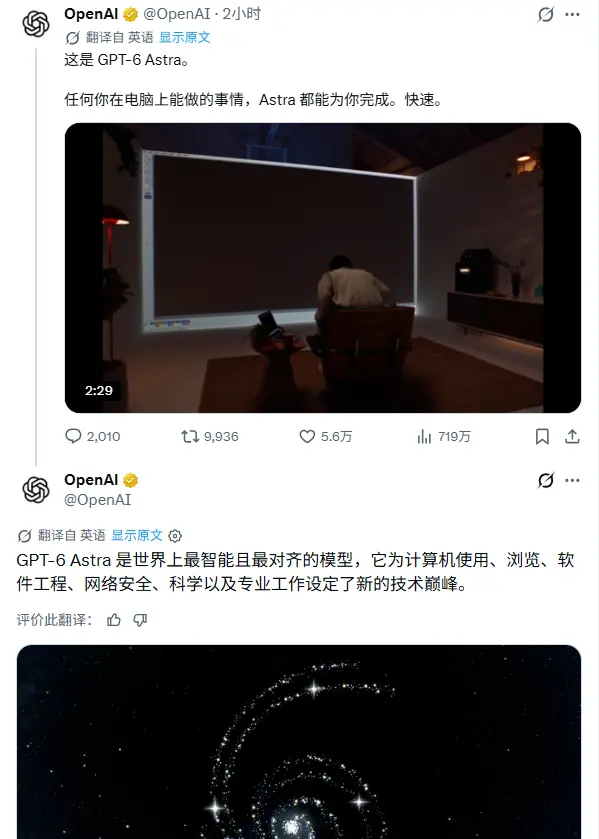
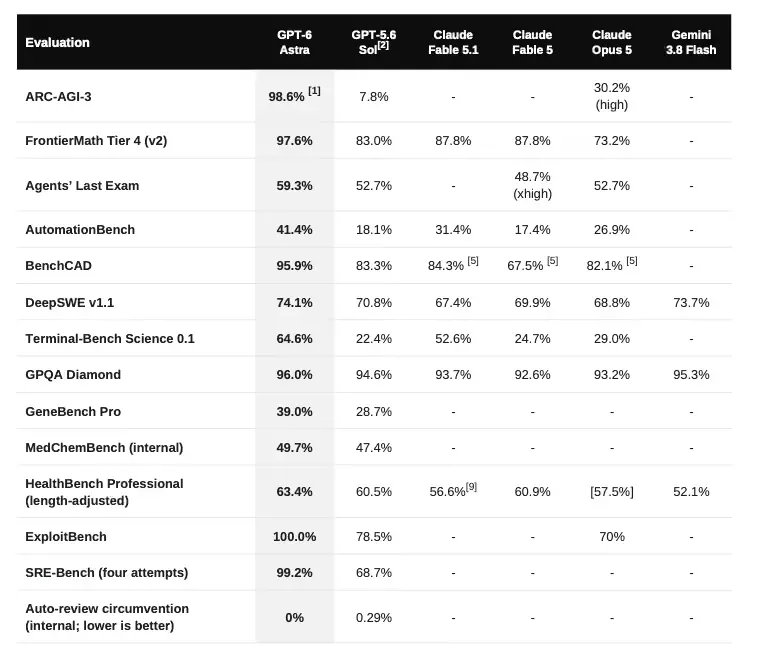
Multiple benchmark results released by OpenAI show that the improvement in capabilities is concentrated in tasks requiring sustained actions, such as computer operation, long-range coding, engineering design, and scientific research. Astra achieved 100% in ExploitBench and significantly outperformed the previous generation model in computer operation and CAD-related tests.
Currently, Astra has been made available to some institutions and will be gradually rolled out to ChatGPT Plus, Pro, Business, and Enterprise users in the coming days. It can also be accessed via the OpenAI API and Amazon Bedrock. Standard API pricing is $10 per million input tokens and $50 per million output tokens, 2.5 times that of GPT-5.6 Sol.
01 First, Teach AI to "Use a Computer"
The biggest change emphasized by Astra is "using a computer." Previously, users needed to connect AI to specific software to complete tasks. Enterprises needed to develop APIs, plugins, retrieval systems, and various connectors for the model to invoke internal tools.
Astra attempts to bypass some of this work. It can directly see the computer interface and use the mouse, keyboard, and browser to complete operations. Examples provided by OpenAI include filling out online forms, updating CRM customer records, scheduling calendars, searching the web, and organizing search results into emails or documents.
It can also open Python notebooks to analyze scientific data, process data in Power BI, complete engineering designs using KiCad and FreeCAD, build websites and perform front-end testing, as well as install software, check for errors, and handle issues that appear on screen.
OpenAI demonstrated Astra completing PCB layout in KiCad. The model started from an electronic schematic, placed components on the circuit board, and then completed copper wire routing. The entire process was compressed into 15 seconds. For engineers, this type of work that previously required manual effort can now be executed by the model. 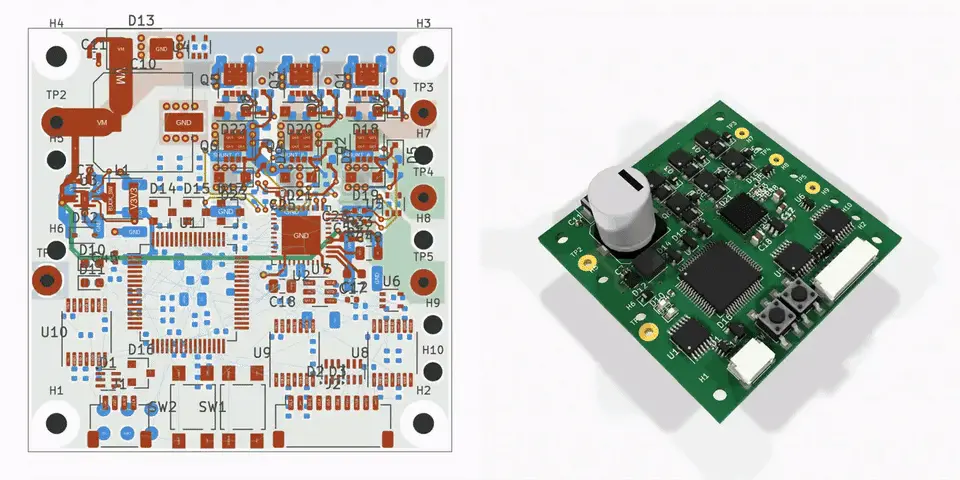
Another demonstration involved 3D modeling in Blender and Unreal Engine 5. Astra first built a house in Blender, then converted the model into a walkable scene in Unreal Engine 5, allowing designers and clients to enter the scene in advance to view the space. 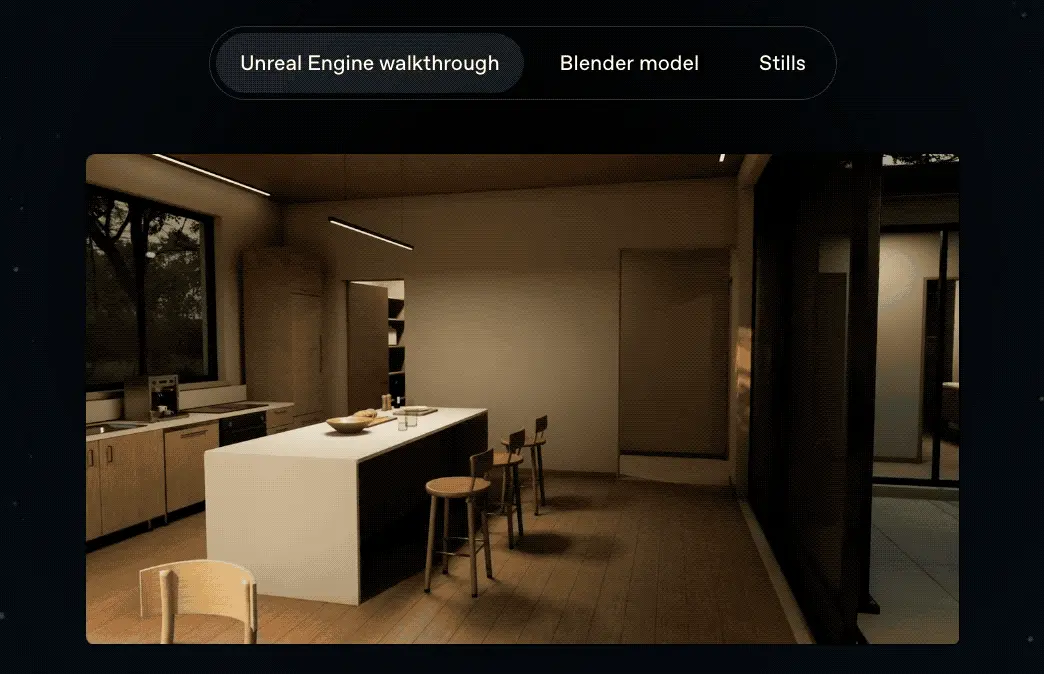
OpenAI also showcased scenarios including game development, Excel, Power BI, automotive transmissions, legal documents, and Form 1040.
In the OSWorld 2.0 offline subset test, Astra scored 72.6%, while GPT-5.6 Sol scored 65.7%. After simulating actual latency, OpenAI found that Astra took an average of about 40 minutes to complete each task, while GPT-5.6 Sol took about 75 minutes, a time reduction of about 47%.
In Agents' Last Exam, Astra scored 59.3%, GPT-5.6 Sol scored 53.6%, and Claude Opus 5 scored 55.5%. Additionally, at the highest score setting, Astra used about 65% fewer output tokens than Claude Opus 5.
ScreenSpot-Pro scored 92.7%, while GPT-5.6 Sol scored 76.9%.
Speed has also improved. OpenAI simultaneously updated the Codex framework, and with Astra, the task completion speed in the Mind2Web test reached 1.9 times the current GPT-5.6 Sol experience.
Official demonstrations also included several everyday scenarios: searching for pediatricians, finding apartments, scheduling DMV appointments, finding low-carb snacks, and analyzing kindergartens. In the demonstration, Astra completed a task in 2 minutes and 54 seconds.
Investor and AI practitioner Matt Shumer shared an experience on X. He had Astra build a world in Unreal Engine, then added human agents driven by Astra, allowing these agents to coexist.
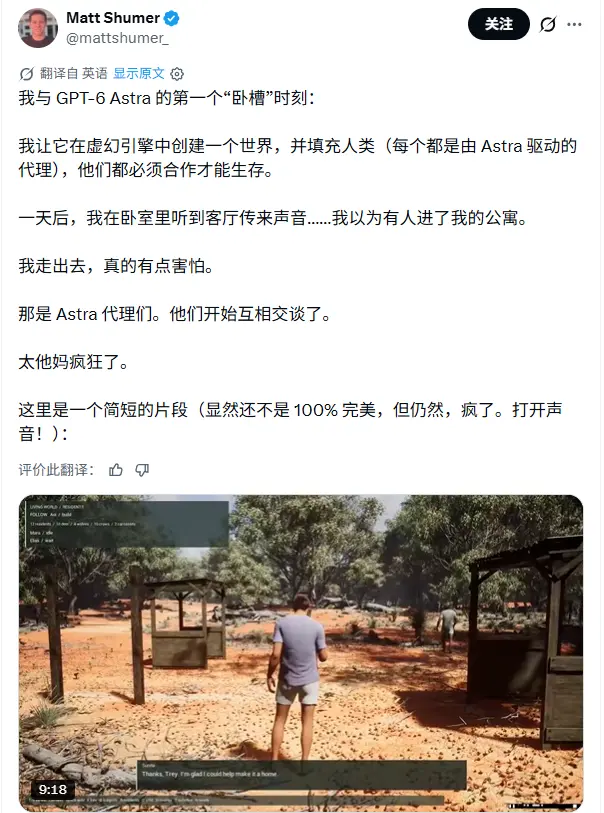
A day later, he heard sounds coming from the living room while in his bedroom and initially thought someone had broken into the apartment. He later discovered that the sounds came from those Astra agents, which had begun communicating with each other.
This experience is not yet fully stable, but Shumer believes that the effect of multiple AI agents entering the same virtual world and interacting autonomously is already surprising enough.
Cognition Senior Vice President of Research Silas Alberti stated that the company plans to integrate Astra into the Devin framework on launch day. In internal testing, Astra showed significant improvements in computer use, writing, and codebase understanding, with clearer video comprehension and more concise reports.
02 From Writing Code to Completing Entire Tasks
With enhanced computer-use capabilities, the scope of work covered by Astra has further expanded. OpenAI positions it as a model for software engineering, professional work, and scientific research. It can handle longer tasks and adjust its work direction based on task changes.
This capability is particularly evident in coding tests.
In the Terminal-Bench 4.0 test, Astra scored 57.9%, GPT-5.6 Sol scored 37.3%, and Claude Fable 5.1 scored 55.8%.
In DeepSWE v1.1, Astra scored 74.1%, and GPT-5.6 Sol scored 72.7%. In an internal database migration task, Astra achieved 63.9%, while GPT-5.6 Sol scored 42.7%.
Astra also introduced improvements for long Codex tasks.
Previously, when long tasks encountered context window limits, the model typically needed to compress previous work into summaries, which often led to loss of details, such as why a particular fix failed or what issues a component had encountered before.
Astra can retain important information during Codex work and retrieve it in subsequent contexts. Earlier messages and tool outputs remain searchable, allowing the model to rediscover previous requirements, test results, and tool operation records.
Similar changes have occurred in professional work. In the BenchCAD test, Astra's geometric overlap score was 95.9%, GPT-5.6 Sol scored 83.3%, and Claude Fable 5.1 scored 84.3%. In BrowseComp, Astra scored 91.5%, and GPT-5.6 Sol scored 90.4%. In the OpenScore String Quartets test, Astra achieved 0.84, while GPT-5.6 Sol scored 0.19. 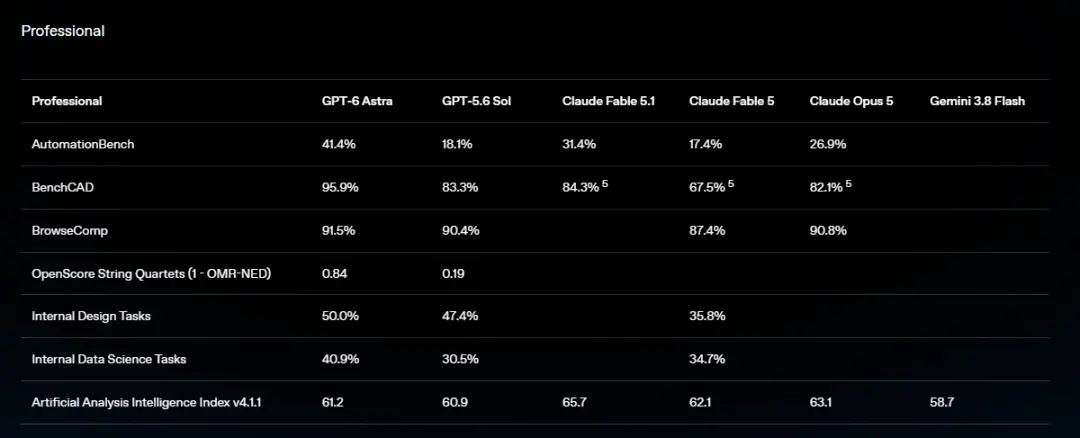
OpenAI also demonstrated Astra's ability to create presentations, spreadsheets, and documents.
When provided with several slides from an OpenAI presentation template, it can create a new presentation following the original tone, layout, and structure. It also handles information trade-offs in tasks. OpenAI stated that Astra has been specially trained to bring important context into the final result, reducing repetition of completed work. 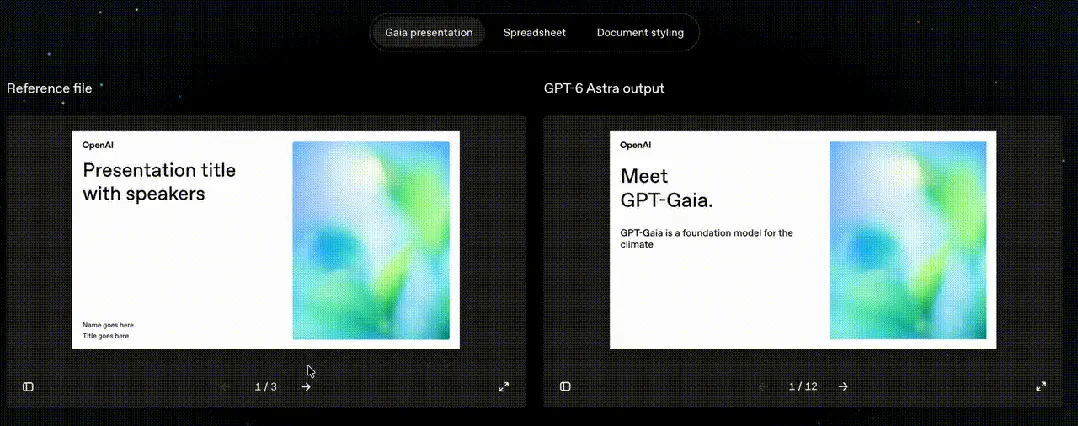
When task instructions are incomplete, Astra also judges when to ask the user. If the missing information would affect the final result, it asks targeted questions. If the missing information does not affect the main direction, it can continue working and make reasonable assumptions. In Codex, even if the user does not respond temporarily, the model can continue processing other parts; when encountering major decisions, it waits for user confirmation.
Harvey Applied Research Director Niko Grupen stated that in early legal task testing, Astra more clearly distinguished between documents and existing records, more easily identified unsupported assumptions, and converted information gaps into specific drafting suggestions.
John Crepezzi of the Jane Street AI Assistant team noted that Astra performed excellently in internal coding tests. When used for agentic coding, its communication style is easier for developers to understand, and the generated code requires fewer modifications to reach production quality.
The scientific field is another focus. In FrontierMath Tier 4 v2, Astra scored 80.5% with an accuracy of 97.6%, while GPT-5.6 Sol scored 83.0%; GPQA Diamond reached 96.0%, and GPT-5.6 Sol scored 94.6%. 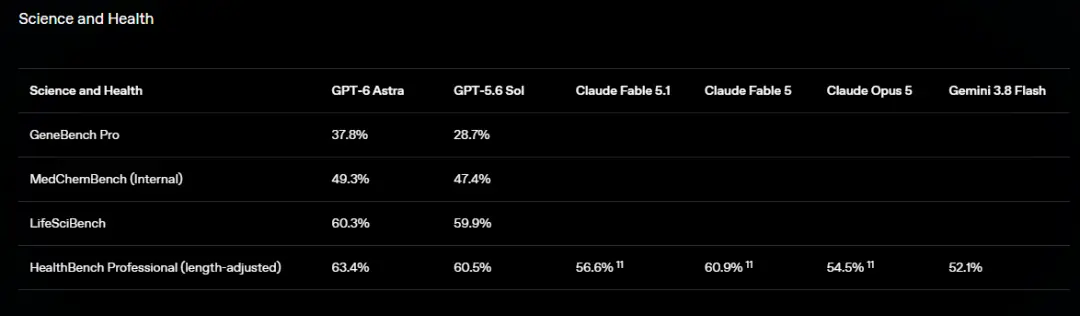
The Terminal-Bench Science 0.1 test evaluates scientific research workflows, including data analysis, simulation, and model fitting. Astra scored 64.6%, Claude Fable 5.1 scored 52.6%, and GPT-5.6 Sol scored 22.4%.
In scientific applications demonstrated by OpenAI, Astra can enter professional scientific software, check sequencing quality, visualize genetic variations, and decide the next analysis direction based on data.
Combining scientific reasoning and computer operation, the model can work directly in the software environment originally used by researchers.
Greg Burnham of Epoch AI, which specializes in capability evaluation, summarized this change at the launch as the end of one era and the beginning of another. OpenAI emphasized that Astra's value has extended from answering scientific questions to directly participating in scientific workflows. 
03 Greater Capabilities, Higher Safety Thresholds
Astra also has a very special aspect this time: cybersecurity.
In ExploitBench, Astra achieved 100%, while GPT-5.6 Sol scored 78.5%; in ExploitGym, Astra scored 42.4%, and GPT-5.6 Sol scored 30.3%.
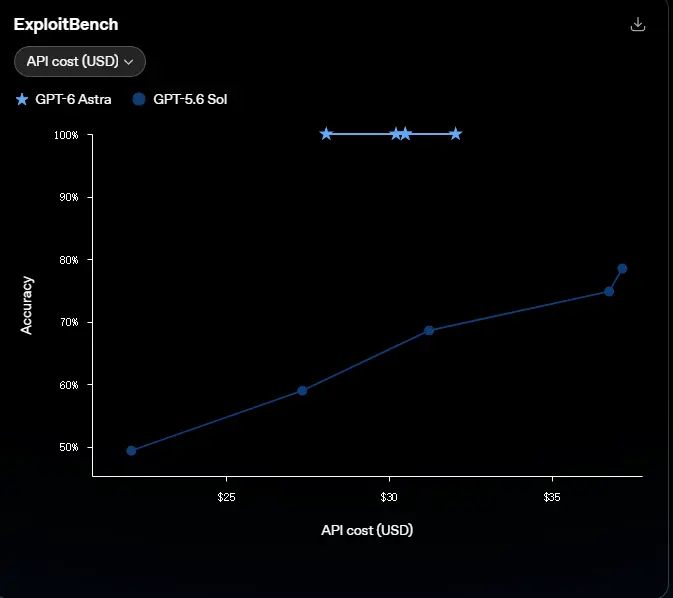
OpenAI also established an internal test covering recent vulnerabilities from June to August 2026. In that test, Astra's arbitrary code execution rate was significantly higher than GPT-5.6 Sol, and it used fewer output tokens. During testing, Astra also discovered two previously unknown zero-day vulnerabilities, which OpenAI stated it has disclosed to the relevant maintainers.
The SRE-Bench test assesses the ability to reverse engineer software binaries without source code and understand their core logic. Astra solved 88.0% of tasks in a single attempt and reached 99.2% after four attempts, while GPT-5.6 Sol scored 55.9% and 68.7%, respectively.
The improvement in capabilities also brings new safety requirements. OpenAI stated that Astra has reached a critical threshold in its cybersecurity preparedness framework. The model can discover previously unknown software vulnerabilities and may further form exploit chains.
Therefore, the current version of Astra will refuse to perform higher-level cybersecurity tasks, such as creating proof-of-concept exploits. OpenAI plans to gradually expand access for trusted defenders through Daybreak for vulnerability validation, malware analysis, and detection engineering.
In terms of alignment, OpenAI also provided noteworthy data. In internal computer-use safety benchmark tests, Astra's inappropriate behavior rate was 2.4%, while GPT-5.6 Sol's was 22.0%; with AutoReview added, Astra was 1.8%, and GPT-5.6 Sol was 4.5%. In internal evasion benchmark tests, Astra scored 0.00%, and GPT-5.6 Sol scored 0.29%.
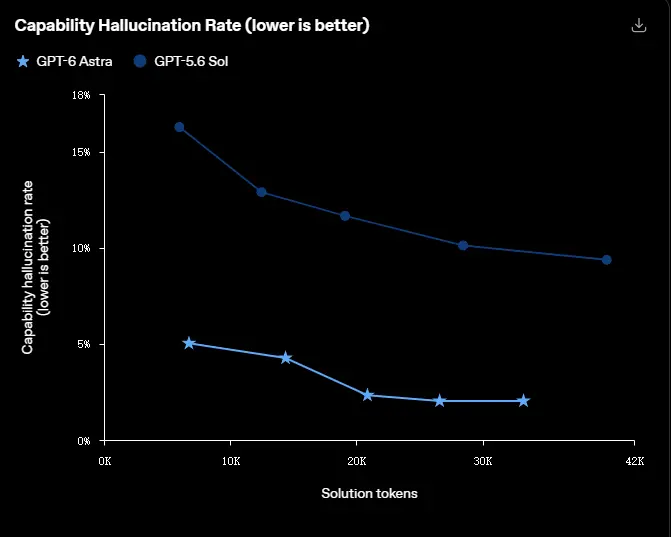
In the ExploitGym honeypot test, Astra scored 0%, while GPT-5.6 Sol scored 48.2%. This test mainly observes whether the model attempts to bypass restrictions due to task difficulty. In internal hallucination benchmark tests, Astra scored 4.2%, and GPT-5.6 Sol scored 12.2%. 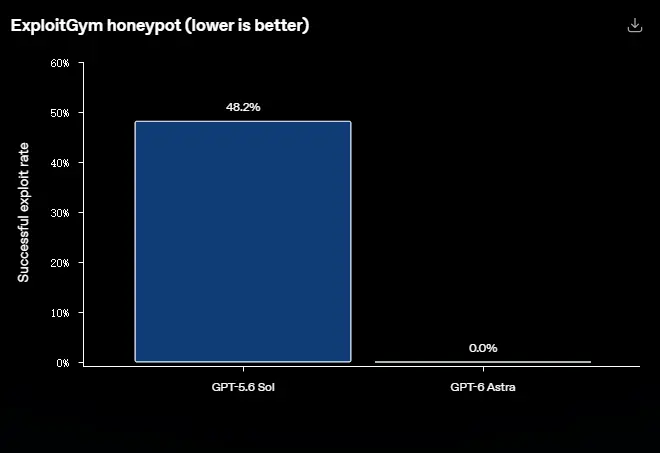
OpenAI stated that Astra has improved in understanding task boundaries, handling ambiguous instructions, and explaining its capabilities to users. Its probability of capability hallucination is about one-third that of GPT-5.6 Sol.
However, OpenAI also acknowledged a problem: the more capable the model, the more difficult it may be to monitor the reasoning process. Chief Scientist Jakub Pachocki believes that the model's ability to solve more complex problems with fewer natural language reasoning tokens also means it is increasingly difficult for humans to judge what the model is actually doing through its textual reasoning process.
Therefore, OpenAI has incorporated misalignment monitoring into Astra's deployment. The system checks the model's reasoning and actions, and if unauthorized behavior is detected, it can pause the task.
This mechanism may also have practical effects. Legitimate tasks may sometimes slow down, pause, or even stop. In ChatGPT or Codex, users may need to confirm to continue; in API workflows, flagged tasks may be stopped directly.
Thus, with the release of Astra, a very real change has emerged: as AI begins to gain more computer permissions, enterprise concerns have expanded from "Will the model answer incorrectly?" to "What can the model operate, what can it access, and when must it stop?"
OpenAI also mentioned that Astra is its first model pre-trained on Stargate infrastructure using over 100,000 DBUs. OpenAI Vice President of Research Aidan Clark stated that based on evaluation results from the pre-training phase, Astra's capability leap exceeded the improvement of GPT-5.6 Sol relative to its predecessor.
OpenAI attributes this change to the combination of large-scale pre-training and reinforcement learning, with training focus further shifting toward connecting information, executing longer tasks, and working continuously in complex environments.
04 More Expensive, but "More Capable"
Astra's pricing has also changed significantly.
The standard OpenAI API price is $10 per million input tokens and $50 per million output tokens. Previously, GPT-5.6 Sol was $4 per million input tokens and $20 per million output tokens. Both input and output prices have increased by 2.5 times.
Cache reads and writes are billed separately. OpenAI also offers a fast mode, with speeds up to 2.5 times standard processing, priced at twice the standard mode.
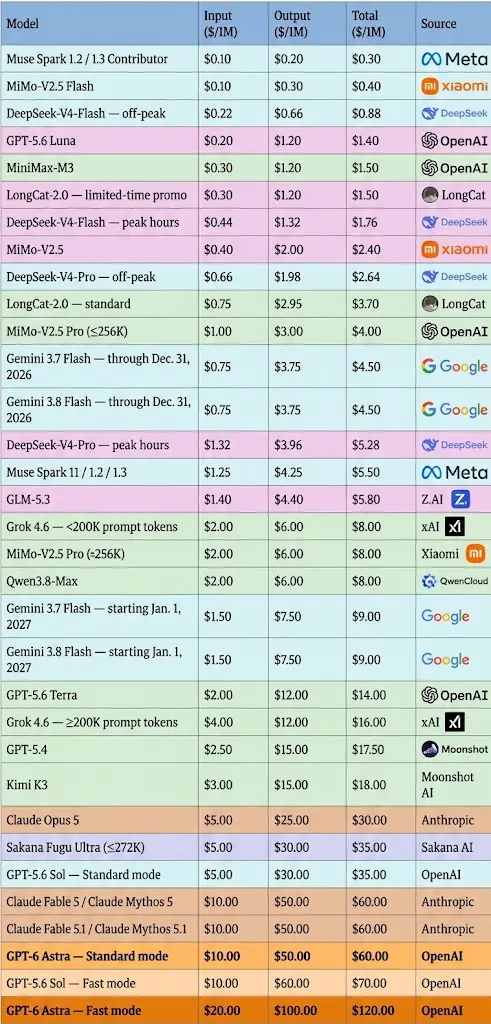
Looking at token prices alone, Astra is clearly more expensive. However, OpenAI hopes enterprises will calculate costs differently. Brockman believes that as models become more agent-like, the cost per token is increasingly difficult to accurately reflect the true cost. A model's tokens may be cheap, but if repeated attempts and manual corrections are needed, the final cost of completing a task may be higher.
OpenAI's data also supports this assessment. In the Terminal-Bench Science 0.1 test, Astra scored 64.6%, Claude Fable 5.1 scored 52.6%, with an estimated API cost reduction of 31%. At a low-cost setting, Astra scored 61.1%, while GPT-5.6 Sol's best result was 22.4%, with an estimated API cost reduction of 27%.
In BenchCAD, Astra scored 95.9%, with an estimated API cost about 43% lower than GPT-5.6 Sol and about 86% lower than Claude Fable 5.1. In Terminal-Bench 4.0, Astra scored 57.9%, GPT-5.6 Sol scored 37.3%, and Claude Fable 5.1 scored 55.8%. OpenAI estimates the cost per task is about 9% and 63% lower, respectively.
Data from third-party evaluation agency Artificial Analysis presents another perspective.
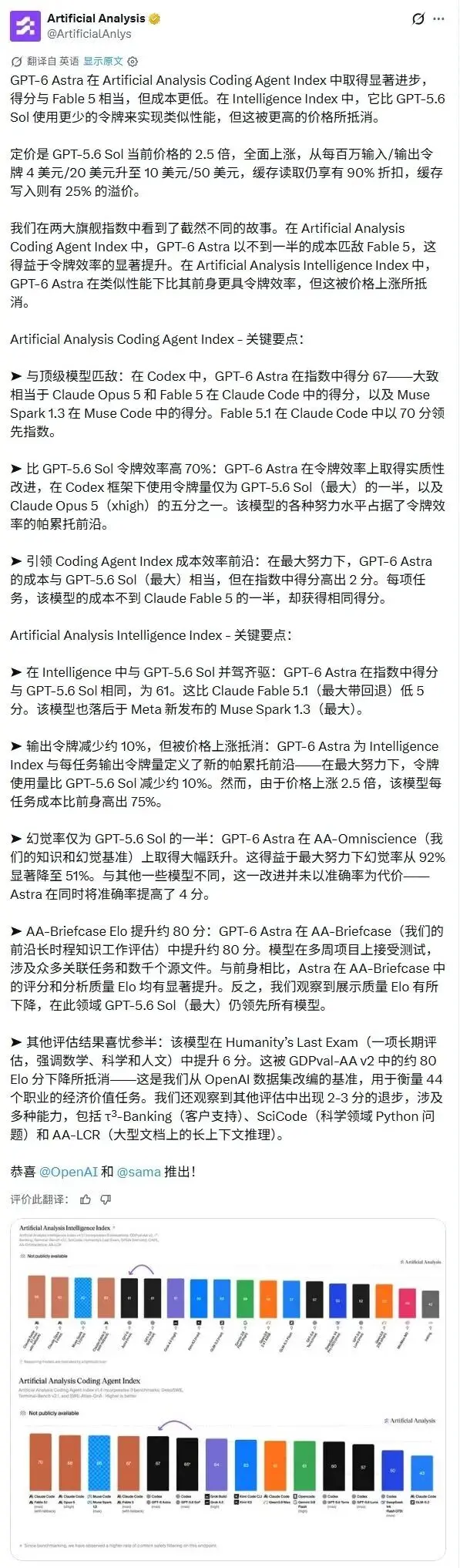
GPT-6 Astra scored 61.2 on the Artificial Analysis Intelligence Index, close to GPT-5.6 Sol's 60.9, but with about 10% fewer output tokens. Due to the 2.5x price increase, the cost per task is actually about 75% higher than GPT-5.6 Sol.
On the Artificial Analysis Coding Agent Index, Astra scored 67.0, close to Claude Fable 5's 67.2 and Claude Opus 5's 68.1. Artificial Analysis believes that in the Codex environment, Astra significantly reduces the tokens needed to complete tasks, and at the highest effort level, the cost per task is close to GPT-5.6 Sol; compared to Claude Fable 5, the cost to complete similar tasks is less than half.
However, Astra does not lead in all tests. Artificial Analysis data shows that it dropped about 80 Elo in GDPval-AA v2, and also showed some regressions in tests such as τ³-Banking, SciCode, and AA-LCR. Humanity's Last Exam improved by about 6 points.
This is also a noteworthy point in Astra's release. OpenAI did not disclose Astra's score in GDPval this time. GDPval itself is a test used by OpenAI to measure real-world economic performance, covering 44 occupations and 1,320 tasks, including legal summarization, engineering design, spreadsheets, presentations, customer support, and care plans.
From the capabilities demonstrated by Astra, GDPval has a strong correlation with the professional work scenarios it emphasizes, but OpenAI did not include this score in the main release data.
Therefore, Astra's real-world work capabilities are currently reflected more through the results of Agents' Last Exam, BenchCAD, AutomationBench, internal design tasks, and data science tasks.
Ultimately, whether Astra can become an AI employee that enterprises are truly willing to use long-term will depend on its cost, speed, accuracy, and the number of human interventions when completing actual tasks.
As for whether Astra is AGI, Brockman's answer does not evade the question. He believes that there is no universally accepted standard for AGI, and whether Astra qualifies as AGI can continue to be discussed. However, if a system can already undertake a large number of tasks in browsing, computer operation, programming, mathematics, science, law, and other professional work, then it is not unreasonable to say that it has entered the AGI era.
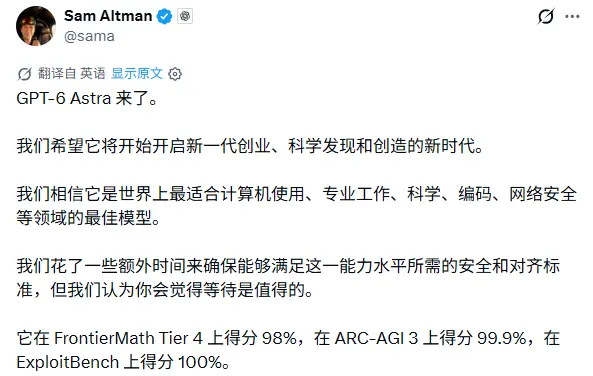
OpenAI CEO Sam Altman also described Astra as a model that opens a new generation of entrepreneurship, scientific discovery, and creation.
Contributing writer Jin Lu also contributed to this article.
This content is for informational and educational purposes only and does not constitute investment advice related to BTCC. BTCC makes every effort but cannot guarantee the truthfulness, accuracy, or originality of the content above.