How to Invest in Gold in Australia: A Complete Guide

Gold has long been regarded as a store of value, as well as a hedge against inflation, currency volatility and economic uncertainty. In Australia, interest in investing in gold remains strong, given the country’s status as one of the world’s leading gold producers and exporters.
If you are looking to diversify your portfolio or preserve your wealth in the long term, it is essential to understand how to invest in gold in Australia. This guide explores why Australians invest in gold, the different investment methods available, the factors that influence gold prices, and how to trade gold efficiently.

Table of Contents
\Unlock Up To 30,000 USDT In Welcome Rewards!/
Why Invest in Gold in Australia?
According to the World Gold Council, Australia is a major global gold producer, ranking among the top gold-mining nations worldwide. The country’s stable regulatory framework and well-developed financial markets make investing in gold relatively accessible and transparent.
Key reasons Australians invest in gold include the following:
- Inflation Hedge: Gold often retains value when fiat currencies weaken.
- Portfolio Diversification: Gold tends to have a low or negative correlation with equities during market stress.
- Safe-Haven Asset: Investors frequently move capital into gold during geopolitical or economic uncertainty.
- Currency Protection: As gold is priced globally in US dollars, it offers protection when the Australian dollar fluctuates.
Different Ways to Invest in Gold in Australia
Australian investors have several different ways to gain exposure to gold. Each method has its own advantages, risks and logistical considerations.
1. Physical Gold: Bars, Coins and Bullion
The traditional approach of buying physical gold in the form of bars or coins remains popular. Reputable dealers, such as the Perth Mint, offer investment-grade bullion that is backed by government guarantees. However, the high costs associated with safekeeping and insurance often deter more active investors from purchasing the metal outright.
If you decide to invest in physical gold, there are a few things you should bear in mind: secure storage (such as a home safe or safety deposit box), insurance, and premiums over the spot price. It is also important to consider authenticity and dealer reputation when buying physical gold.
2. Gold Stocks
Investing in or trading stocks can be a great way to gain indirect exposure to gold. This allows you to gain exposure to every aspect of the gold industry, including mining, production, funding and sales.
However, it’s important to note that gold stocks don’t always move in the same way as bullion, as share prices are influenced by many other factors. For instance, the performance of shares in gold-related companies is influenced by more than just gold prices; operational factors, management efficiency, and geopolitical risks also play a part.
If you choose this option, you should be aware of the risks involved in buying stock, as it is notoriously volatile. While this investment method can leverage gold prices, it involves higher volatility and company-specific risks than owning bullion directly.
3. Gold ETFs
Another option is to invest in a gold-backed exchange traded fund (ETF). These ETFs track the movement of a portfolio of shares in publicly traded gold mining, refining and production companies. Investing in an ETF provides much wider exposure than a single position would, making them a popular way to diversify a portfolio.
With an ETF, you own shares in the fund, which owns the physical gold. This gives you exposure to gold without having to worry about storage or buying and selling it yourself. You benefit from the price of gold without owning the asset itself. Like shares, ETFs are traded on stock exchanges, making them easier to buy and sell as required.
4. Gold Futures
Investors willing to take on more risk may be attracted to futures and options. With gold futures, you agree to buy or sell gold at a specified price on a specified future date. With a gold options contract, you enter into an agreement that gives you the option to buy or sell gold if its price reaches a certain level by a predetermined date.
Futures contracts allow you to exchange gold at a fixed price on a specified future date. You are obliged to fulfil your part of the trade, whether through physical delivery or cash settlement. The quantity and quality of futures contracts are standardized, but their price is driven by market forces.
Successfully trading in gold futures or options requires a brokerage account and an in-depth knowledge of the industry. You will need to closely monitor your account and the price of gold to ensure that you do not miss the opportunity to exercise your options. However, you may also amplify any losses incurred, as futures and options generally involve leverage, or the use of borrowed money to purchase securities.
Notably, BTCC, one of the world’s longest-running cryptocurrency exchanges, supports tokenized gold futures trading with leverage of up to 500x. Users interested in gold trading can currently use USDT to trade gold commodities on BTCC without having to open an account with other traditional exchanges.
Trade Gold on BTCC ⇓
[TRADE_PLUGIN]GOLDUSDT,GOLDUSDT[/TRADE_PLUGIN]
What Factors Affect Gold Prices?
The price of gold is influenced by multiple macroeconomic and market dynamics.
- 1. Supply and Demand Dynamics: As with any produced commodity, the price of gold is fundamentally driven by the law of supply and demand. However, gold is unique in that new supply each year is small compared with the total existing stock, meaning prices are particularly sensitive to fluctuations in demand or sentiment rather than production levels.
- 2. Central Banks & Interest Rates: Monetary policy, particularly the decisions of central banks such as the US Federal Reserve, exerts a significant influence on gold prices.
- 3. Inflation & Currency Strength: Gold is often seen as a hedge against inflation. While this is true, the relationship can be complex. When investors believe that inflation is rising faster than interest rates can keep up with it, gold becomes a more attractive store of value. Additionally, gold is priced in US dollars globally. A strong dollar makes gold more expensive for non-dollar buyers, which often lowers demand and prices. Conversely, a weaker dollar makes gold more affordable internationally, supporting higher prices.
- 4. Geopolitical Events & Market Uncertainty: For instance, political elections can cause uncertainty, which can lead to an increase in the price of gold as more people seek out this safe haven asset.
Is Gold a Safe Investment in Australia?
Like any investment, gold carries a high level of risk. You could lose money. As with other investments, a loss can materialise in different ways. The first step to managing your risk when investing in gold is to understand the potential outcomes.
- Price risk: Investors who buy gold when the metal is nearing record-high prices face this risk. Despite the high prices, positive dynamics are at play: gold is recovering from decades of low prices and is becoming an increasingly popular asset for diversifying portfolios, both for central banks and individual investors.
- Speculation risk: Despite its strong performance in 2026, gold remains an unpredictable asset. Bearing this in mind when making trading decisions could protect you from overexposure and unrealistic expectations.
- Opportunity cost risk: “Opportunity cost” refers to the potential returns from another investment type during the period in which you were invested in gold. Since gold has historically been used for diversification rather than growth, the opportunity cost can be high.
All investments carry risks and involve trade-offs. While gold provides diversification benefits and inflation hedging, the precious metal’s unpredictability creates speculation and opportunity cost risks. Buying near all-time highs also adds price risk. Furthermore, financial scams are prevalent in the gold industry, so it is important to choose providers carefully.
[TRADE_PLUGIN]GOLDUSDT,GOLDUSDT[/TRADE_PLUGIN]
Where & How to Invest in Gold in Australia?
When it comes to investing in gold in Australia, as well as the above-mentioned ways, you can also invest via the BTCC platform. BTCC, one of the world’s longest-running cryptocurrency exchanges, supports tokenized gold futures trading with leverage of up to 500x. Users interested in gold trading can currently use USDT to trade gold commodities on BTCC without having to open an account with other traditional exchanges.
Note: You can deposit and receive up to 30,000 USDT now when you sign up and verify your account on BTCC. Every new user gets a 10 USDT coupon after completing their registration. You will also get an additional 10 USDT coupon on completing your KYC verification.
The following sets forth the detail guidance on how to trade tokenized gold futures on BTCC.
Step 1: Create a BTCC account
Step 2: Complete BTCC’s identity verification
Step 3: Fund your BTCC account
On the BTCC official homepage, choose “Deposite”, and then fund your account with your preferred method

Step 4: Place your tokenized GOLDUSDT futures order
Go back to the BTCC official homepage, choose “Futures” -“USDT-M Perpetual Futures Contract”-“Tokenized Stocks & Commodities”-“GOLDUSDT”.

You can also directly click the button below to enter the gold order page.
[TRADE_PLUGIN]GOLDUSDT,GOLDUSDT[/TRADE_PLUGIN]
Then, choose the contract trading order type. Futures contract orders on BTCC platform include market orders, limit orders and SL/TP orders.

- Market Order: users place orders at the best price in the current market to achieve fast trading.
- Limit Order: Limit orders are a type of order to buy or sell futures at a price more favourable than the market price. When you buy at a price lower than the market price or sell at a price higher than the market price, the order will be in the form of a limit order.
- SL/TP Order: SL/TP orders are a type of order to buy or sell futures at a price less favourable than the market price. When you buy at a price higher than the market price or sell at a price lower than the market price, the order will be in the form of a SL/TP order.
Step Five: adjust the leverage multiple.
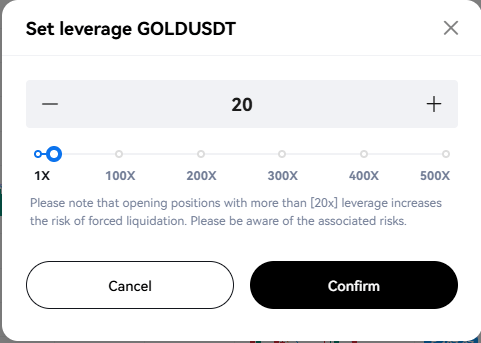
Please keep in mind that operating leverage carries the risk of liquidation. Leverage should be adjusted based on your financial status and risk tolerance.
Step Six: choose the lot size and set the SL/TP price .
Step Seven: after setting the basic data information, users can choose to buy (open long) or sell (open short) after entering their ideal price. Traders should remind that the price cannot be higher or lower than the highest buying price or lowest selling price of the platform.
Step Eight: click the buy or sell button, and the tokenized gold futures contract order is completed.
Conclusion
There are multiple ways to invest in gold in Australia, ranging from physical bullion and ETFs to mining stocks and futures. As a globally recognised store of value, gold can strengthen a portfolio’s resilience during periods of economic volatility. However, investors should consider their financial objectives, risk tolerance and time horizon before allocating capital.
For most Australians, a balanced approach combining gold exposure with other asset classes provides a prudent way to benefit from gold’s defensive characteristics while maintaining long-term growth potential.
\Unlock Up To 30,000 USDT In Welcome Rewards!/
Crypto Investing Guide:
How to Invest in Silver in Australia: A Complete Guide
Best Sign-Up Bonus Instant Withdraw No Deposit Crypto Apps 2026
Best Crypto Exchanges Offering Free Sign-Up Bonus 2026: No Deposit Required!
How To Invest In Gold in Canada: A Complete Guide For All Traders
Best Non KYC Crypto Exchanges In 2026
Best Crypto Exchanges With Lowest Fee In Australia 2026
Top Free Bitcoin Mining Apps & Cloud Mining Platforms For Effortless BTC Earnings In 2026
Crypto Regulation Australia (Updated 2026): Everything You Need To Know
How To Legally Avoid Tax on Crypto In Australia: An Ultimate Guide
Please be aware that all investments involve risk, including the potential loss of part or all of your invested capital. Past performance is not indicative of future results. You should ensure that you fully understand the risks involved and consider seeking independent professional advice suited to your individual circumstances before making any decision.
For any inquiries or feedback regarding this article, please contact us at: [email protected]
